Clarkson's Farm Season 5 Episode 3 Review: Robots, Potatoes and a Floating Dairy
What happens — the short version (spoilers)
- LAMMA turns farm machinery into theatre
- Robots sell Jeremy a new version of competence
- Onions and beetroot arrive through the side door
- Kaleb goes abroad one question at a time
- Jacob's potato farm makes precision feel expensive
- Rotterdam's floating dairy turns waste into inputs
Clarkson's Farm season 5 episode 3 sends Jeremy and Kaleb from the LAMMA machinery show to a Dutch precision potato farm and a floating dairy in Rotterdam, with the future of Diddly Squat reduced to the usual questions: what works, what costs money, and whether Kaleb can be replaced by something with GPS.
LAMMA turns farm machinery into theatre
The episode opens with Kaleb in the mood of a child on Christmas morning, except the presents are combines, straw blowers, tedders and pieces of kit Jeremy cannot identify without help. He has even had his hair cut before going to the machinery show, which is exactly the kind of detail that makes this series work. Nobody is being asked to laugh at farming. The joke is that, for Kaleb, LAMMA is a proper occasion.
Jeremy, who has spent a lifetime around motor shows, finds himself on the wrong side of the expertise gap. He can name cities where cars were displayed, but he cannot reliably tell a mower from a mulcher. Kaleb is stopped by farmers who know him, then disappears into a talk where he introduces his books, theatre tour and social media work with a confidence Jeremy labels as humble only in the technical sense.
That leaves Jeremy wandering the halls like a man who has lost both his interpreter and his dignity. The show is funny because it lets the machinery remain genuinely specific. A tedder is not just a prop with spikes on it. A straw blower is not a muck spreader. The farming world has its own language, and Jeremy, for once, is the tourist with a bad phrasebook.
Robots sell Jeremy a new version of competence
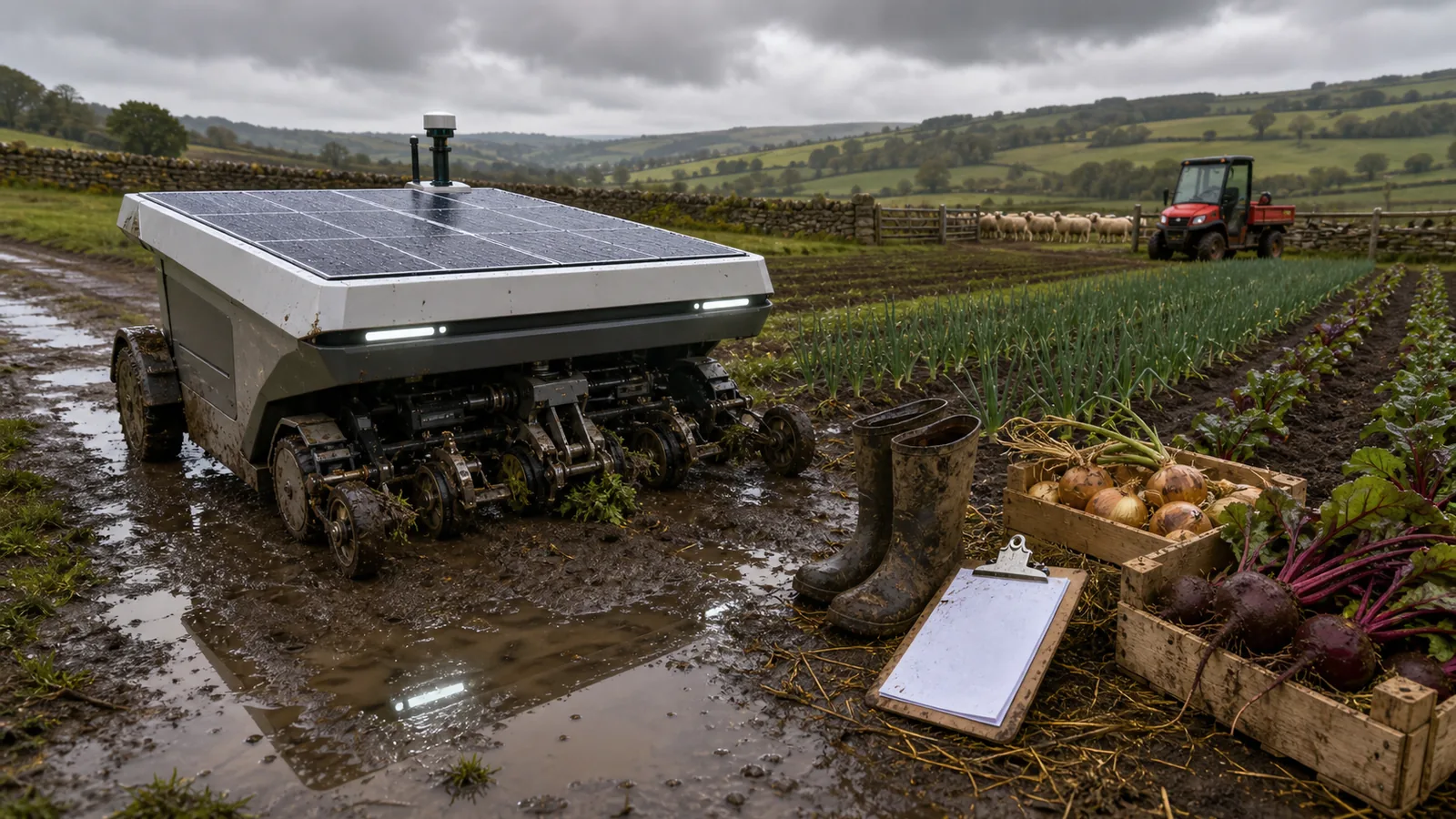
The episode shifts when Jeremy reaches the high-tech section. A solar-powered seeding and weeding machine catches his attention because it does something farmers actually need: it plants, weeds, runs on GPS, works to an accuracy of 8 to 10 millimetres, stops if rain risks damaging the crop, and sends messages when it needs attention. The salesman recommends high-value crops such as onions or beetroot, and Jeremy immediately starts thinking less like a sceptic and more like someone who has found a way round his own limitations.
The driverless tractor lands even harder. It can run night and day unattended, use existing implements, cultivate, drill and travel at normal working speed. Jeremy’s conclusion is not subtle: normal farming, without Kaleb. It is half joke, half business case. He has spent enough years proving he cannot plough, cultivate, drill or attach equipment gracefully. A tractor that does not require him to be good at tractor driving has obvious appeal.
Charlie receives the pitch with the correct amount of caution. Jeremy talks about climate, government and the need to stop doing the same thing every year while expecting a better result. Charlie asks practical questions: obstacles, lifting ability, actual use. Jeremy admits he did not ask about the lifting capability because the machine looked cool. That is the whole tension of the episode in one exchange. Jeremy sees modernisation. Charlie sees a purchase order with missing columns.
Onions and beetroot arrive through the side door
The best Charlie moment comes when Jeremy unveils the seeding and weeding robot. It is not being bought because Diddly Squat grows onions and beetroot. Diddly Squat is apparently going to grow onions and beetroot because that is what the robot can do. This is farming strategy by equipment brochure, and Charlie’s face has to carry the weight of every spreadsheet not yet opened.
Still, Jeremy is not wrong to look for a way out of the farm’s current pattern. The episode makes that case by letting Kaleb list the existing inefficiencies on the road later: pigs placed far from the farm, goats needing movable fencing and shelters, chickens split into small pens, and every new idea creating more daily work. Jeremy accepts most of it because the evidence is hard to dodge. Diddly Squat is busy, but not always efficiently busy.
That is why the robot thread matters in a practical way. It is not science fiction placed on top of a rural show. It is the answer Jeremy wants to the problem the series keeps showing: labour, weather windows, poor timing, and too many projects scattered across too much ground. Whether the answer is affordable, suitable or sensible remains open. But the reason he wants one is not random. It is written all over the farm’s work list.
Kaleb goes abroad one question at a time
Before the Dutch farms can teach Diddly Squat anything, Kaleb has to leave England. The road trip is the episode’s broadest comedy, but it stays useful because it turns the research mission into a clash of scales. Jeremy is thinking about the failure of old businesses that did not modernise. Kaleb is thinking about whether the air is different in France, whether a one-hour time difference causes jet lag, and how oxygen works in the Channel Tunnel.
The passport scene gives the episode its neatest small reveal: Kaleb’s middle name is Wayne. Jeremy uses it at once, because of course he does. The train questions pile up in the same rhythm as farm questions do at home. How deep is the tunnel? How many trains are down there? How many carriages? How many cars? The fact Jeremy cannot answer most of it is part of the pleasure. He has become the exasperated guide to a system he only partly understands.
Bruges softens the joke. Kaleb actually likes it. He looks at the lit canals, asks about the blood of Jesus, wonders what it would be worth, and asks whether there are crocodiles. The show could have made him a simple yokel abroad, but it does not quite do that. He is nervous, curious, blunt and frequently ridiculous, which is also how he approaches new machinery. By the time he is eating chips and meatballs at a Belgian petrol station, the trip has become less a jolly and more a working education with mayonnaise.
Jacob’s potato farm makes precision feel expensive
The first proper lesson comes from Jacob van den Borne, whose potato farm straddles the Belgian and Dutch border. Jeremy notes that it is about the same size as Diddly Squat, which makes the comparison hurt. Jacob’s sheds are filled with Fendts, sprayers, trailers and an amount of equipment that makes Kaleb visibly giddy. When the conversation turns to value, the shed is casually placed in the tens of millions of euros.
The scale is impressive, but the important bit is the method. Jacob explains that when he took over from his father in 2006, one part of a field produced 30 tonnes of potatoes while another part of the same field, with the same seed, produced 90. In 2009 he started precision farming. His equipment scans the soil, maps conducting material such as organic matter, water and nutrients, and turns those differences into decisions.
That is where the episode becomes more than a gadget tour. Jacob is not just buying smarter toys. He is asking the field to stop being treated as one uniform block. His tractors can seed and fertilise at variable rates, changing what they do in different patches. His sprayers can target weeds instead of covering everything. Jeremy calculates a possible saving on herbicide bills, but the bigger point is waste. Not a square metre is supposed to be treated without a reason.
Then comes the drone. Jacob has made his farm an airport because European rules would otherwise stop him flying drones by computer or letting them work together. It is a very Clarkson’s Farm solution in reverse: instead of grumbling at regulation from outside the gate, he changes the category of the gate. The drone carries 50 litres, can cover a hectare in minutes, lands automatically, and leaves Jeremy embarrassed by his own drone. Kaleb resists because he likes a cab, but even he admits Jacob is a serious farmer.
Rotterdam’s floating dairy turns waste into inputs
The second Dutch stop looks absurd before it looks practical: a dairy farm on water in the middle of Rotterdam. Peter van Wingerden and Minke’s floating farm has about 30 cows, covers less than an acre, and still contains feeding space, automated milking, pasteurising, butter making and an underwater cheesery. The cows choose when to be milked, and the system measures weather, temperature, humidity and what the cows are doing.
The cleverness is not only the automation. It is the loop between farm and city. Peter delivers dairy produce, then comes back with brewer’s grain from breweries and unsold bread from shops, none of which costs him money. Grass comes from a football stadium’s main pitch. The cows eat waste the city cannot use, and the farm turns it back into food.
The manure loop is even neater and more unsettling. A robot collects it. The farm uses cow dung to help desalinate sea water for the cows to drink, and Peter also shows Jeremy building material and insulation made from manure. This is where Kaleb’s head almost visibly overheats. Diddly Squat can sell compost and argue about fields. Rotterdam has cows floating above a cheesery while their waste helps make drinking water.
Peter’s larger point is local production and food loss. He says a huge share of food produced in the world is lost while many people still do not have food. The farm’s answer is to put production close to the waste stream and the customer. Jeremy cannot move Diddly Squat to the Thames, and the joke lands because it is true: his farm is in the countryside and not floating. For once, being surrounded by fields almost looks old-fashioned.
The future still has to pass the farm test
What makes the episode work is that it does not pretend the future is clean, easy or cheap. Jacob’s farm is dazzling, but it sits on heavy investment, serious knowledge and a shed full of kit. The floating dairy is ingenious, but it works because Rotterdam gives it waste bread, brewer’s grain, stadium grass, water, customers and a dense city around it. These are not plug-in fixes for a Cotswolds farm with goats in the wrong place.
Jeremy’s enthusiasm is still understandable. Diddly Squat has spent years learning that charm does not make weather kinder, paperwork shorter or machines easier to attach. A driverless tractor, a seeding robot, precision spraying or a tighter circular system all speak to a real weakness on the farm: too much effort leaking away before it becomes output.
Kaleb’s resistance is just as useful. He likes tractors, cabs and the physical job. He is not against competence, but he is suspicious of replacing the work he understands with screens, codes and automated flight paths. The episode does not resolve that argument. It puts both men in front of farmers who have already made their choice, then sends them home with their heads full and the farm still waiting.
Tiny details worth clocking
Jeremy stealing Lisa’s car before she wakes is a small domestic crime treated with exactly the right amount of cowardice.
Kaleb getting a haircut for LAMMA tells you more about the show’s farming culture than a paragraph of explanation would.
Charlie asking about obstacles and lifting capacity is the accountant’s revenge on every shiny sales pitch.
The Agbot leading directly to onions and beetroot is a lovely example of technology creating the farming plan instead of serving one.
Kaleb’s Channel Tunnel oxygen theory is daft, but it also fits the episode’s theme: every impressive system still needs somebody to explain how it actually works.
Jacob making his farm an airport is the sort of regulatory side-step Jeremy usually dreams of, only done by a farmer who appears to have read the manual.
The floating dairy’s football-stadium grass is the episode’s neatest circular detail: city maintenance becoming cow feed before anyone has time to call it waste.
Final verdict
Episode 3 is one of the season’s cleanest idea episodes. It starts with Kaleb worshipping farm machinery at LAMMA, then gradually turns that enthusiasm into a serious question for Diddly Squat: if the old routine is producing too much work for too little return, what exactly should change?
The answer is not a single machine. The Agbot looks tempting, but Charlie’s questions expose the missing homework. Jacob’s potato farm is thrilling, but it is built on data, capital and discipline, not just expensive tractors. The Rotterdam dairy is the most futuristic stop, yet its genius is almost old-fashioned: use what is nearby, waste less, and make every output feed another input.
The comedy keeps it from becoming a lecture. Kaleb abroad, Jeremy baffled at LAMMA, the tunnel questions, the chips, the manure insulation and the idea that Diddly Squat’s first mistake is being in the countryside all keep the episode light on its feet. But underneath the travel jokes is a blunt farm problem. Modernising is not a taste preference. It may be the difference between being busy and being viable.
Rating: 8.3/10 - A sharp, funny technology episode that makes the future of farming look impressive, costly and awkwardly necessary.
More episodes from Clarkson's Farm S5 — Farm chaos and village stakes, episode by episode. Jump to any episode in the season:
Where to go next
Reviewed by Mira Vance · QuizFandom Editor & Lead Reviewer. Every rating is an honest per-watch assessment from the desk that also writes the quizzes — not a press release rehash.