Clarkson's Farm Season 5 Episode 8 Review: Harvest, TB Rules and One Very Expensive Weather Bet
What happens — the short version (spoilers)
- The isolation barn starts the episode in a bad mood
- Kaleb's combine is enormous, cheap and immediately suspicious
- Rain arrives on the one day it can be most annoying
- The wheat and barley race gets squeezed by hospital time
- Lisa becomes the grain-carting professional
- The last field ends with labour, not leisure
Clarkson's Farm season 5 episode 8 turns harvest into a race against rain, machinery faults, TB restrictions and Jeremy's hospital date. Kaleb finally gets behind his own combine, Lisa becomes unexpectedly useful with a grain trailer, the birds deliver rare good news, and Charlie arrives with the sort of accounts sheet that makes precision farming look painfully small next to the weather.
The isolation barn starts the episode in a bad mood
Episode 8 opens where the previous hour left off: with the cow that failed to pass the TB test being moved into isolation. The barn that had been prepared for harvest is hurriedly turned into a TB unit, which is a very Diddly Squat sort of efficiency. One minute it is meant for grain. The next it is for a distressed cow, separated from her calf and pregnant with twins.
Kaleb explains the horrible practical catch. If the calf goes in with her, the calf may have to go as well. So one animal cries in one place and the other cries somewhere else. There is no neat welfare answer, just the least damaging version of a bad rulebook problem.
Endgame is then brought in as well, partly because of his value and partly because nobody wants to risk him. Even that job refuses to be clean, with the bull getting his head between the car and trailer before eventually going into his own solitary confinement. The episode finds a small amount of comedy in the loading, but the mood is not comic. Jeremy says he cannot bear the idea of putting Endgame on a lorry, and for once the farm’s big animal chaos has very little bounce in it.
The livestock trouble keeps spreading. The calf with pneumonia is worse the next day, so another pen has to be built for her and her mother. Kaleb says they need to keep feeding her while the antibiotics do their work. Jeremy, already sick of fencing panels and cattle pens, says he just wants to get the harvest in. It is a simple farmer’s wish and the episode spends the next hour making it as difficult as possible.
Kaleb’s combine is enormous, cheap and immediately suspicious
The good news is that harvest can begin before Jeremy goes to hospital, starting with the oats. It is also Kaleb’s first Diddly Squat harvest in the combine seat, and he has bought his own machine for the job. It is wider than Simon’s old combine by eight feet, with a 30-foot header rather than 22, and it cost £35,000 instead of the half-million-plus a new one might have required.
That bargain explains itself as soon as it starts making noises. The combine rattles, clanks and vibrates, then meets oats so short that Kaleb is not cutting them at first, just bending them over. Jeremy calls it like combining a lawn. To get any grain, Kaleb has to lower the header enough to risk taking stones in with the crop.
This is the practical comedy the show does best. The machine is huge, the field is difficult, the operator is delighted, and the crop is doing everything it can to stay below the blade. When a horrible noise appears, Jeremy finds the rubbing and reckons running so low has broken something. By midday they have half a trailer and a repair delay, which is not the tempo anyone wanted with hospital and weather closing in.
Rain arrives on the one day it can be most annoying
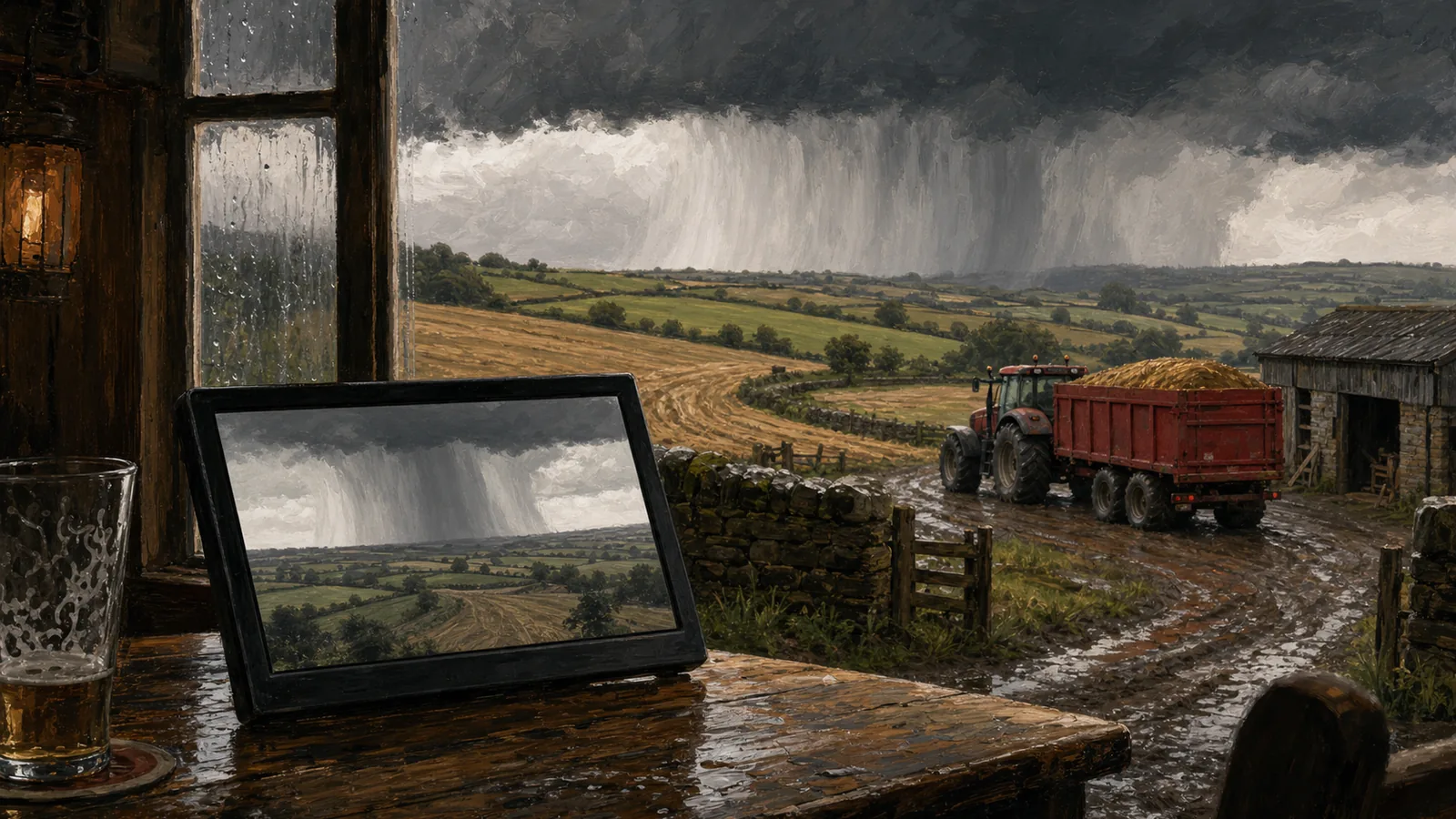
For months, the farm has needed rain. Naturally, the day they start harvesting is when it appears. Jeremy checks the pub CCTV nine miles away and sees the weather coming across. Suddenly the job is not just cutting oats but getting whatever they have into the dry before the downpour reaches them.
The sequence is funny because it is all panic over tiny margins. Jeremy struggles with the tractor, worries about the trailer, and tries to get the oats away while the valley disappears behind rain. Kaleb wants to avoid drying charges, which would be especially ridiculous in a year defined by drought. The crop has been starved of moisture for months, and now the farm is sprinting to keep harvest moisture out of the grain.
After the rain stops, three hours of warm sunshine gets the crop back to 13.6, and the mood changes completely. The combine starts working properly. Jeremy settles into grain carting. Kaleb gets to live the thing he has wanted since he was a boy: harvesting Diddly Squat in his own combine. It is one of the season’s kinder moments, made better because it is not tidy. There is spilt grain, deer in the way and more radio abuse, but the oats get finished.
Even then, the result is modest. Jeremy says the oats yield is visibly smaller than in previous years. The mustard is worse. From a five-acre field, only half is combined, and one side has simply failed. The biggest farm-shop seller has not behaved like a biggest farm-shop seller. Weather has turned a product line into a sad look inside a trailer.
The wheat and barley race gets squeezed by hospital time
The next morning, Jeremy is told his cancer operation will happen in six days. He wants the winter wheat and spring barley harvested before he leaves, but rain turns the next three days into a write-off. By Saturday, he has only a day and a half left, so Kaleb brings the combine back and Jeremy provides what he calls professional escort services through town.
For a while, the wheat goes well. Kaleb’s massive combine fills the trailer fast, forcing Jeremy to move quickly. That would be easier if the tractor did not knock its mirror back in and briefly trap him in his own cab. The whole thing is classic Diddly Squat: a high-pressure operation briefly stopped by a door mirror and a man asking the film crew to pull bits of Lamborghini back into shape.
By evening they are only two cartloads from finishing the wheat, and the barley looks possible the next morning. Then the tractor throws up a clutch pedal sensor fault and becomes paralysed. Ben, the local Lamborghini mechanic, cancels his evening and tries to rob parts from another tractor, then spends the night working through plugs, wires and control units. It is a useful reminder that modern farm machinery can be both heroic and faintly absurd: one sensor can hold up a harvest.
The rain then makes the mechanical question moot. Jeremy has to pack for London with the barley still standing. Kaleb tells him not to worry and jokes about putting him on FaceTime at the front of the tractor. The work still has to happen. Surgery does not stop barley ripening, and barley does not wait politely for surgery.
Lisa becomes the grain-carting professional
With Jeremy away, Lisa gets her training. Kaleb teaches her to reverse with the trailer, explaining that it has a mind of its own and jackknifes as soon as she gets it wrong. She does get it wrong. Then she gets it right, and the episode gives her the small practical victory the farm actually needs.
Her first moving offload from Kaleb’s combine is treated like a stunt, but it is just a real job done under pressure. She keeps the trailer under the spout, brings barley back to the barn and finishes the day proud enough to say an honest day’s work is done. The comedy is still there, including a breakdown in the Lamborghini and traffic hooting around her, but Lisa is no passenger in this episode. She is useful.
Kaleb admits the soppy bit without dressing it up. Lisa is doing well, but he misses Jeremy’s voice on the radio. Not the skill, he says, but the friend. That is about as sentimental as the episode needs to get. The fieldwork has become their thing, and Jeremy’s absence makes the machinery sound different.
When Jeremy returns, sore but standing, Lisa keeps showing up anyway. She has enjoyed grain carting enough to borrow one of Kaleb’s tractors, and Kaleb promptly prefers her to Jeremy for the offloading. Jeremy tries to force his way back into the job, but Lisa blocks him off and the radio channel politics do the rest. The farm has accidentally trained his replacement while he was in hospital.
The last field ends with labour, not leisure
The durum wheat harvest is grim. Kaleb’s combine reports 0.2 tonnes a hectare, while Jeremy says six or seven would be average. That is not a yield; it is a receipt for a dry year. The combine takes an age to fill, and when it does, Kaleb keeps choosing Lisa for the carting.
Gerald turns up while Jeremy is trying to farm through post-operation discomfort, and the two trade medical stories in the middle of harvest. The episode is careful not to make the health material solemn for too long. It is serious, obviously, but it is also discussed beside tractors, over radios and between jokes about catheters, injections and the exact kinds of chairs Jeremy can tolerate.
Then Taya rings Kaleb. She is in labour, with contractions every five minutes, and Kaleb decides he can finish the field quickly before leaving. Jeremy’s reaction is half congratulations and half disbelief. The line between livestock timing and family timing has become worryingly thin.
Just under 30 minutes later, the final strip is done. Harvest 2025 is complete, and Kaleb heads off for the birth. Jeremy hopes the episode can end on a happy note because there have not been many lately. It cannot quite manage that, but it does give the farm a clean finish to the harvesting itself, which in this year counts for more than usual.
The birds give Diddly Squat one clean win after harvest. Hannah returns with her bird survey. The presentation is jokey, and Jeremy complains that the setup is a bit American, but the findings are genuinely good. An average farm would have between 20 and 35 bird species. Diddly Squat has 45.
The corn bunting result is even better. Hannah explains that corn buntings have lost between 83% and 86% of their population and are extinct in Ireland. More than 10 on a farm would be trophy territory. Diddly Squat has 19.
It is the rare episode 8 scene where a project produces a clean, positive outcome. The bird work has not fixed the drought, the TB restrictions or the accounts, but it does show that the farm’s margins, hedges and awkward conservation decisions have not been for nothing. Hannah then matches the main people to birds: Charlie as a grey partridge, Kaleb as a yellowhammer, Lisa as a kestrel and Jeremy as a skylark, with the gobshite part doing a lot of work.
Jeremy says the news has made his heart sing. In a different episode, that might feel too neat. Here, the line can stand; plenty is still waiting to stamp on it.
The accounts and the TB letter refuse a happy ending
The second TB test is the hard turn. Sam measures the cow again and says she is inconclusive for a second time, which means she is treated as a reactor and has to be slaughtered. Jeremy argues that the system feels like a hung jury being treated as a conviction. Lisa asks whether the cow can stay until she has her calves, but because she is only five months pregnant, that is not an option.
The farm then gets its harvest numbers. Charlie had forecast a £37,800 farming profit. Instead, the cost of farming that year is £5,152, which Jeremy translates correctly as a loss. Wheat is 30% below expectation, barley nearly 40% down, and durum 45% down. The galling part is that the farm has not been casual. It has used precision drilling, precision muck spreading, soil mapping, nutrition planning, the AgBot and the RoboDroid. The crops went in well. Then it did not rain for 15 weeks.
So the next year’s seed and fertiliser becomes another weather bet, this time with Jeremy putting in £70,000 of his own money, then correcting the logic to £75,000 because the farm has just lost five. It is a bleak accounting scene because it has no villain handy. The technology worked. The plan worked. The sky did not.
The cattle side gets worse. The pregnant cow turns out to be Poppy, Diddly Squat’s first ever calf, and she is taken away. Then the sick calf with pneumonia cannot recover. Charlotte explains that she likely missed the colostrum she needed at the start, leaving her unable to fight infection properly despite antibiotics and painkillers. The decision is to euthanise her. It is quiet, factual and horrible.
Even the postscript refuses closure. Charlie later receives the post-mortem letter on Poppy: non-visible lesions, with no conclusive sign she had TB. Jeremy is furious that the cow has been killed and the farm is still locked into the procedure, with another test due within 60 days. The season then ends with him back in hospital after treatment has gone awry, saying he will see everyone for season 6 if it is successful.
Tiny details worth clocking
Kaleb buying a combine wider than Simon’s after years of mocking Jeremy’s large tractor is a neat bit of farm karma.
The pub CCTV becoming a weather radar is very on-brand for a farm where the business empire now helps warn the crops.
Lisa saying she has barley in the barn lands because it is not decorative enthusiasm. She has actually done the job.
Charlie comparing seed competition to puppies is the sort of explanation that works until Jeremy notices they are talking about puppies.
Gerald’s phone refusing to go silent during the end-of-year picnic is exactly the technological finish that gathering deserved.
Final verdict
Episode 8 is a strong, grimly funny finale because it keeps every emotional beat attached to a practical consequence. Jeremy’s hospital date matters because the barley is still standing. The rain matters because drying charges would be absurd after a drought. Lisa’s grain-carting matters because somebody has to get the crop in. The TB result matters because it controls movement, breeding plans, slaughter decisions and the farm’s future tests.
The season closes on a blunt farm result. Diddly Squat did much of the work properly, using better mapping, better drilling and better information. It still lost money when the weather did not cooperate. The episode earns that result by showing the machinery, the waiting, the breakdowns, the numbers and the animals rather than just announcing that farming is hard.
Rating: 9.0/10 - A tough, funny and properly grounded finale that turns harvest pressure, TB bureaucracy, animal care and farm accounts into one long argument with the weather.
More episodes from Clarkson's Farm S5 — Farm chaos and village stakes, episode by episode. Jump to any episode in the season:
Where to go next
Reviewed by Mira Vance · QuizFandom Editor & Lead Reviewer. Every rating is an honest per-watch assessment from the desk that also writes the quizzes — not a press release rehash.