Clarkson's Farm Season 5 Episode 5 Review: Robots, Calves and the Last Guinea Fowl
What happens — the short version (spoilers)
- Mission Control puts every mistake on screen
- Storm damage gives the old kit a last laugh
- The guinea fowl story gets brutally short
- Goats move out so the cows can move in
- AgBot and FarmDroid put the crop plan on rails
- Snails bring eggs, slime and another pub calculation
Clarkson's Farm season 5 episode 5 finds Diddly Squat briefly behaving like a farm from the future, with drone maps, AgBot dashboards and a solar onion planter, only for foxes, fallen trees, goats, calving ropes and one badly timed calf to drag everyone back into the muck.
Mission Control puts every mistake on screen
Episode 5 opens with spring properly arriving, which at Diddly Squat means birth, noise and machinery all happening at once. The cows and EasyCare sheep are close to giving birth, the guinea fowl are already doing their work as aggressive alarm clocks, and the AgBot is cultivating while Kaleb is still in bed. That last fact pleases Jeremy so much that he decides the farm now needs an office with the proper air of technical command.
Mission Control is an old barn cleared of Lisa’s shop storage and filled with the sort of objects that make sense only on this farm: a cheap three-piece suite, filing cabinets, the Pig Award and a pair of crows that Kaleb does not entirely trust. The joke is visual, but the usefulness is real. A drone map built from 6,000 images shows the farm in enough detail for Kaleb to spot a patch Jeremy missed while drilling. The technology does not flatter him. It simply enlarges the mistake.
The AgBot dashboard gives Jeremy the thing he loves most, which is farming that looks like a control room. Engine speed, load, AdBlue level, oil level and live front-camera footage all sit on the screen while the machine works elsewhere. Each pixel represents two centimetres, which is impressive until the same system reveals a fly-tipped white good in a hedge. The future of farming, it turns out, includes being able to see exactly where some idiot has dumped a fridge-shaped problem.
Storm damage gives the old kit a last laugh
The AgBot’s selling point is not just precision. It is time. If it can cultivate by itself, Jeremy can go and deal with the annoying jobs that do not put themselves on a spreadsheet but still cost effort and money. First there is the fly-tipping cleanup, a small job with a large emotional charge because somebody else’s cheap disposal becomes the farmer’s wasted morning.
Then the episode moves into the woods, where Storm Darragh has left a mess of fallen trees. The green Lamborghini is unavailable with another technical fault, so Jeremy is back on the older machine he calls the GOAT, complete with jerky gear changes and brakes that do not inspire deep confidence. From one spot, he counts ten fallen trees. This is not romantic woodland management. It is storm aftermath with a winch.
The winch sequence is a tidy example of the show’s best mechanical comedy. Jeremy and Kaleb start by working well together, then reach a tree caught between others and immediately split into rival engineering departments. Kaleb wants a simpler approach. Charlie arrives and asks why they do not just cut it. Jeremy announces that chainsaws are for the weak, which is a brave position for a man standing next to a tree that has already beaten gravity once.
The ground anchor misbehaves, Kaleb has to lower it manually, and then Jeremy’s plan actually works. The tree pivots the way he said it would. The satisfaction is almost industrial. Kaleb does not want to give him the moment, Jeremy knows he has earned it, and Charlie is left watching two men turn storm clearance into a matter of national pride.
The guinea fowl story gets brutally short
The episode’s darkest farm joke is also its shortest. After the woodland victory, Lisa calls Jeremy back because the farmyard is too quiet. Last episode’s guinea fowl were introduced as noise with legs, so silence is not a good sign.
The evidence is feathers. A fox has got into them, killing almost all of the birds. Jeremy tries to process this through the practical language of livestock loss and the comic language of explaining the disaster to a granddaughter who might want to see them at the weekend. The line he draws between London fox sentiment and actual farm fox damage is blunt, but the point is not decorative. On a farm, a fox is not an urban mascot. It is a predator with access.
There is a brief reprieve when Lisa spots one surviving bird up a tree. It is a small, ridiculous relief: one guinea fowl safe above the crime scene. By the following morning, even that is gone. Jeremy finds the last bird dead, its head bitten off and left. The sequence is grim without being milked. The birds were funny, loud and inconvenient, then they were farm reality.
Goats move out so the cows can move in
With cows close to calving, the barn needs to become a maternity ward. That means the goats have to move out to a field called Hollowback. A trailer would be sensible, but it is a lovely spring afternoon, so Jeremy decides they can walk there. Lizzie, introduced as the goat farmer, reacts with exactly the right amount of doubt.
For a while, the goats treat the route as a buffet. Jeremy offers verbal leadership, Kaleb pushes, Lisa watches the sheep get involved, and Lizzie supplies the only hint that somebody has done this sort of job before. The comedy is not that goats are chaotic in the abstract. It is that every animal decision has a knock-on effect. To prepare for calving, a barn has to be cleared. To clear the barn, goats must go somewhere else. To move goats, several adults must chase animals that are more interested in eating than cooperating.
When the move finally settles, the episode lets itself enjoy the sight. Goats, sheep, spring light and a farmer who has spent the day worshipping robots now doing the oldest possible version of livestock movement. Kaleb, always closer to the ledger than the sunset, points out that the farm was meant to be cutting down on animals. Jeremy’s answer is that the pigs are going, the sheep will go eventually, but the goats are staying. The film crew vote helps. The goats, apparently, have staff support.
AgBot and FarmDroid put the crop plan on rails
The crop work is where the episode’s machine argument is strongest. The AgBot has finished cultivating and is now drilling the lager crop into prepared, fertilised fields on time. Kaleb immediately spots sections where the drill has not started, and Jeremy insists the machine knows what it is doing. It is the recurring Diddly Squat technology problem: the system may be clever, but the man watching the soil wants seed in the ground now, not after a confidence-building software pause.
The road issue is more awkward. The AgBot is not allowed on the public highway, so moving it to another field should mean detaching the drill, using the Lambo, loading and unloading the robot, and then reattaching everything. Kaleb says he could have drilled the whole farm, plus plenty more, in the time Jeremy’s legal method would take. Jeremy’s black-cloth solution is staged as a joke, but it makes the real point neatly. A machine can be revolutionary in a field and still become a faff the second a road is involved.
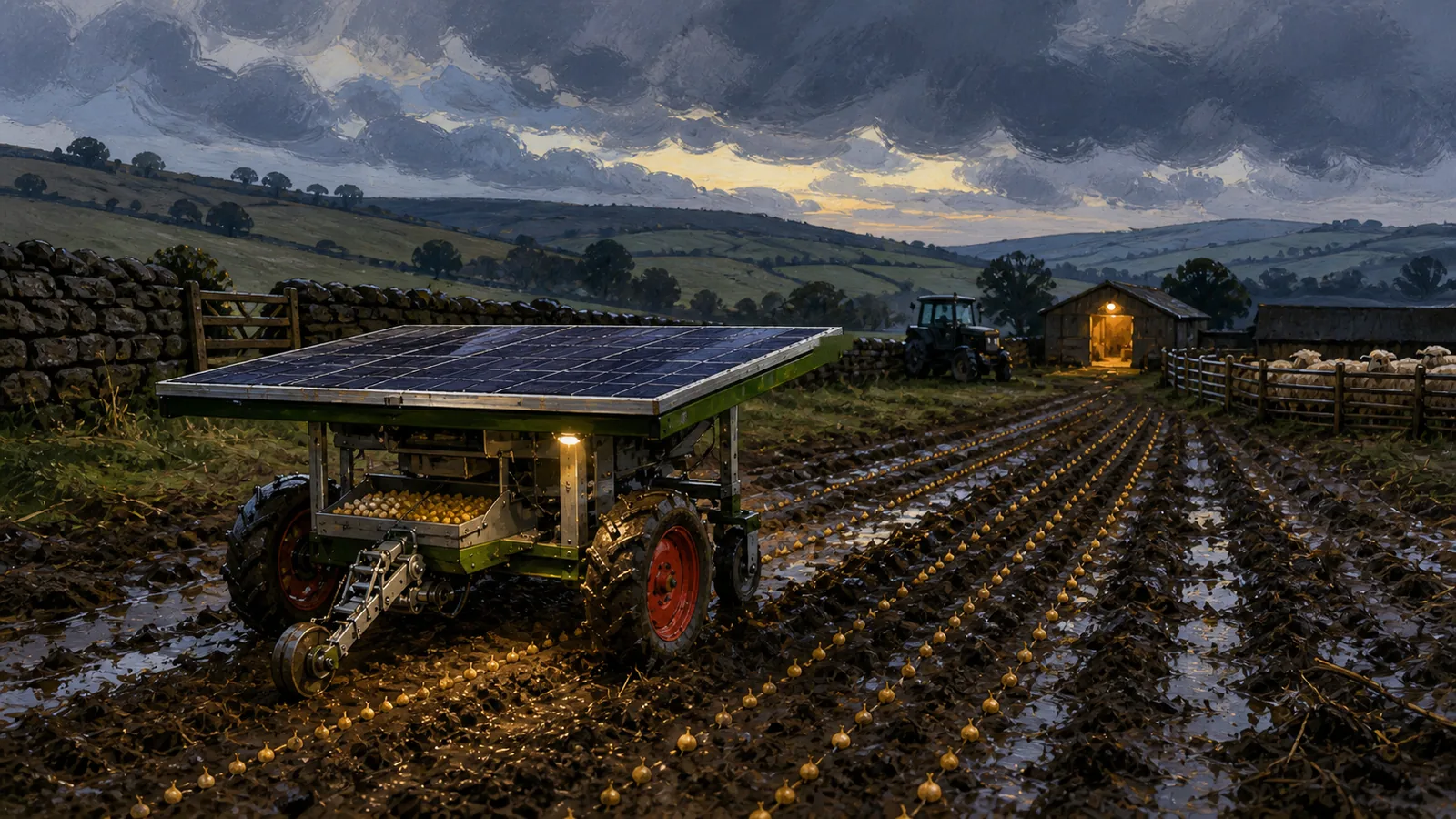
Then comes the FarmDroid, a solar-powered onion planter from the same January machinery-shopping impulse that brought in the AgBot. Razmus explains that it uses GPS, remembers where every onion seed goes, plants at 15-centimetre spacing and will later convert to weeding because it knows where the crop is. It is slow, with a maximum speed of one kilometre an hour, but it can keep going into the night.
The numbers and sounds sell it better than the sales pitch. The field is planned for 600,000 onions. Each click is a seed. Charlie has mentioned a depth of around three centimetres. When they check the first seed and then measure 15 centimetres to the next, even Kaleb is impressed. The show gets the wonder right because it keeps the wonder attached to a job: straight rows, spacing, depth, weeding and time.
Snails bring eggs, slime and another pub calculation
Lisa’s snail enterprise gets one of the episode’s stranger business meetings. The snails have started laying eggs, and George, the supplier, shows Jeremy and Lisa the first batch in damp compost to be kept near a heater. That would be odd enough on most farms. Here it is simply another sideline in a year already full of robots, pub arithmetic and animals that refuse to fit neatly into categories.
George also explains snail courtship in far more detail than Jeremy appears prepared for. The practical result matters more than the biology lesson: once the adults have bred, they can go to the pub, while the eggs become the next generation. Lisa adds that crushed shells can be used for the chickens as grit. It is a tidy loop, if one is prepared to accept snails as both livestock and menu item.
The slime pitch is less convincing to Jeremy. George and Lisa say there is money in beauty treatments, with snails placed on faces for a paid session. Jeremy hears the figures and remains unconvinced, which feels fair. The pub can probably understand garlic butter. Essex facial economics may need a better spreadsheet.
Calving makes Jeremy useful, until farming answers back
The cow births give the episode its warmest stretch. The first calf arrives so quickly that the Moocall alert feels out of date before Jeremy reaches the barn. Endgame’s first calf is already there, the mother is eating the placenta, and the other cows gather round to inspect the newcomer. It is calm, clean farm television in the middle of a noisy episode.
The next birth is slower. Moocall goes off at 3:15, and Jeremy spends hours in the barn waiting through hooves, a nose, a head and the slow, physical business of a calf arriving. When it finally comes out, he clears the airway, gets straw involved and watches it try to stand. Missing a night’s sleep looks cheap once the calf is breathing.
The third birth is the one that makes him part of the job. A tongue appears, Jeremy worries, and Kaleb talks him through pulling gently on the legs during contractions. Ropes come out. Kaleb arrives from Oscar’s birthday duties and helps, but Jeremy does real work here. When the long calf is finally delivered and the mother starts licking, his relief is not performed. It is earned by sore hands and panic.
That feeling does not last unchallenged. Later, with all the calves born and bouncing, Jeremy starts talking about retiring into cow midwifery. Kaleb gives him the version he has not seen: a dead calf inside the cow, no C-section, and a horrible removal done to save the mother. The retirement plan weakens immediately. Then the new boy calf needs castrating with a rubber band, and the calf shits over Jeremy badly enough to send him, temporarily, towards London, advertising friends and a Bentley. Farming supplies perspective very efficiently.
Tiny details worth clocking
Gerald’s visit to Mission Control is brief, but his scepticism about machines taking over from people belongs in the episode. He may not supply tidy minutes, but he understands weather, habit and human oddness.
The drone map catching Jeremy’s missed drilling is the neatest use of technology in the hour. Precision does not just help future work; it also records past embarrassment.
The fly-tipped white good is a small rural cost with no upside. Someone saves themselves a disposal fee, and the farm gets the labour.
Richard Ham is still on the farm because Jeremy and Lisa cannot eat him, cannot breed from him, and cannot keep him alone. The arrival of another boy pig, named James Boar, is silly but practical companionship.
Jeremy and Lisa’s Bovril date night, watching the AgBot and FarmDroid work in the dark, is oddly convincing. It is not glamorous, but it is very them.
The FarmDroid clicks are excellent television. Every tiny sound is an onion seed, which makes the machine feel less like a gadget and more like a till ringing quietly in the soil.
Kaleb laughing while Jeremy is covered in calf mess is harsh, but not unfair. Earlier in the episode Jeremy got to be right about the winch. Balance had to be restored.
Final verdict
Episode 5 works because it lets the modern and the old-fashioned sit in the same muddy yard. The AgBot and FarmDroid really do change the pace of work. They cultivate, drill, plant, watch, measure and keep going after dark. The control room, the apps and the cameras make the farm feel briefly like a monitored system rather than a pile of weather, animals and broken equipment.
But the episode never lets the machines win the whole argument. A fox wipes out the guinea fowl. Storm Darragh leaves trees across the wood. Goats will not walk cleanly just because a barn needs clearing. Cows give birth on their own schedule, not the Moocall’s. A calf can make Jeremy feel useful and then humiliate him with perfect timing.
That balance is the appeal. Diddly Squat can buy robots, hire winches, map fields from drones and measure onion spacing to the centimetre. It still has to clean up dumped rubbish, move animals by hand, sit up through the night and accept that some jobs end with muck on your face. This is a funny episode, but the laugh is usually attached to a consequence.
Rating: 8.5/10 - A strong, practical episode that makes the robots impressive without forgetting that animals, weather and bad luck still run the farm.
More episodes from Clarkson's Farm S5 — Farm chaos and village stakes, episode by episode. Jump to any episode in the season:
Where to go next
Reviewed by Mira Vance · QuizFandom Editor & Lead Reviewer. Every rating is an honest per-watch assessment from the desk that also writes the quizzes — not a press release rehash.