Clarkson's Farm Season 5 Episode 4 Review: AgBot, Guinea Fowl and Expensive Sausages
What happens — the short version (spoilers)
- The pub gets fixed before the numbers get worse
- Guinea fowl arrive as revenge in bird form
- An unexpected lamb turns the flock into a mystery
- Full tables still leave the pub in the red
- The car park turns into another pub problem
- The AgBot looks like salvation until the app starts talking
Clarkson's Farm season 5 episode 4 gives Diddly Squat a very familiar farm equation: the pub is full but losing money, the pigs are charming but uneconomic, the guinea fowl are loud enough to count as infrastructure, and Jeremy's driverless tractor works brilliantly until it remembers it has software.
The pub gets fixed before the numbers get worse
Episode 4 begins in late February, with winter easing off and spring planting looming. That sounds almost hopeful, which is usually the point at which Diddly Squat finds a new way to make optimism expensive. Before the hi-tech crop programme can begin, the farm has animals to send off, a pub to maintain and a set of new problems already queuing at the gate.
The Farmer’s Dog is closed for a couple of days while the kitchen gets a new non-slip floor and electricians have another go at the power supply. It is a useful reminder that the pub is not just a rustic backdrop. It is a working building with lights that flicker, grease to extract, a cesspit to empty and a floor that has to be safe before anyone can carry plates across it.
Alan’s return gives the opening some warmth without getting gooey. He is back after major heart surgery, joking with Jeremy about blocked arteries, lung trouble, old building dust and injections that suppress appetite. The scene is funny because it is so plain-spoken. Two men who should be talking about boards and flooring end up discussing the bodily costs of years spent working around tools, dust and bad habits.
Guinea fowl arrive as revenge in bird form
The episode’s first new arrivals are ten guinea fowl, a present from Jeremy’s eldest daughter and, very quickly, everyone else’s problem. The birds have been kept in a barn, where they have made the air more or less uninhabitable, so Jeremy, Lisa and Kaleb set about moving their house to a copse.
As farm jobs go, this should be modest: put birds in house, move house, leave birds to learn where home is. Because this is Diddly Squat, the staircase has to come out, the machinery nearly makes a mess of the move, and the team miscounts the birds while standing next to them. Gerald’s 78th birthday briefly interrupts the operation, complete with candles that will not light and a warning that guinea fowl are not exactly library animals once they get going.
The practical detail is what saves the sequence from being only noise. The birds are to stay shut in for five days so they recognise the new home. The chosen spot is woodland, partly because guinea fowl can get up trees if a fox comes. The thinking is sound enough. The execution is a wet, slippery, smelly muddle, which is more or less the Diddly Squat house style.
An unexpected lamb turns the flock into a mystery
On the way to the copse, Jeremy spots something that should not be there: a sheep with a newborn lamb. The issue is not lambing itself. The EasyCare sheep are expected to be pregnant. This lamb belongs with the older North Country Mules, the so-called DifficultCare sheep that were meant to be heading into the pub food chain, not extending the flock.
That turns a comic transport job into a small breeding investigation. Jeremy calls the shepherd, who suggests that a male lamb may still have had his testicles before weaning and found his way to the ewes. Jeremy prefers a more theological explanation and decides the lamb may be the Second Coming in woolly form. Lisa and Kaleb are less moved, especially once Jeremy starts treating the mother as if she has acquired biblical immunity from becoming mutton.
Under the joke is a real management problem. One lamb in the wrong group means the farm’s neat categories have failed. Animals that were thought to be one thing are now something else. Even the virgin-birth argument is, underneath, a farmer asking how a breeding plan got away from him.
Full tables still leave the pub in the red
The funniest and most painful business scene comes when Charlie brings Jeremy the first four months of pub trading results. The headline figure is not a gentle one: profit before tax is minus £8,486. Jeremy’s confusion is understandable. The pub is fully booked every day. They cannot squeeze in more customers. From the dining room, it looks like success. From Charlie’s paperwork, it is a loss-making machine with a queue outside.
The explanation is grimly practical. The pub’s own popularity has made the infrastructure too expensive to run. The cesspit is being emptied twice a week. The grease extraction needs doing twice a week. Parking attendants are needed to stop chaos on the A40 and keep the council from going mad. Jeremy puts the parking cost at £47,000 a month, which makes a full restaurant feel less like victory and more like a trap.
Jeremy’s answer is to put prices up. He has had a survey done of other pubs in the area and argues that The Farmer’s Dog is cheaper on examples such as chicken liver parfait with sourdough and steak pie. The problem is reputation. Newspapers have been calling it expensive anyway, so Jeremy reasons they might as well charge closer to what people already think they charge, especially when their ingredients cost more. Being perceived as expensive while losing money is a very particular sort of pub misery.
The car park turns into another pub problem
Just when the pub seems to have run out of new ways to be difficult, more than a hundred travelling people arrive at the car park and use it as a base for horse-and-buggy racing on the nearby dual carriageway. Jeremy starts to go over, then Lisa points out that he is neither a diplomat nor a man with a heart that needs that sort of morning.
The police cannot stop the racing because old by-laws allow horses to be exercised on the road. The pub, meanwhile, is blocked. Customers cannot get in. Four hours later, the group leaves, the pub can finally open, and the staff are left with another cleanup job. There is not much litter, but Annie has found syringes, which she assumes were used for the horses.
Then comes the oddest accounting note in the episode: £150 left for the padlock and rubbish. It does not fix the lost morning or the disruption, but it is exactly the sort of detail this series catches well. Owning a pub means profit-and-loss meetings, floor repairs, parking marshals, newspaper grief and, apparently, a horse-racing event landing in your car park before breakfast.
The AgBot looks like salvation until the app starts talking
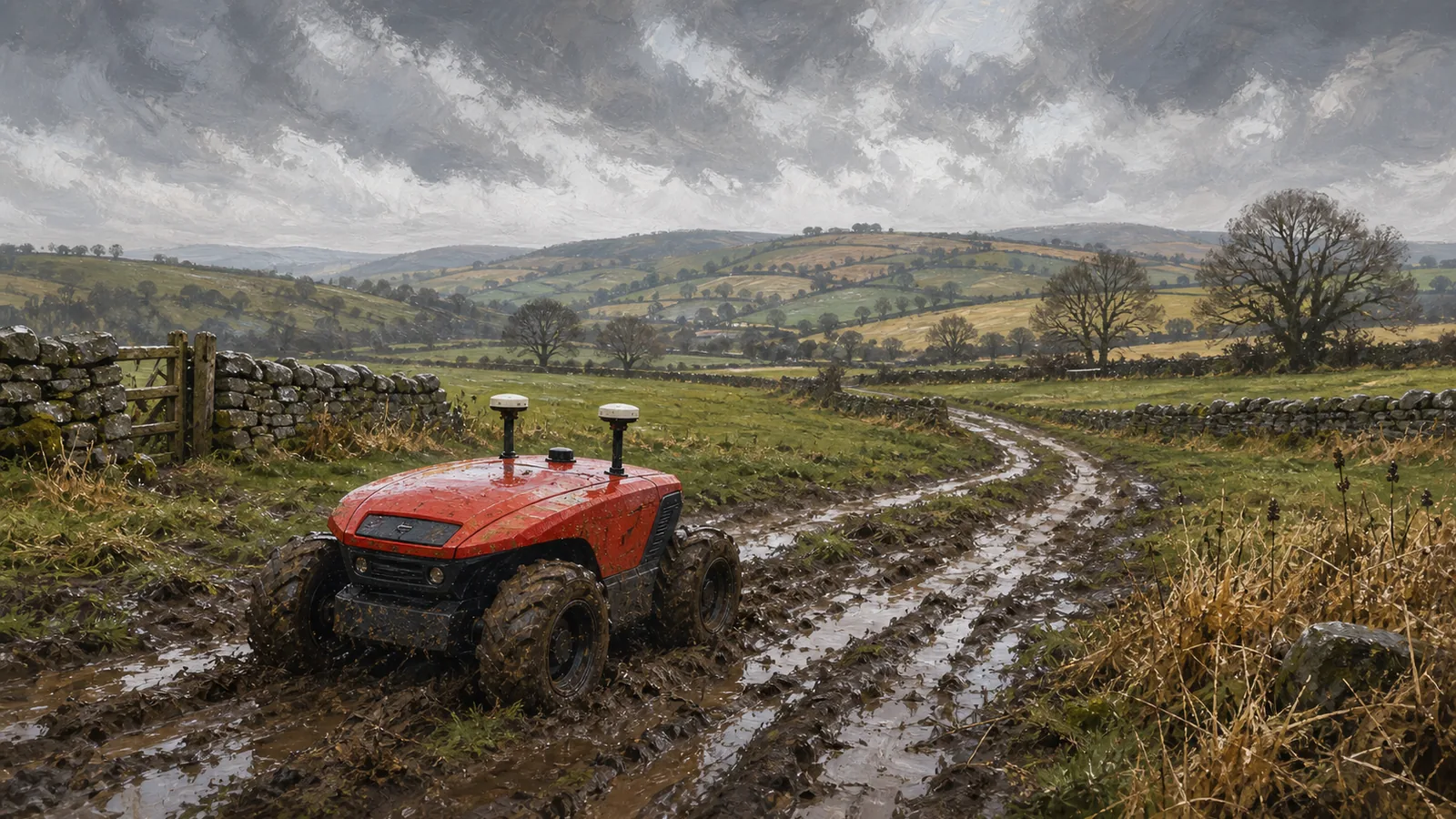
The AgBot’s arrival gives Jeremy the cleanest burst of delight in the episode. In the yard, it looks properly futuristic: Dutch-built, powered by a diesel engine running a generator and two electric motors, using two GPS receivers and a scanning system that can detect obstacles. Will explains the safety layers, the two-centimetre accuracy and the emergency stop, while Jeremy sees the obvious personal advantage. A tractor that can hitch an implement with a controller is a tractor that fixes one of his longest-running humiliations.
The test run is genuinely impressive. The AgBot maps its route, works out its turns, then drives itself with a neatness Jeremy could never reliably manage. It even rescues the Range Rover when Jeremy and Will get stuck, a lovely reversal in which the driverless tractor tows out the human support vehicle while being piloted remotely.
The easy win does not last. The weather has left the ground too wet for proper cultivation, so the first demonstration can only prove the concept. Later, when Jeremy brings the AgBot into the field to show Kaleb, the machine repeatedly stops with errors, delayed satellite messages and instructions that sound as if they were assembled by a printer manual having a bad day. Kaleb’s tractor starts first time, naturally. A machine can be accurate to the centimetre and still be useless if the signal, software or conditions decide otherwise.
The rhino muck sequence makes the precision argument visible. The Dutch lessons from the previous episode start paying off when Jeremy, Will and Jacob begin the field work. Will helps Jeremy map the boundaries so the AgBot knows where it is. Jacob scans the soil and produces the kind of map that turns a field from one green block into a patchwork of stronger and weaker ground.
That information gives the farm two practical uses. The first is variable seed drilling, with seed rates changing according to soil quality. The second is targeted muck spreading, using rhino dung from Cotswold Wildlife Park. Reggie explains that rhino dung is fibrous and nutritionally useful because of the animals’ short stomachs, which is both a genuine agronomy point and an excellent thing to hear in a wildlife park.
Back in the field, Kaleb spreads it at variable rates, putting less on the rich soil and more on the weaker patches. The numbers jump from 5 tonnes a hectare to 45 tonnes a hectare, and even Kaleb is impressed. This is the episode’s most grounded argument for technology. Not a shiny robot in a showroom. Just better information changing where the muck goes.
Saying goodbye to the pigs lands hardest
The closing pig sequence starts with David the butcher showing Jeremy the problem with the rare-breed Sandy and Blacks. Their pork is too fatty for much beyond sausages. David’s comparison is plain enough that Jeremy cannot argue. The breed’s character is right there on the counter, and so is the business problem: very nice sausages do not help much if they have been very expensive to produce.
Once Jeremy accepts that the pigs make no financial sense, there is only one option: the pig enterprise has to end. The ordinary fattening pigs are going off anyway, but this time there will be no new piglets to replace them. Surprise, one of the mothers from the first batch bought three years earlier, makes the decision stop being abstract. Jess tries to frame it as for the better good. Jeremy’s answer is simpler: it is still sad.
Clumsy and Swizz at least get a softer ending. They are not going to slaughter. They are going to a farm school, keeping their names and becoming exhibits for children. Jeremy says the pair produced 70 surviving pigs between them over four batches, which is a decent legacy by any practical measure. The episode began with animals heading to the pub kitchen. It ends with two old mothers leaving for a classroom and Jeremy unable to make it feel casual.
Tiny details worth clocking
The new kitchen floor matters more than it looks. A full pub still has hidden jobs that become bills.
Alan being back after surgery gives the episode a welcome lift, but the dust-and-mask conversation is a reminder that old working habits leave invoices of their own.
The guinea fowl miscount is pure farm comedy: ten birds, several adults, and still two missing in plain sight.
Gerald’s 78th birthday scene is brief, but his warning about guinea fowl noise turns out to be excellent technical advice.
The lamb in the wrong flock is funny because the explanation matters. One unscheduled lamb means somebody’s animal management was not as tidy as everyone thought.
The £150 left after the pub car park incident is one of the strangest accounting details in the episode.
The AgBot towing out the Range Rover is the best advertisement it gets, mostly because it solves an actual problem before it starts failing at a planned one.
Final verdict
Episode 4 lets the comedy and the business pain do equal work. The guinea fowl are ridiculous, but they still need housing, settling and fox logic. The AgBot is thrilling, but it still has to talk to satellites, avoid errors and wait for the field to dry. The pub is packed, but the cesspit, grease extraction and parking attendants are eating the upside.
The pig story gives the hour its emotional weight. Jeremy can love the pigs and still stop keeping them. He can love the AgBot and still stand in a field while it refuses to read its own messages quickly enough. He can fill a pub and still lose money.
That is useful farm television. It does not pretend one clever purchase or one busy weekend fixes anything. It shows the farm as a chain of consequences: animals, mud, food, bills, weather, council worries, technology, and the awkward fact that every sentimental decision eventually has to meet a ledger.
Rating: 8.4/10 - Funny, practical and unexpectedly sad, with the AgBot spectacle balanced by the harder arithmetic of the pub and the pigs.
More episodes from Clarkson's Farm S5 — Farm chaos and village stakes, episode by episode. Jump to any episode in the season:
Where to go next
Reviewed by Mira Vance · QuizFandom Editor & Lead Reviewer. Every rating is an honest per-watch assessment from the desk that also writes the quizzes — not a press release rehash.