Clarkson's Farm Season 5 Episode 2 Review: The Corrs, Whitehall and a Grotto Full of Goats
What happens — the short version (spoilers)
- EasyCare rams arrive with small-farm optimism
- The Corrs meet The Farmer's Dog's utilities
- Whitehall turns politics back into farm accounts
- Rest lasts until the next job appears
- Storm Darragh adds repairs to the Christmas list
- Geese night runs into basic stock control
Clarkson's Farm season 5 episode 2 sends Jeremy from EasyCare rams to The Corrs, from a farmers' rally in Whitehall to storm damage, snail slime, goose arithmetic and a Christmas grotto that works just well enough for the goats to start dismantling it.
EasyCare rams arrive with small-farm optimism
The episode begins with two jobs on Jeremy’s list: deciding how the pub will do Christmas, and deciding whether to go to the London farmers’ rally about the budget. Before either can be settled properly, the farm supplies its own priority in the form of two EasyCare rams.
They do not arrive looking like grand breeding stock. Jeremy calls them woolly mice, notices their size, and then has to be reminded that EasyCare rams are not built like the usual heavy-set version. Kaleb applies marker paint so the team can see which ewes they have serviced, and the rams head off to meet the flock with more administrative usefulness than physical glamour.
The best part is Louise’s explanation for the dead ewe. Jeremy tells her one of the ewes has died, and she suggests it may have gone into despair because a sister was left at home. It is a wildly soft theory in a programme that has just spent time with dead sheep, vaccination and public finances, but it also suits the breed’s odd place in the show. EasyCare is sold as practical. The animals keep behaving as if the paperwork has not reached them.
The Corrs meet The Farmer’s Dog’s utilities
The pub thread starts with a disaster nobody wants to inspect for long. Annie reports that somebody has had an accident, Jeremy gags, Charlotte calls it vile, and Nick decides it cannot possibly have come from one person. The clean-up is still going on when the day’s big booking arrives.
That booking is The Corrs, which is both a coup and a logistical problem. Lisa has got them through her Irish address book, and the pub now has to behave like a music venue while still being a pub with limited power, customers booked for food, and toilets placed close enough to the performance area to worry Charlie.
The show gets good mileage from the gap between celebrity booking and rural infrastructure. The band are given Jeremy’s office as a green room, complete with sweets carefully adjusted for rock-and-roll folklore, but there is no fan heater because the electricity is already under suspicion. Jeremy has to explain, more or less, that the evening may come down to cooking or singing.
The gig itself works. The room sings along, Charlie stops fretting about lavatories and electricity long enough to dance, and Jeremy gets the pub moment he wanted: a small room, a live band, and a sense that the idea behind The Farmer’s Dog has briefly become real. It is not sentimental for long, because the episode has already shown the price of the moment. The magic has a generator hum behind it.
Whitehall turns politics back into farm accounts
A couple of days later, the Diddly Squat convoy heads down the M40 for the farmers’ rally in London. Jeremy is still undecided about speaking. He says both the doctor and Amazon have told him not to, which is a very modern pair of authorities, and the fear from the previous discussion remains: nobody wants to be part of a riot-hungry mob.
The atmosphere in Whitehall is not that. Andrew Marr describes what he sees as mainstream, patient, weather-beaten Britain, and the programme backs that up with farmers from different places explaining the same pressure in plain terms. One says a farm of just over 200 acres will be hit hard. Another asks why people producing food and looking after countryside should be punished.
Charlie gives a reporter the long version of a quick comment, which is exactly what Charlie is for. He talks about business relief, Agricultural Property Relief, tax liability on assets, and the impact on confidence to invest in future production. The comedy is that the reporter runs out of time before Charlie runs out of clauses. The usefulness is that he keeps the rally from becoming just a placard montage.
Olly Harrison’s speech supplies the emotional centre: family farms, low prices, low wages, long hours, food production and children. Jeremy wisely does not try to outdo it. His own speech is shorter and built around one demonstration. He asks how many people are from family farms, then asks those who think they will be unaffected by the APR and BPR changes to lower their hands. Almost no one does. The point is made without a spreadsheet, though the spreadsheet is never far away.
Rest lasts until the next job appears
After the rally, Jeremy says he is glad he went and spoke. His doctor is less pleased. The instruction had been rest, and he repeats the doctor’s idea of rest as sitting by the fire, drinking minestrone soup and reading a book. He has not been doing that.
The farm gives a quick demonstration of why. When he tries to help Kaleb and Lisa weigh cows, he is immediately pushed out of the job. Lisa tells him to stop before he hurts his back. Jeremy, naturally, asks who would do it without him, only for Lisa to say she and Kaleb could manage.
Being excluded from physical labour sends him first to government paperwork, which bores him, and then to cutting down a Christmas tree for the pub, which is exactly the sort of thing a man on blood thinners and post-hospital instructions should probably leave alone. The scene is not played as a huge crisis. It is more useful than that. He hauls, pants, stops, and admits he should not have done it.
That is the episode’s running mechanism in one sequence. Jeremy cannot quite stop trying to be useful with his body, while everyone else is increasingly treating him as a liability with a clipboard. On this farm, even resting becomes another job that has to be enforced.
Storm Darragh adds repairs to the Christmas list
Just when Jeremy decides he needs a proper rest, Storm Darragh arrives. The news reports power cuts across the UK and the Republic of Ireland, plus a rare red warning for strong winds. At home, the sound alone is enough to make Lisa worry about the trees.
Morning turns weather into work. At the pub, Annie shows Jeremy the damage: something heavy has swung up, cracked and fallen, missing a car bonnet by centimetres. A beam has come down, the outside structure has lost strength, festoon lighting has been ripped, and a tree is left precarious. This is not atmospheric winter television. It is the part where somebody has to decide what is safe, what can open, and what now costs money.
Back at the farm, Lisa’s sheep shelter has been flattened. Luckily, the sheep were not in it, but they now need moving. Jeremy suggests the new barn. Lisa says no, because she has put snails in there.
This is the programme at its most agriculturally ridiculous: a storm has destroyed a sheep shelter, and the spare indoor option has already been claimed by a thousand snails whose slime Lisa hopes to turn into cream. She explains mucin, anti-inflammatory benefits, anti-ageing, vegan suitability and future breeding numbers. Jeremy is not so much sceptical as left looking for the beginning of the conversation.
Geese night runs into basic stock control
Lisa’s other livestock project is more conventional, at least until the maths starts. She has reared geese through bad weather and daily work, and now the pub is preparing for the first festive goose night. The birds look good in the kitchen, and Jeremy gives the evening to her.
Then Nick explains the problem: all the geese are for tonight. Lisa had thought the 30 birds would provide lunches and dinners up to Christmas. Nick says they cover one banquet, no more. It is funny because nobody is being theatrical. This is just stock control arriving late, wearing an apron.
The episode cuts neatly between Lisa absorbing that news and Jeremy upstairs selling Charlie on a Christmas grotto. Charlie immediately asks the questions Jeremy has not: where Santa comes from, whether checks are needed, how long each child gets, how many presents are required, whether a parent or elf must be present, and what happens if the goose hut still contains goose mess.
The grotto begins as festive instinct and becomes a staffing, safeguarding, cleaning and throughput problem. Twelve children an hour, six hours a day, 72 sets of presents: Charlie can turn Christmas into an operational model faster than Jeremy can find a reindeer.
The grotto survives, mostly
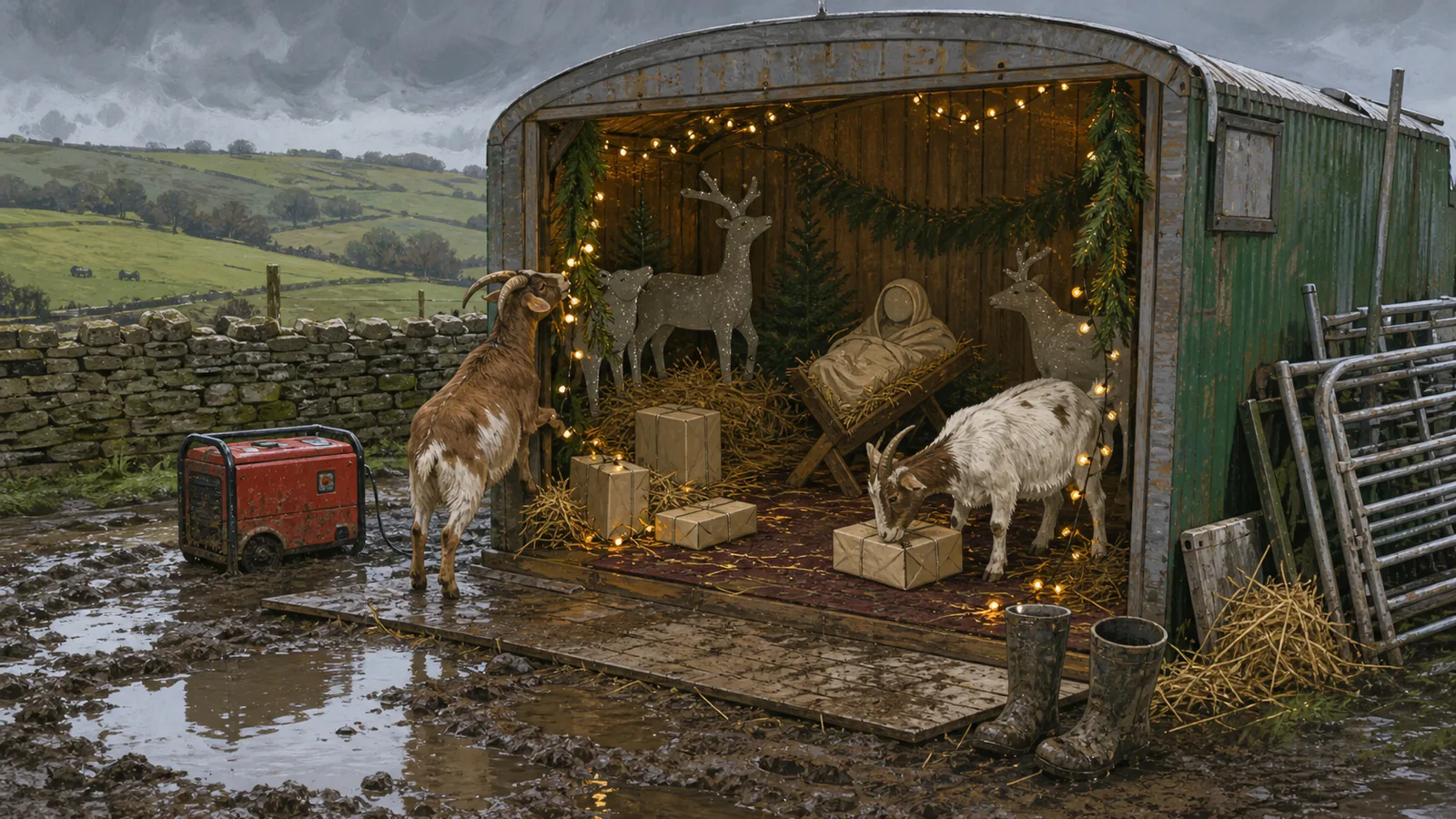
Once the animals are moved for winter, Jeremy can finally build the grotto. A local Santa is hired after the most direct background-check conversation imaginable. The goose hut is moved to the pub, carpet goes down, presents arrive, plastic deer stand in for reindeer, and Jeremy arranges a Nativity scene with the confidence of a man who then has to check a Bible.
The religious discussion is pure Clarkson’s Farm because it begins with decoration and ends with Kaleb trying to understand B.C., evolution, Mary, Joseph and whether the Nativity timeline makes any biological sense. The props are no calmer. The hired Baby Jesus has too much hair, the replacement looks wrong in a different way, and the Angel Gabriel appears to have brought a towel with the wrong name on it.
Jeremy then improves the Nativity by adding real goats, which immediately start urinating, eating fairy lights and making Baby Jesus unsafe. A donkey arrives. A snow machine works. Joey the camera assistant is recruited as an elf because a camera operator in the grotto would ruin the mood. Somehow, when families arrive, Charlie admits it is actually good.
Then he does the accounts. Ten pounds a ticket becomes eight after 20% goes to the government, presents cost four pounds, Santa costs something, and the elf is borrowed from the crew. Before the numbers can fully kill the mood, the goats start throwing the infant around. It is a successful Christmas attraction by the very specific standard that children like it and the livestock have not yet won.
Tiny details worth clocking
Kaleb not knowing The Corrs is a small generational wound placed inside Jeremy’s dream pub night.
Charlie worrying about the toilet route during a live gig is exactly the kind of unromantic issue that separates a working pub from a fantasy pub.
The rally section uses London well: Kaleb asking whether the Royal Albert Hall is a museum is funny, but it also keeps the Diddly Squat group feeling like visitors, not political professionals.
Lisa’s snail plan is not just a random gag. It creates a real space problem when the storm destroys the sheep shelter.
The EasyCare sheep finally being penned only leads to vaccination, nail clipping and more injuries. The breed name remains optimistic.
The lock-in at the end works because it gathers the people who have actually made the place function: staff, farm regulars, old faces, and the usual chaos around darts, gifts and free drinks.
Final verdict
Episode 2 is looser than the opener, but its pieces fit around one clear pressure: the farm and pub keep creating real jobs faster than anyone can sentimentalise them. The Corrs gig is a genuine win, but only after a foul clean-up, utility worries and Charlie’s toilet anxiety. The rally is serious, but it stays grounded in assets, tax exposure and investment confidence. The Christmas grotto is silly, but it still needs staff checks, ticket maths, presents, animal handling and someone to stop goats eating powered lights.
Jeremy’s health remains the quiet constraint underneath it all. He is told not to speak, then speaks. He is told to rest, then cuts down a tree. He is told not to help, then becomes paperwork-adjacent and bored within minutes. The joke is not that he is heroic. It is that farming gives very little room to be selectively useful.
The ending is warmer because the pub has earned it. After The Corrs, Storm Darragh, geese miscalculation, sheep bruises and a grotto held together by carpet, plastic deer and livestock tolerance, the Christmas lock-in feels like a staff meeting with drinks. Jeremy’s closing thought is the right one: they have made a good pub, but the New Year still has to produce a good farm.
Rating: 8.1/10 - A funny, busy Christmas episode that keeps its bigger politics and sillier grotto chaos tied to the same practical question: who is doing the work, and what will it cost?
More episodes from Clarkson's Farm S5 — Farm chaos and village stakes, episode by episode. Jump to any episode in the season:
Where to go next
Reviewed by Mira Vance · QuizFandom Editor & Lead Reviewer. Every rating is an honest per-watch assessment from the desk that also writes the quizzes — not a press release rehash.