Clarkson's Farm Season 5 Episode 7 Review: Skylarks, Silage and a Brutal TB Test
What happens — the short version (spoilers)
- The FarmDroid keeps planting into dust
- One wet morning is not a rescue
- The silage argument has no clean side
- Operation Skylark finds the wrong warm things
- The crop walk is a weather bill
- Jeremy's office chat changes the harvest plan
Clarkson's Farm season 5 episode 7 begins with Diddly Squat waiting for rain and ends with the herd losing its TB-free status. Between those two blows, Jeremy tries to replant failed crops, save skylark chicks, keep the cows fed, plan harvest around cancer treatment and discover whether clever technology can tell a bird's nest from warm sheep muck.
The FarmDroid keeps planting into dust
The FarmDroid is back in the onion and beetroot field, replanting a crop the dry spring has already battered. Jeremy’s worry is plain: planting is pointless if the rain never comes. He works it out in painful farm maths, saying 10,000 litres of water over a hectare gives the equivalent of one millimetre of rain, while the crop needs 24 millimetres every week.
The machine itself is not the problem. It put 200,000 seeds in the previous day and knows where every one is. Kaleb is so absorbed by it that Jeremy accuses him of watching “CornHub”, which is a good description of this episode’s humour: the kit is impressive, the situation is serious, and nobody is allowed to admire anything without being mocked.
With the sky still doing nothing useful, the farm turns to other jobs. Kaleb mows and bales grassland for silage, getting eighteen bales for winter cow feed. The EasyCare sheep and lambs are moved into a fresh field of government-mandated eco plants, helped by neighbours and their sheepdog, Midge. It briefly looks like proper, competent farming. Then the show remembers Kaleb has smashed the producer’s Land Rover while reversing during baling, and balance is restored.
One wet morning is not a rescue
A few days later, rain finally arrives. Jeremy plays “Love Reign O’er Me” on his phone, Kaleb stands in it happily, and Endgame is released back to the herd. The bull looks magnificent, the calves run about, the wipers get used for the first time in months, and everyone gets one of those rare Diddly Squat mornings where the farm seems to be repaying effort with joy.
It lasts about a day. The blue sky returns, and Jeremy looks for a distraction he has wanted to tackle for years: farmland birds. He has seen songbirds around the farm, but not enough of the traditional birds he wants back. Hannah, a birdwatcher from the next village, arrives at 4 a.m. and immediately turns the farm into a listening exercise.
She identifies garden warbler, blackcap, wren, skylark and greater whitethroat, sometimes before Jeremy’s Merlin app catches up. Her enthusiasm is funny, especially when she explains how a rescued finch once lived in her hair, but the knowledge matters. She says thirteen out of roughly twenty farmland bird species are on the red list, with turtle doves down 99%, grey partridges down 92%, and 118,000 miles of hedge gone in seventy years.
The silage argument has no clean side
The bird tour stops being charming when Hannah sees a rye grass field Kaleb has cut for silage. She says skylarks and other birds nest in the crops, and that waiting another two weeks could have avoided killing chicks. Jeremy can see the point, but he can also see Kaleb’s. Cut now, and the grass can regrow for a second cut. Wait, and winter feed gets tighter.
That argument moves to the GS4 field, where the sheep have been grazing and Kaleb wants to mow next. Jeremy sets up the debate like a rural courtroom. Hannah estimates there may be six nests across the 21 hectares, with an average of four eggs each, so about 24 chicks at risk. She says the safer date is around the 16th of July, seventeen days away.
Kaleb’s defence is practical rather than cruel. The grass is green now and has feed value. In the heat, it will die back. The cows are already short of grass, and the farm may have to start using winter resources early. A chain on the mower might warn adult birds or deer, but it will not help chicks in nests. Cutting higher is not really possible because the mower bed runs on the ground. Jeremy tells Kaleb not to cut that night and says he will try to find a plan.
Operation Skylark finds the wrong warm things
Before that plan arrives, Lisa’s new geese need moving for Goose Night at the pub. They get shade, water, housing and an electric fence, though only after the fence is found switched off and the birds make a break for it. Once it is on, the geese get their first lesson in electricity. It is a small job, made exactly as undignified as a small livestock job can be.
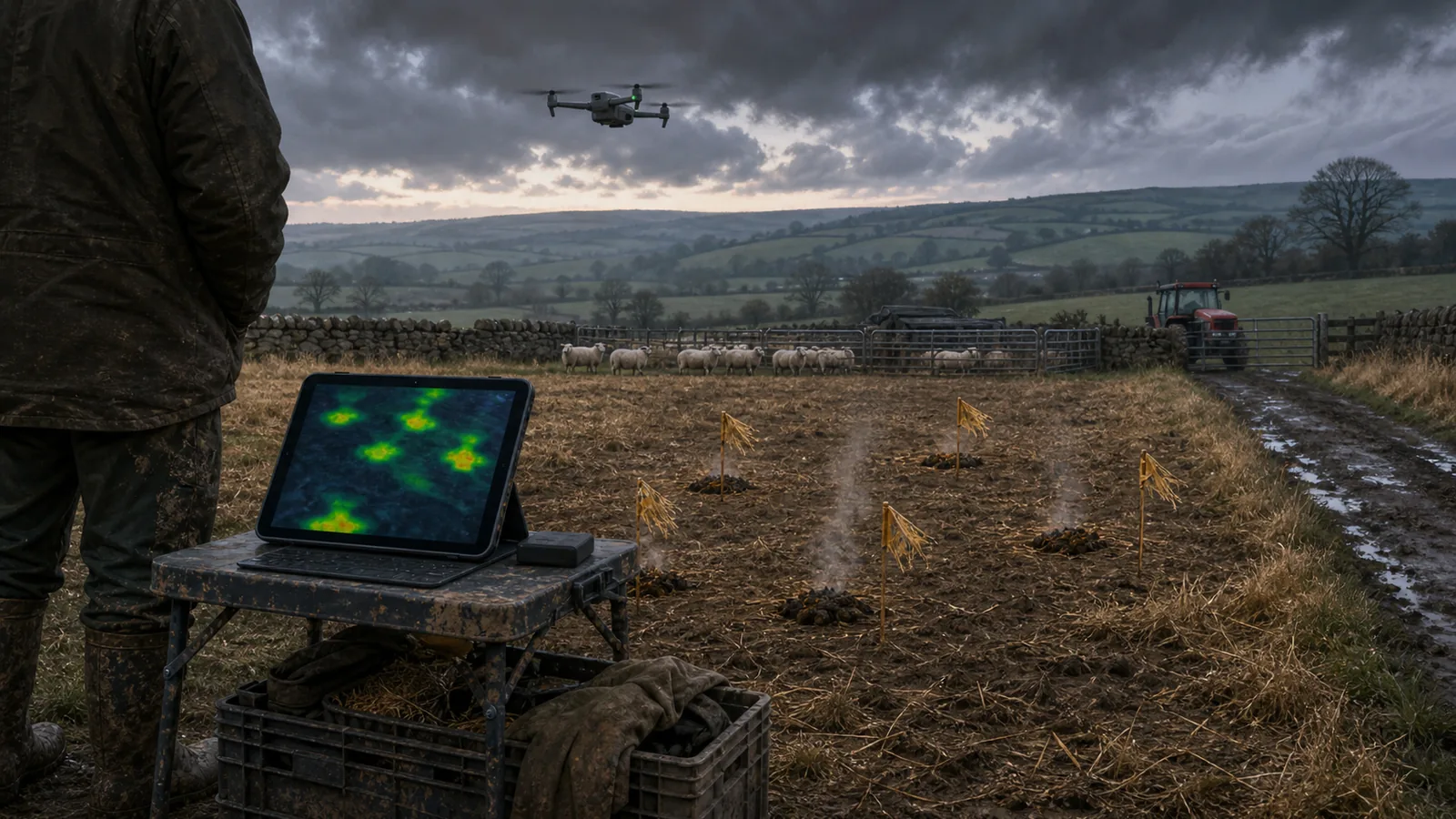
Charlie then suggests a possible answer to the skylark problem: thermal drones. Chris, the farm’s drone man, explains that the camera needs a clear temperature difference, so the flight has to happen very early before the sun warms the ground. At 4 a.m., Operation Skylark begins.
For a moment, it looks brilliant. In Mission Control, Jeremy sees warm green-yellow patches against cold earth, lines them up with Google Maps, gets What3words locations and heads into Barn Ground with Lisa to mark five possible nests. Kaleb could then mow round them and still get the silage.
The five possible nests turn out to be five piles of still-warm sheep muck. The drone has done its job perfectly, just on the wrong biological target. With no realistic way to find the nests, Jeremy goes with his heart and asks Kaleb to stand down until the chicks have flown. Two weeks later, Kaleb finally mows the field, by which point he says the feed may be like cardboard for the cows.
The bird pantry plan runs into the same sky. Hannah and Jeremy also try to create a winter pantry for birds in the field margins. The idea is sound enough: mow the margins, cultivate them, then drill a bird food mix so farmland birds have something to eat when natural food is low. It also avoids Kaleb’s cash crops, which makes the scheme easier for him to accept.
The execution is less tidy. Hannah walks in front of the AgBot so they do not mince a skylark or corn bunting, while the machine creeps along at 2.5 kilometres an hour. Jeremy then fits the cultivator and tries to break up soil that has been baked hard by the dry weather.
Kaleb arrives and immediately calls the job rubbish. He says the ground is too hard, the cultivator is making craters, and Jeremy has basically wrecked a margin. For once, Jeremy does not win the argument by volume. The ground is too dry, and even Hannah accepts there is no point drilling seed without moisture. The bird project joins the onion field in the same queue: good idea, wrong sky.
The crop walk is a weather bill
As harvest approaches, the drought stops being a background worry and becomes visible in every field. Jeremy says the farm has had the driest spring for over a hundred years, a drought has been formally declared, and the spring crops have had 70% less rain than average in the five months since planting.
The onion and beetroot field is the clearest failure. They planted it twice. Jeremy says they put in 1.6 million onion seeds and, after first counting five plants, corrects himself to seven. He defends the RoboDroid because the machine did what it was asked to do. The trouble is that March, April, May and June together brought no more than twenty millimetres of rain.
The mustard field is just as grim, and that hurts commercially because mustard is the shop’s biggest seller. Wheat is thin, with small heads and shrivelled grains. Barley is six inches shorter than it should be, a point Jeremy underlines by comparing it with his own clip from five years earlier. The sheds still have to be cleared and cleaned for grain, but the crop walk has already warned everyone what sort of harvest may be coming.
Jeremy’s office chat changes the harvest plan
After the sheds are prepared, Jeremy calls Charlie and Kaleb into the office to talk dates. He wants a better plan than last year, when opening the pub made harvest more disorganised and stressful. Charlie says oats are next week and wheat probably the week after, around Monday the 28th or the end of July.
Then Jeremy tells them he has cancer. He says he has known since May, after a medical and a biopsy; it is aggressive but early. He is hoping to get harvest done before treatment, but the operation may fall in the middle of it. The scene is plain, and better for it. Kaleb asks where. Jeremy says where is of no concern to anybody.
The farm consequence follows straight away. Simon, the combine man, has retired. Kaleb was going to combine and Jeremy was going to cart grain, but Jeremy may be out of action, so Lisa needs training. Kaleb and Charlie respond kindly, yet the conversation still turns to who drives what and whether Lisa can load stationary. Personal news and harvest logistics sit in the same office, because farming gives nobody a clean diary.
The TB test takes the whole herd hostage
The next job is the six-monthly TB test with Dilwyn. There is some good news first: all bar one cow is pregnant again, six of them in about 35 days, and Endgame’s value as a breeding bull is obvious. One calf has a touch of pneumonia, but Dilwyn hopes it should be okay.
Then the readings start getting close. One cow passes by a tiny margin after Dilwyn checks the chart. Another is close. Endgame gives everyone a fright when Dilwyn first thinks he has failed, then checks again and says he has passed, right on the borderline, with five millimetre increases at top and bottom.
Finally, the cow carrying twins fails. Dilwyn says the whole farm is under restrictions and has effectively lost its official TB-free status. The ministry will explain what they can and cannot do. There will be another test in 60 days, and if she is inconclusive next time she becomes a reactor and will be slaughtered, twins included. No cattle can come in or out, and the winter plan to get more cows is gone.
Tiny details worth clocking
Midge the sheepdog gives the episode its cleanest display of competence. Everyone else debates, reverses badly or checks apps; the dog just moves sheep.
Kaleb blaming the Land Rover damage on a pheasant is hopeless, but at least it is delivered with commitment.
Hannah hearing a yellowhammer mid-sentence is exactly the sort of expertise that makes Jeremy’s bird app look underqualified.
The donkeys, renamed Ben and Ben by Jeremy’s granddaughter, give Charlie a chance to complain about a petting zoo before admitting that farming should include things people enjoy.
The thermal drone failure is funny because the technology does not fail. The sheep simply provide better heat signatures than the skylarks.
Final verdict
Episode 7 is one of the season’s toughest hours because every decent intention comes with a cost. Save the skylarks, and the silage loses feed value. Drill bird food, and the soil is too dry. Replant onions, and seven survive from 1.6 million seeds. Plan the harvest, and Jeremy has to plan around treatment too.
The TB test gives the hour its hardest finish. It is not just an emotional blow; it is a rulebook problem, a movement problem and a breeding problem. Diddly Squat can joke through geese, drones and Kaleb’s reversing, but it cannot charm rain out of the sky or argue with a TB chart.
Rating: 8.8/10 - A sharp, bruising episode that turns bird protection, failed crops, harvest planning and TB rules into one long lesson in farming consequences.
More episodes from Clarkson's Farm S5 — Farm chaos and village stakes, episode by episode. Jump to any episode in the season:
Where to go next
Reviewed by Mira Vance · QuizFandom Editor & Lead Reviewer. Every rating is an honest per-watch assessment from the desk that also writes the quizzes — not a press release rehash.