Mayor of Kingstown S4E1 Review: The Long Walk Starts Before the Prison Gate
What happens — the short version (spoilers)
- Kyle takes a plea deal, two years with possible early release, surrendering to county before prison transport, to protect the McLusky family secrets around Robert.
- Mike scrambles to wire the prison, place Carney near Kyle, and threaten the new warden, but is told repeatedly he no longer has free access.
- New warden Hobbs purges the old back channels, pushes Carney to the yard, and tells Jackson DOC now controls him inside and outside the walls.
- Evelyn offers to save Kyle if Mike gives up Robert; Mike refuses and tells her she is dead to him after she frames Kyle's surrender as his own choice.
- Bogota reopens its deal with Bunny, and a street chase ends with Mike killing a young Colombian gunman, confirming the cartel killed the Russians.
- At intake, an inmate with a lock in a sock breaks the escorting officer's jaw and beats Kyle badly; Kyle refuses the infirmary and crawls to his cell.
Kyle's surrender turns one brother's guilt into Kingstown's newest currency, while a new outside force tests every fragile arrangement.
Mayor of Kingstown begins Season 4 by making Kyle McLusky’s prison sentence feel less like a legal outcome than a civic ritual. The premiere is structured around a countdown to surrender: paperwork, protection deals, domestic farewells, a barroom send-off, the drive, the strip search, the walk through the yard. Around that line of dread, Kingstown keeps moving as it always does, with bodies on railroad tracks, drug debt inside Anchor Bay, and officials treating leverage as a public language.
Kyle’s deal makes family loyalty look like another sentence
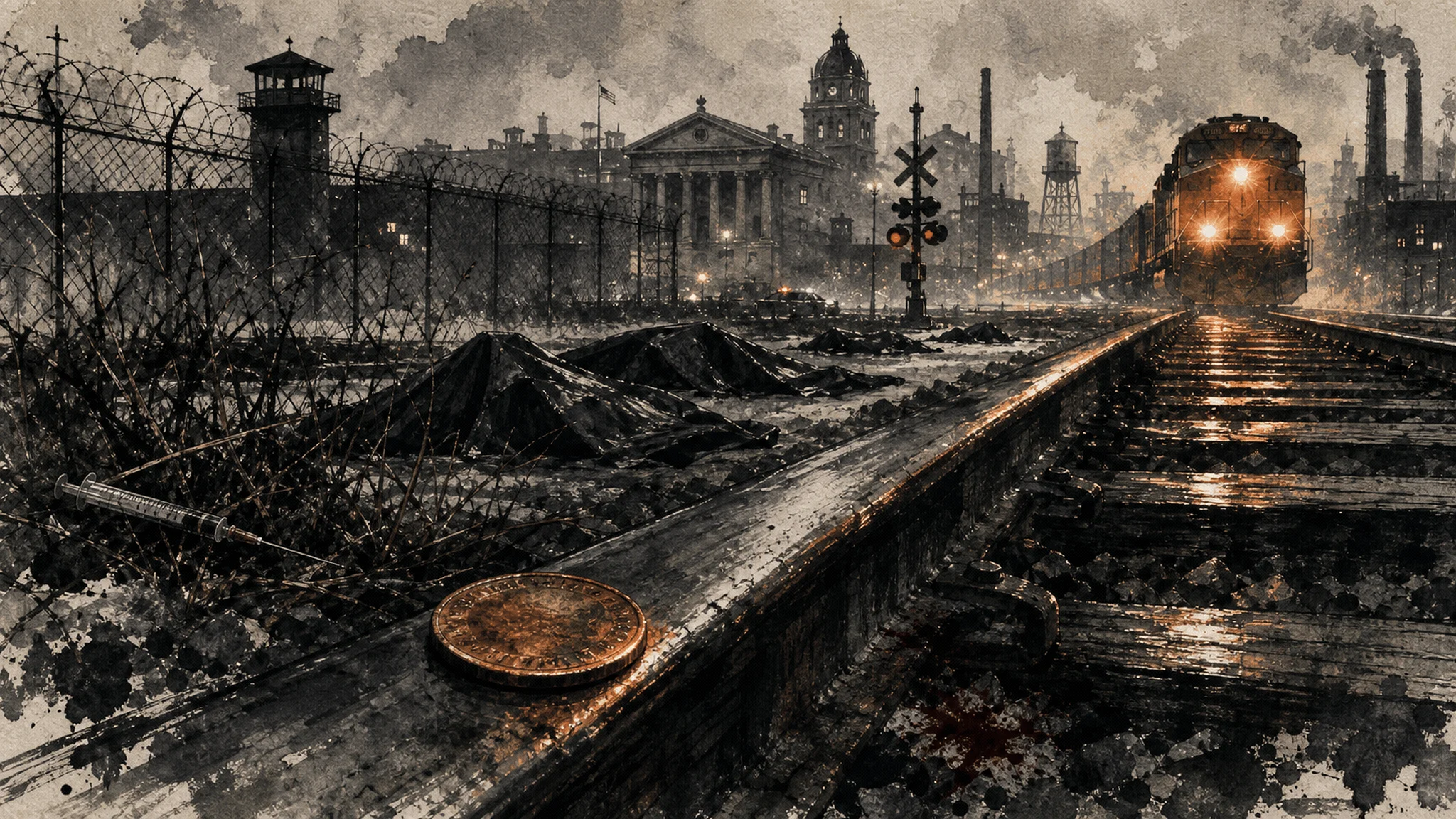
The episode opens with a recap of the Sixth Street bridge disaster, then makes its first new image a grim little lecture on value. Moses weighs a penny, recites its copper, zinc, and tin, and says war determines value while bound men begin to come around nearby. The cut to the railroad aftermath gives that monologue its practical shape. Mike McLusky, played by Jeremy Renner, arrives with Ian Ferguson, played by Hugh Dillon, and sees what Ian has already processed in his own brutal shorthand: the victims were drugged, placed on the rail, and decapitated by a freight train.
That crime scene is lurid, but Mike’s real emergency is Kyle, played by Taylor Handley, whose lawyer Chester arrives with the best deal anyone is going to get. Two years, possibly six months with good behavior, and a surrender to county before DOC transport. Mike erupts because the arrangement means his brother will move through the same correctional machine the McLuskys manage from the outside.
Kyle says he made a choice on the bridge for the right reasons and can live with the consequences. The line has the calm of a man trying to save everyone else the trouble of panic. Mike immediately starts building a safety net: meet the warden, put Carney near him, wire the place, visit after intake. He says there is “zero fucking upside,” but that he has eyes on him. In Kingstown, love often sounds like surveillance because surveillance is the only protection anyone trusts.
The domestic goodbye with Tracy McLusky, played by Nishi Munshi, pushes that logic harder. Tracy asks why telling the truth would violate Kyle’s code when he saved a man’s life. Kyle answers with the premiere’s most loaded image: it is a house of cards, and he cannot be the reason it falls. The later scene with Stevie makes that answer plain. If Robert faces the full weight of his history, he may take Ian, Mike, Mitch’s memory, and half the department with him. Kyle is going inside to preserve a system he knows is rotten because his family is trapped inside its beams.
That is why the send-off feels sour before it begins. Tracy cannot pretend at the bar, so she says goodbye at home with their son in the room. Kyle offers household logistics, names a repairman, and tries to turn absence into chores. Tracy tells him to look at his son. The scene keeps its moral attention there: not on the deal as strategy, but on the child who has no language for why his father is leaving.
Hobbs closes the drawbridge on Mike’s old authority
Season 4’s most important new variable may be Warden Hobbs, played by Edie Falco, because she recognizes Mike’s power without behaving as if she needs it. Her first staff address is all institutional confidence: she has run five prisons, has a flawless record, and fixes flawed institutions. Then the follow-through gets sharper. She rejects lingering loyalty to Kareem Moore, dismisses Carney’s self-presentation as Kareem’s right hand, and tells Jackson that DOC pays him and controls what he does inside the walls and now outside them.
That last phrase matters. Hobbs is reaching into the informal networks that let Kingstown function around official failure. Carney, who is supposed to be Mike’s friendly face for Kyle, gets pushed to the yard. Jackson gets a reminder that off-duty does not mean outside the warden’s reach. The old system is still corrupt and violent, but Hobbs arrives with a rival kind of order, one that wants to absorb the back channels rather than bargain with them.
Mike’s office meeting with her is therefore one of the premiere’s strongest confrontations. He offers the usual menu: if gangs are at war, call him; if COs cross lines, call him; there is not a problem inside those walls he cannot solve. Hobbs answers by refusing the premise. She is not Kareem. There are no more free passes. This is her castle, and only she can lower the drawbridge.
Falco’s delivery gives the castle metaphor administrative chill. Hobbs promises to keep Kyle alive, then makes clear that alive may be all Mike gets. She refuses to place Carney in Ad Seg and will not give Mike the prisoner layout he wants. When Mike asks about Merle Callahan, she says Callahan is in the infirmary and will not reach Kyle. Mike finally drops the courtesy and warns that if anything happens to his brother, there will be consequences. The threat lands, but the scene has already shifted the ground. Mike can still intimidate. He cannot assume access.
Evelyn Foley’s scenes sharpen the same loss from another angle. She tells Ian she can save Kyle if he gives her Robert Sawyer, and she offers to forget Charlie and Morrissey in exchange. Ian refuses and calls her a greater evil. Later, she comes to Mike’s office and frames Kyle’s surrender as Kyle’s choice because he has an out if he tells the truth. When she says Kyle will go in like any other prisoner, just as Mike did, the old intimacy between them dies in the room. Mike tells her she is dead to him. It is the sound of the town’s legal and unofficial power centers splitting when Kyle most needs them aligned.
Colombia reopens the prison-yard ledger
While Mike tries to protect Kyle from every known danger, the unknown one keeps announcing itself. Ian reads the railroad deaths as something beyond Bunny Washington’s interests. The victims are Russians, likely part of someone cleaning up Konstantin’s mess, but the method is too elaborate for business as usual. Mike calls it the devil they do not know.
Bunny, played by Tobi Bamtefa, is confident when Mike comes to him. His streets are wired, nobody is moving on the king, and he has housekeeping underway to keep things pin-drop quiet. He also agrees to help Kyle, promising that if Kyle steps out of Ad Seg, Raph will have eyes on him. The favor is personal before it is strategic. “Family’s family,” Bunny says, and the premiere lets that mean something even in a world where family is often the excuse for another compromise.
Inside Anchor Bay, Raph learns how unstable that promise may be. A Spanish-speaking group delivers a message from outside: the arrangement can lapse now that things are steady. Roberto rejects that version. Bogotá has lost a cook and soldiers, another shipment is coming, and Bunny’s side still owes. Raph tries to frame the old partnership as back-to-back survival. Roberto answers that circumstances changed and that he is the one talking, not Bunny.
The scene translates the premiere’s larger politics into prison-yard accounting. Peace was never a moral settlement. It was a payment plan backed by fear, supply, and temporary need. Once Bogotá feels strong, the ledger reopens. Raph gets word to Bunny, who has no outside counterpart to negotiate with and tells Raph he can manage it. By the time out-of-state plates roll past Bunny’s corner and gunfire follows, the outside war has already found its route through the inside.
Mike’s intervention in the chase gives the premiere its bluntest action beat. Ian warns him that the pursuit is an update, not an invitation, but Mike drives into it anyway. After the crash, Ian notes that the surviving young gun keeps saying “abogado.” Mike has killed one of them. Ian later warns that the dead man may be blood relation to the survivor, and that Colombia is in Kingstown. Mike’s answer is bleakly practical: at least they now know who killed the Russians.
That knowledge arrives too late to protect the walk Mike has spent the whole episode trying to control. Kyle sobers up in the car while Mike gives him prison instructions so precise they sound rehearsed from old wounds: watch everyone without watching, trust no one unless Mike says to, put down whoever comes for him, and do not become them to survive. Then Mike leaves him at the gate.
The intake sequence strips away every abstraction around “going in.” Mullen orders Kyle through a full search, then escorts him into the noise of the yard. A man blocks the path, Mullen asks what block he belongs to, and the attack erupts. The later report from Carney fills in the mechanics: an inmate with a lock in a sock broke Mullen’s jaw and went after Kyle. Kyle refused the infirmary and made it to his cell badly beaten. The man in the neighboring cell gives him the real first rule of prison as a former cop: do not go to sick bay, because every space between here and there is a kill zone.
What this episode argues
The premiere’s strongest idea is that Kingstown punishes reform and corruption with the same machinery. Hobbs may be competent, Evelyn may be pursuing a real accounting, Mike may be trying to save his brother, and Kyle may be accepting responsibility for a choice made under impossible conditions. None of that changes what the institution does once a body crosses the threshold.
That is why the railroad murders and Kyle’s beating belong in the same hour. One is theatrical criminal messaging; the other is prison routine breaking open under pressure. Both turn bodies into public warnings. Even Mike finding an unresponsive woman in the street between his prison errands fits the pattern. Another day in Kingstown means another person on the ground while the men with phones decide which emergency can be answered first.
Verdict
“The Long Walk Starts Before the Prison Gate” is a strong, grim re-entry for Mayor of Kingstown because it centers the hour on one physical passage and lets every subplot tighten around it. The premiere has the usual Sheridan bluntness, and some dialogue still announces its themes with a heavy hand, but the structure gives the episode force. Kyle’s surrender is not treated as a plot reset. It is treated as a family sacrifice, a police scandal, a prison logistics problem, and a moral debt all at once.
Mike is especially convincing in the scenes where his competence stops looking useful. He makes calls, cuts deals, threatens a warden, pleads with a prosecutor, briefs his brother, and still fails to prevent the first attack. That failure gives the season a clean opening wound. Mike checked every box, as Ian tells him. Kingstown found the empty space between them.
Rating: 8.4/10
More episodes from Mayor of Kingstown — Season 4 — Mike vs. the cartel pipeline that's been quietly running through Kingstown. Jump to any episode in the season:
Where to go next
Reviewed by Mira Vance · QuizFandom Editor & Lead Reviewer. Every rating is an honest per-watch assessment from the desk that also writes the quizzes — not a press release rehash.