Mayor of Kingstown S4E10 Review: Kyle Takes the Shot Mike Cannot Fire Himself
What happens — the short version (spoilers)
- A diner ambush leaves Mike stunned, and Kyle survives by using a civilian's gun, so Mike and Ian rewrite the scene to erase the third shooter.
- Mike hides a captured Billy and interrogates him about Callahan, admitting it stopped being an interrogation and became punishment.
- Mike tells Nina to lift the lockdown so one faction can bleed another, calling it prison thinking; Bunny then triggers a deadly inside uprising.
- Callahan surrenders to the station unarmed and demands due process, but Captain Walter ultimately decides Callahan was never there.
- Mike takes Callahan to a rail yard, then changes the ritual by calling Kyle, handing the execution to the man Callahan wounded most.
- Callahan goads Kyle to the end before Kyle finally fires; the shots bring no catharsis, only Kyle sobbing as Mike says it is over.
A finale about law, family, and transferred violence asks whether justice can ever leave Kingstown with clean hands.
Mayor of Kingstown Season 4 Episode 10 begins with the town already past the point where official language can keep up. The manhunt for Robert has been declared over, Kyle has been pulled into a deal built around Frank Moses, and Merle Callahan has stopped being a prison rumor and become an active threat in the streets. The hour uses the diner ambush as its ignition point, then spends the rest of the finale watching every faction choose a theory of justice. Mike McLusky (Jeremy Renner) wants the least dirty solution still available. Kingstown, as always, demands something worse.
The diner makes survival a problem of evidence
The opening shootout is staged less as an action flourish than as a jurisdictional disaster. Mike’s ears are ringing, his head stunned and half inside the shock of gunfire, while Stevie curses through pain, Sarah hands over her gun, and Kyle McLusky (Taylor Handley) comes in low and panicked before joining the fight. The key detail is not simply that Kyle survives. It is that he survives through a weapon that cannot easily belong in the official version of events.
That is why Mike’s first instinct after the bullets stop is not celebration. He checks Sarah, tells her to leave out the back, and gives her the story she needs: she left the gun behind the counter, and Kyle knew where it was. The line lands like a miniature Kingstown charter. Violence happens first. Paperwork becomes the second battlefield. A civilian’s proximity to police violence must be erased before the sirens close in.
Ian Ferguson (Hugh Dillon) understands the same logic at the crime scene. When the captain notes that witnesses saw three gunmen, Ian pushes a cleaner story: two dead attackers in tactical gear, an Aryan Brotherhood assault ordered by Callahan, no meaningful third man. He is not only protecting Mike. He is protecting the entire arrangement that lets Kingstown keep functioning after events that should force public accountability. Eyewitnesses become unreliable because blood, bullets, and panic make them easy to dismiss. Two bodies are enough for the report. The missing third is for the unofficial city.
The episode’s most bitter move is that the unofficial city is already working. Mike has Billy alive, bound, and hidden away before the police narrative has cooled. What follows is not an interrogation in any noble sense, and the episode does not pretend the line was anywhere but crossed. Mike asks where Callahan is, presses Billy on the phone Callahan uses, and tries to puncture the prison-code fantasy that Billy keeps calling honor. Billy insists on loyalty. Mike answers by dragging Shaver’s mutilation back into the room and making clear that Billy’s code did not protect anyone from cruelty.
The scene becomes uglier because Billy’s refusal is not empty bravado. He gives Mike fragments, not coordinates: Callahan is not a spectator, he is front lines, and he could be in Kingstown. Mike extracts enough to confirm a shape, but not enough to prevent what comes next. By the time Ian suggests Billy would have talked if he knew anything, Mike admits the scene stopped being an interrogation for him an hour earlier. That confession matters. The finale does not let Mike’s rage remain procedural. It names the moment when information gathering becomes punishment.
Mike lets Kingstown bleed
The prison plot works as the finale’s second pressure chamber. Hobbs tells Nina Cortez she is lifting the lockdown, and Cortez’s answer about Torres gives the decision a cold military grammar. She let Torres see her. He knew. He did not beg. Hobbs praises the dead soldier’s sacrifice, then tells Cortez there will be something to report only when there is something to report. The exchange is spare, but it frames the prison violence as institutional messaging. A dead man is useful only once the larger objective has been completed.
Mike’s call to Nina sharpens that point. He tells her it is time to lift the lockdown. When she asks why he cares, he gives the episode’s governing metaphor: sometimes something has to bleed to be cured. Nina calls that medieval thinking. Mike corrects her with the more damning phrase: prison thinking. The distinction is the whole show in two sentences. Kingstown does not imagine itself as barbaric. It imagines itself as practical, and practicality becomes the language that excuses controlled collapse.
Bunny’s side of the hour pushes that controlled collapse into open campaign. Mike goes to him after the diner and reframes the day as an alliance: Kingstown and Detroit aligned, Bogota hit inside and out, the new empire secured through scorched earth. Bunny tells Mike to mind his own business, but he immediately calls Raph and prepares the inside move. The prison doors buzz, the inmates surge, gunfire erupts, and the episode cuts through the consequences without pretending the operation is clean. This is not a heroic counteroffensive. It is a municipal ecosystem rebalancing itself with bodies.
That is where Officer Stephens’ scene with Hobbs carries more weight than it might first appear. Stephens has clocked in after killing to save Kyle, and Hobbs speaks to her with an almost maternal restraint. No one takes easily to killing, Hobbs says, because it disturbs the soul. Then she gives Stephens the consolation Mike gives Sarah by other means: focus on the life saved. In another show, that might be comfort. Here it is a workplace adaptation. Killing becomes something the job must help you metabolize quickly enough to report for the next shift.
The finale keeps returning to that transfer of burden. Mike tells Sarah that what she did saved his brother. Hobbs tells Stephens the same moral story. Bunny tells Kevin that one last task will make him a free man. Everyone is being given a usable version of what they have done. The hour’s bleakness comes from how necessary those versions are. Without them, nobody could keep moving. With them, the machinery survives.
Callahan chooses the law until Mike gives him Kyle
Callahan’s best move is also his most revealing one: he surrenders. After Mike finds signs that Callahan was at Shaver’s and realizes the man is not running, Callahan walks into the station unarmed and asks for due process. Ian wants to make him disappear through the back door. Captain Walter sees enough to stop that from happening immediately, but his objection does not hold for long. Once he stares at Callahan and thinks through the horrors attached to him, he reaches the same conclusion as the men he is supposed to restrain. Prison would not punish Callahan. It would house him.
Walter’s speech gives the episode one of its strongest moral complications. He distinguishes evil acts from evil people, then admits that law and philosophy cannot contain the man in front of him. That is the official system confessing its own inadequacy. It is also the doorway through which vigilantism enters dressed as practical necessity. Walter does not swing a baton or fire a gun. He simply decides Callahan was never there, and that choice may be the most consequential action he takes.
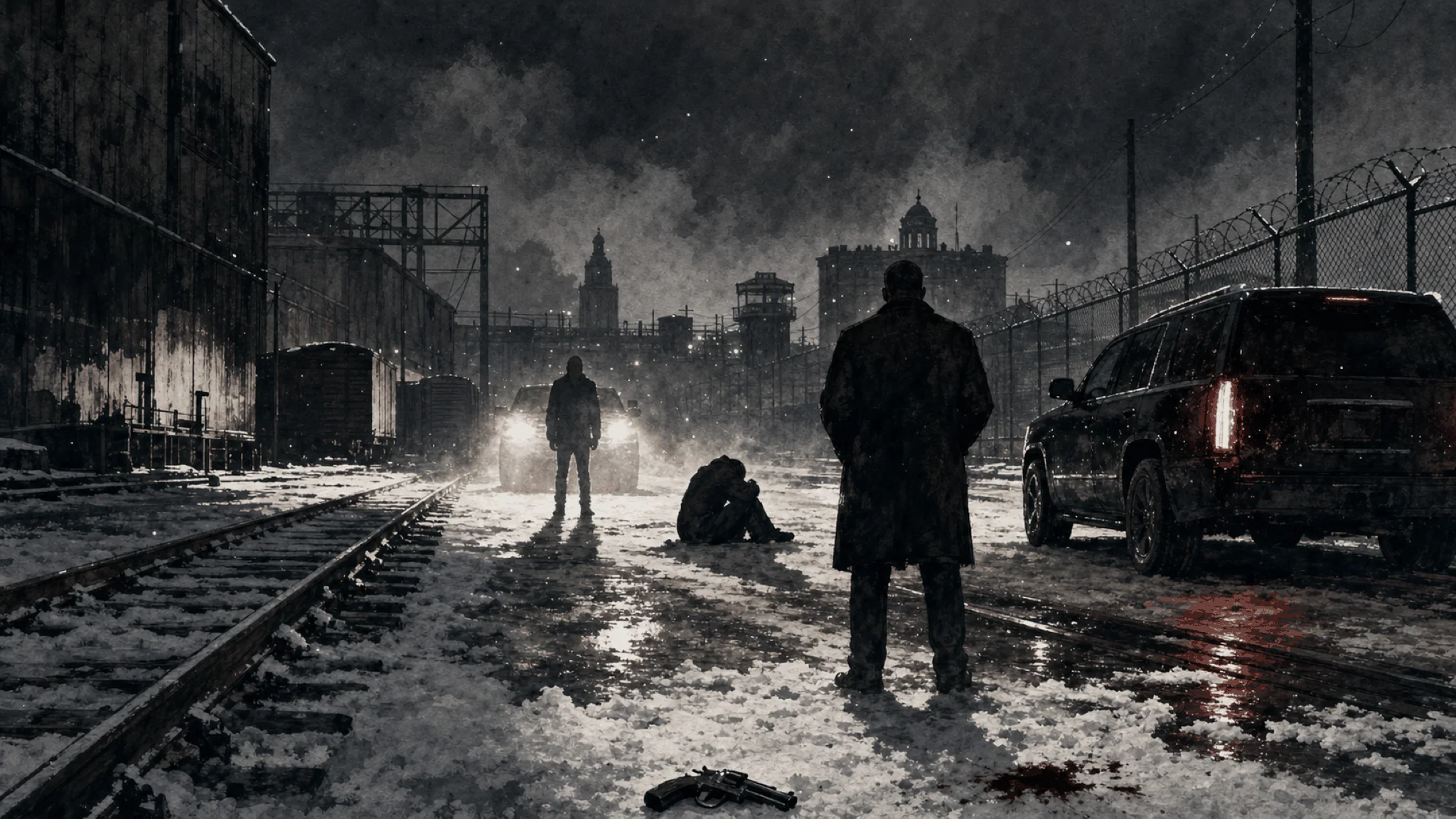
Mike’s rail-yard plan appears, for a moment, to be the old Kingstown solution: bring the monster to an empty place, remove him from the civic record, end the threat. Callahan understands the ritual perfectly and spends his last stretch of road trying to deny Mike any clean emotional payoff. He mocks labor, race, guilt, and fear. He tells Mike that blood cannot wash out blood. He calls him a coward for hiding behind law, even as he has just used law as his own shield.
Then Mike changes the ritual. He has called Kyle.
That decision is the finale’s most severe and most arguable choice. Mike does not decide that Callahan deserves mercy. He decides Callahan does not deserve his wrath. It is a strange distinction, but in Mike’s moral vocabulary it matters. If Mike kills Callahan, the act belongs to Mike’s rage, Mike’s history, Mike’s claim over the city. By bringing Kyle in, Mike hands the execution to the person Callahan wounded most directly. He converts his own revenge into his brother’s release, or at least into the only release Kingstown knows how to offer.
The scene refuses to make that release simple. Callahan keeps talking, because speech is the only weapon left to him. He tells Kyle to go to the morgue in Belleville and wonder what was done to her. Kyle’s gun clicks, his breathing fractures, and Ian whispers for him to finish it. When the shots finally come, they are followed not by catharsis but by Mike closing the moment down. That’s enough. It’s over. Kyle sobs anyway.
Those final sobs are the episode’s judgment on its own solution. Callahan is dead. The threat is removed. The brothers walk away alive. None of that makes Kyle whole. The city has given him an answer in the form of bullets, and the sound that follows says the answer is not large enough for the wound.
What this episode argues
Season 4 Episode 10 argues that Kingstown’s institutions do not fail because they lack power. They fail because their power has been trained toward containment rather than repair. Police can rewrite the diner. The prison can lift a lockdown and let one faction bleed another. The station can hold Callahan just long enough for a captain to decide he was never there. Every official structure still operates. Each one simply makes room for the unofficial sentence it knows is coming.
That is why Mike remains the show’s central contradiction. He is not outside the system. He is the passageway between its public rules and private necessities. Mike carries the role with a hard, exhausted economy, especially in the scenes where he tries to sound functional after crossing lines he knows are real. He can comfort Sarah, coordinate Bunny, pressure Nina, manage Ian, and still understand that none of those actions cancel the stain. The finale’s force comes from watching a man who knows exactly what he is doing continue because the alternative looks, to him, like letting Kingstown devour his family.
Verdict
“Mayor of Kingstown” S4E10 is a grim, controlled finale that works best when it lets procedure and vengeance occupy the same room. The diner aftermath and the rail-yard execution are the hour’s strongest material because both scenes track how quickly survival becomes cover-up, then sentence. The prison uprising is less intimate, but it gives the finale its civic scale and keeps Bunny’s rise tied to the same machinery that breaks everyone else.
The finale is not subtle, and a few of its moves lean hard on speeches that spell the theme out loud. Still, the bluntness fits a town that has abandoned softer forms of language. By the time Kyle fires, the shot feels both inevitable and spiritually useless. That contradiction is Mayor of Kingstown at its best: justice achieved as damage, victory recorded as another wound.
Rating: 8.7/10
More episodes from Mayor of Kingstown — Season 4 — Mike vs. the cartel pipeline that's been quietly running through Kingstown. Jump to any episode in the season:
Where to go next
Reviewed by Mira Vance · QuizFandom Editor & Lead Reviewer. Every rating is an honest per-watch assessment from the desk that also writes the quizzes — not a press release rehash.