Mayor of Kingstown S4E9 Review: Mike Buys Kyle a Door Out With Blood
What happens — the short version (spoilers)
- Mike offers Evelyn a deal: deliver a prosecutable Frank Moses and she gets Kyle out in 24 hours, building rescue on another man's ruin.
- Mike keeps the cornered Lamar calm by promising protection, while really setting him up as bait to trap a grieving, vengeful Frank.
- Mike reaches the near-catatonic, grieving Kyle and tells him this is his last day inside; all he has to do is sign the papers.
- Ian and Stevie wait outside the Eastern Avenue house until Frank kills Lamar on camera, then arrest the decades-long fugitive.
- Humiliated officer Breen, put on restricted duty and degraded by inmates, opens fire in Ad Seg, shooting trapped prisoners as Cindy survives.
- Kyle walks free into Mike's office and Ian welcomes him home, then a gunshot cracks through the scene as the episode cuts away.
A grieving city broker makes one clean bargain, but Anchor Bay keeps manufacturing new forms of collapse inside.
Mayor of Kingstown S4E9 starts with the awful math Mike McLusky has been trying to outrun all season: one brother buried, one sister-in-law dead, one brother still alive but disappearing inside prison by the hour. Mike (Jeremy Renner) has spent much of Season 4 acting like every disaster can be converted into leverage if he moves fast enough. This episode gives him the rarest thing Kingstown ever offers, a deal that might actually save someone in his family. Then it makes him pay for that possibility with Frank Moses, Lamar, and a prison system that finds another way to break open before Kyle can even breathe outside it.
Mike makes grief useful before it can swallow him
The first conversation with Evelyn is the episode’s clearest statement of business. Mike does not ask for mercy for Kyle McLusky (Taylor Handley). He offers a trade. The hunt for Robert is over, Kyle is no longer needed inside, and Frank Moses is close to making the kind of mistake a prosecutor can build a career on. If Mike delivers Moses with a prosecutable case, Evelyn will have Kyle out in 24 hours.
That arrangement gives the hour its structure, but the writing keeps the bargain spiritually ugly. Mike is not saving Kyle by appealing to innocence. He is building a channel where another man’s grief can be caught on camera, processed into evidence, and exchanged for a brother’s release. It is cold, effective, and completely consistent with the McLusky office. In Kingstown, even rescue has to pass through someone else’s ruin.
Frank’s grief over LJ gives the episode one of its strongest scenes because it refuses to make him only a tactical problem. He sits with Mike and talks like a man insulted by the scale of the loss. Nearly 50 years with LJ, bodies stacked, funeral pyres lit, and now a “low-rent” killer has taken the one friend who survived everything else. Mike answers him with a memory of Mitch’s death, not as comfort but as a shared language. He knows the feeling that wants blood beyond the person who pulled the trigger.
The scene also shows how precisely Mike lies without losing the shape of truth. He promises Frank a target. He tells Lamar by phone that he has cleaned up the mess, moved Moses’s attention away from him, and made Bunny believe Lamar is an avenging angel rather than a traitor. Lamar asks why Mike would do that for him, and Mike says it is his job. It sounds like protection because Mike needs it to sound like protection. Really, he is keeping Lamar calm long enough to become bait.
When Mike returns to Frank with Lamar’s name, he does not pretend this is only about LJ. He lays out the power map: Lamar was Frank’s plant, Frank tried to take out Bunny, Bunny survived, and Lamar ended up trapped between two impossible masters. Mike’s exhaustion in that conversation is not performance. He says most of his family is dead, Kyle is barely holding on, and he is tired of Kingstown’s war and blood. But the tired man still knows exactly which wire to pull. Peace in the valley, for Mike, can look a lot like handing one violent man to another and letting the police wait outside.
Kyle’s release is treated like an emergency extraction
The Kyle material works because the episode does not mistake paperwork for salvation. On the legal side, Chester and Evelyn discuss rescinding Kyle’s guilty plea, getting a judge to Anchor Bay, and dressing the reversal in a story about a client transformed by prison. Chester knows there is a condition attached. Evelyn knows the case is being moved for reasons larger than Kyle’s file. Everyone in the room understands the law is being asked to provide a door only after Mike has supplied the proper political weight.
Inside Anchor Bay, Kyle is not waiting at that door. He is almost unreachable. The officer watching him tells Mike that Kyle will not see him, that he is nearly catatonic, that she checks his breathing like she once checked her children. That line lands because it strips away the usual Sheridan machinery of threat and counter-threat. Kyle is not a chess piece in that cell. He is a grieving father whose wife has just died, a man nearly killed again and again, and a brother who may no longer believe any exit belongs to him.
Mike’s speech to him is raw by the show’s standards. He tells Kyle he does not have to talk or look at him, only listen. He says this is Kyle’s last day inside, that Barry is coming back with papers, and that all Kyle has to do is sign. When Kyle says it is too late, Mike refuses the sentence before it can settle. He points him toward his son, toward the fact that they are all each other has left, and then toward vengeance. The tenderness and poison are inseparable. Mike keeps Kyle alive by reminding him he is a father and by promising they will bury the animal who caused this.
That mixture is why Kyle is so strong here even in near silence. Kyle’s pain is not written as noble endurance. He looks emptied out, and Mike’s love arrives with the McLusky family inheritance attached: pain must be converted into motion, rage must be made useful, survival must come with a target. It is a devastatingly practical kind of brotherhood.
Nina’s conversation with Mike outside the cell folds that family crisis back into the wider prison-town economy. She says Torres was a good and loyal man, then admits she brought him into the cartel mess rather than the other way around. Her people still need another person before they will back off: the witness who fed information to the Crips. Mike answers with the moral fatalism the series keeps returning to. Torres chose this world, and anyone who chooses it knows the cost. It is a harsh thing to say to a guilty woman. It is also the rule Mike uses to keep from drowning in every body left behind.
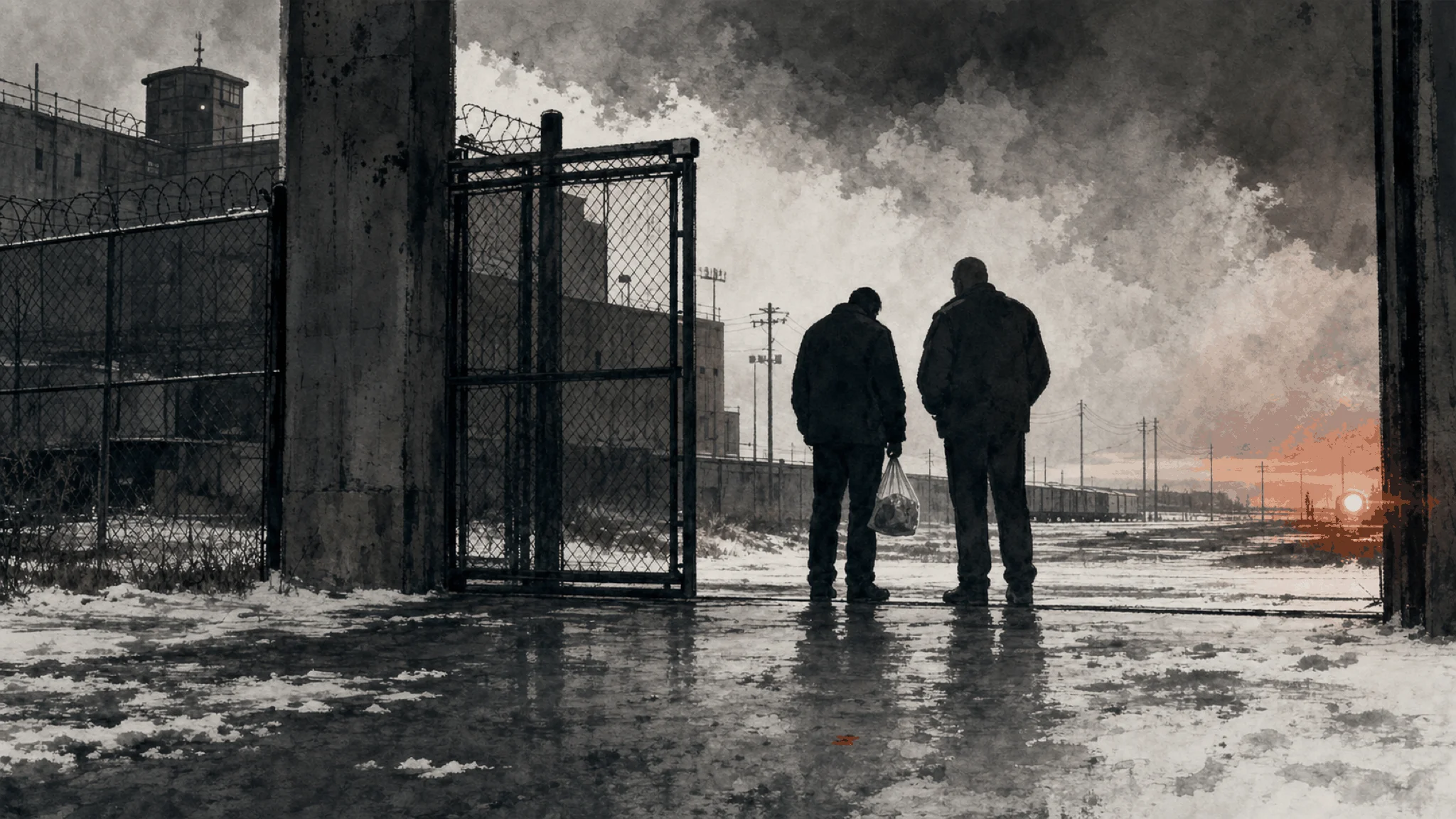
Frank’s capture cannot stop Anchor Bay from detonating
The trap at Eastern Avenue is staged with a patience that makes the violence feel less like an action beat than a bureaucratic appointment. Mike gives Ian Ferguson (Hugh Dillon) the address and tells him to bring Stevie, keep it quiet, and let Moses go inside. Ian and Stevie sit in the car, bickering about waiting, until Frank enters the house. They do not have the case yet. They need the act.
Frank gives it to them with theatrical rage. Lamar is bound and muffled while Frank talks about Detroit, power, and the humiliating fact that Kingstown has reduced him to a janitor cleaning up someone else’s mess. His speech about LJ is mournful in its own warped way. LJ was supposed to end his days by a fishing hole, cooking trout over an open fire. Instead, Frank is in a house with Lamar, naming loneliness as the real wound before the gunshots give Ian and Stevie their evidence.
Frank’s arrest should feel like the episode’s release valve. Ian orders his hands up, Stevie helps take him down, and Frank answers with biblical language, calling Satan and Judas inside. Evelyn recognizes the scale of the catch immediately. Frank Moses evaded Detroit police, state police, and the FBI for decades, then got tripped because a subordinate killed someone he loved. Mike tells her to take the victory, and for a moment the transaction appears complete. Kyle has signed. The judge is ready. Frank is in custody.
But Anchor Bay has been running its own countdown. Earlier, Warden Nina announces Deputy Warden Torres’s resignation and pulls Officer Breen aside over an excessive force complaint. Breen is put on restricted duty because an inmate ended up in the infirmary. He takes it as an insult, and the prison compounds that insult with petty logistics. He is sent to the armory, then ordered to Ad Seg with a mop after Terry makes a filthy spectacle of his cell.
The mop sequence is grotesque, but its purpose is clear. Breen, a violent officer already being investigated, is placed alone in front of inmates who know exactly how to humiliate him. They chant that he eats filth, laugh at him, and turn restricted duty into public degradation. None of that excuses what follows. It does explain how an institution built on contempt can keep staging the conditions for catastrophe while acting surprised by the result.
Breen’s shooting spree in Ad Seg is the hour’s most brutal answer to Mike’s bargain. While Evelyn, Mike, and the court machinery try to pull Kyle out through one legal door, another state employee starts opening cells and firing on trapped inmates. The episode does not give the massacre a neat dramatic shape. It is panic, screaming, locked doors, Breen repeating curses, and Cindy breathing hard after the final gunshot. The prison remains the central character because it can turn almost anyone inside it into an instrument of punishment.
What this episode argues
S4E9 argues that Kingstown does not separate private grief from public violence. Frank loses LJ and becomes the case Mike needs. Mike nearly loses Kyle and becomes willing to feed Frank the target. Breen loses status and turns his humiliation into slaughter. The city keeps converting wounded pride, family loyalty, and institutional failure into acts that can be filed, cleaned, prosecuted, or buried.
That is why the episode’s quietest triumph feels so unstable. Kyle walks through the door at Mike’s office, and Ian welcomes him home. For a few seconds, the room seems to understand the scale of that miracle. Kyle asks for a minute, Mike says he has to get home, and the men around him give him space. Then a shot cracks through the scene. The episode cuts with Kyle newly free and still under fire, which is a cruel cliffhanger but not a cheap one. Kingstown has never promised that leaving a cage means leaving the system that built it.
Verdict
Mayor of Kingstown S4E9 is a strong late-season hour because it lets Mike win the board and still lose control of the room. The Frank Moses trap has clean procedural momentum, but the episode’s real strength is the way it places that win beside Kyle’s collapse and Breen’s eruption inside Anchor Bay. The result is tense without feeling weightless.
There are moments where the dialogue announces the thesis with Sheridan bluntness, especially around Kingstown as a vortex that swallows everyone. Still, the performances keep the hour grounded. Mike’s exhaustion plays without softening his manipulation, Kyle’s silence sits heavy on the screen, and Ian’s stakeout pragmatism carries a grim pulse. This is not the season’s most elegant episode, but it is one of its most consequential.
Rating: 8.4/10
More episodes from Mayor of Kingstown — Season 4 — Mike vs. the cartel pipeline that's been quietly running through Kingstown. Jump to any episode in the season:
Where to go next
Reviewed by Mira Vance · QuizFandom Editor & Lead Reviewer. Every rating is an honest per-watch assessment from the desk that also writes the quizzes — not a press release rehash.