Pursuit of Jade Episode 2 Review: A Butcher's Saber, a Property Dispute, and the Marriage No One Believes Is Real
What happens — the short version (spoilers)
- Changyu reopens the family pork stall and outsells a rival, but her uncle Fan Daniu arrives with a gambling enforcer to claim the house under a male-heir law.
- She pulls down her father's long saber and uses a guard technique she was forbidden to show outsiders, driving the men off after they knock over the spirit tablets.
- Yan Zheng overhears her confess her grief to her parents' tablets, then shares that his own parents died in a war he won't name.
- Neighbors propose a live-in husband arrangement to legally protect the house; Changyu calls Yan Zheng 'a piece of jade found in the snow' that isn't hers to keep.
- She brings him pig liver soup at night and he agrees to marry into the family, sealing a bargain neither fully believes is real.
A domestic morning curdles into a property dispute, a spirit-tablet desecration, and a "live-in husband" proposal across a basin of washing water. Changyu picks up her father's saber, and Yan Zheng says yes to a marriage neither of them believes is real.
The opening hour belongs to the kitchen, not the sword
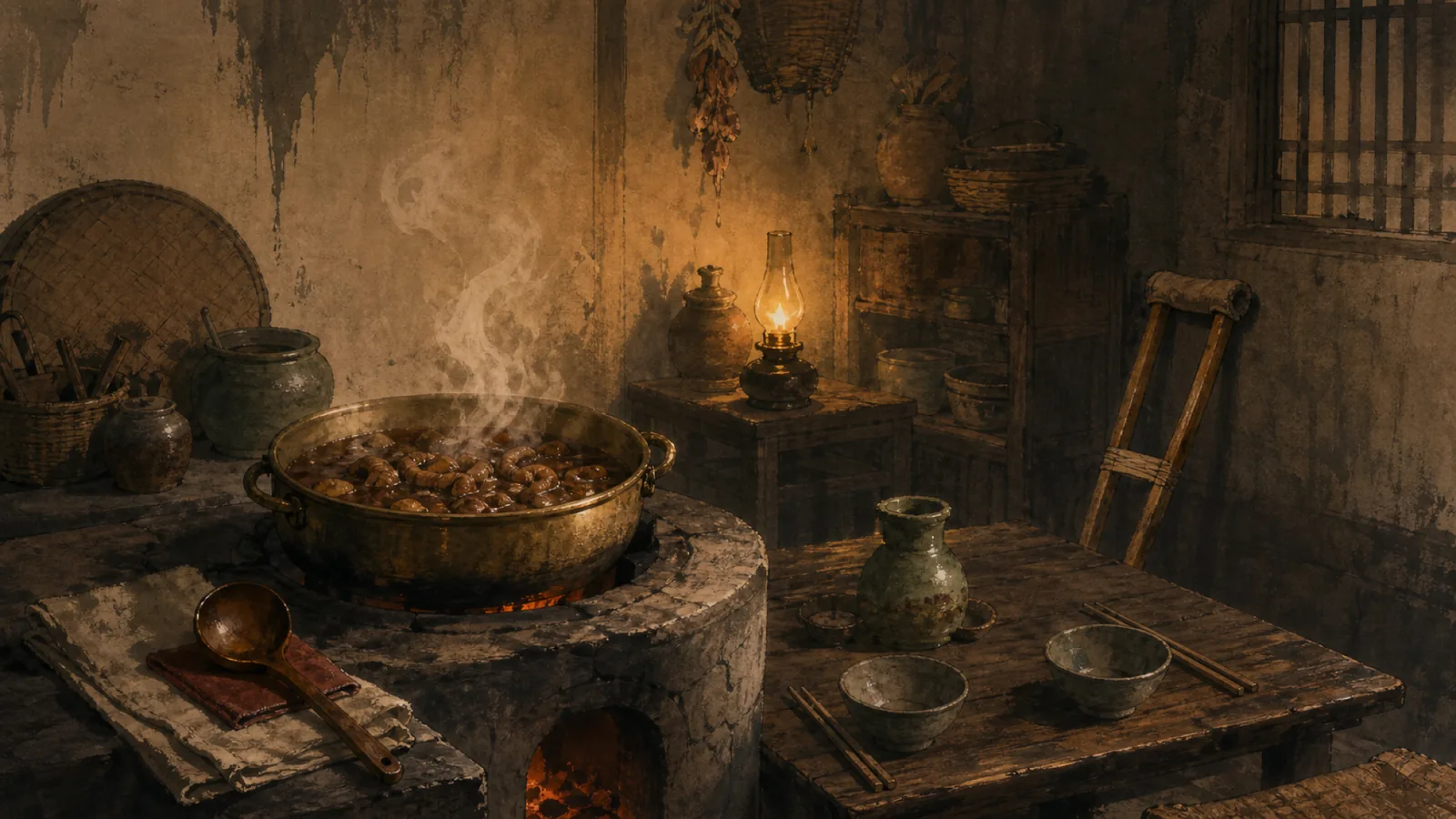
The episode begins with a smell. Fatty intestine noodles on a brass pot, Changyu wrist-deep in offal, Ning carrying word next door so Mrs. Zhao won’t fire up her own stove. The first three minutes are the small currency of a working-class courtyard — leftover bones, neighbors trading dinner, the rule that pork tails come tomorrow because there is only so much of a slaughtered pig to go around. This is the household Yan Zheng has been carried into, and its rules — generosity stretched thin, dignity protected by jokes — are the ones he will have to learn.
The asymmetry at the table is the thing. Changyu’s father was a convoy guard before he became a butcher; he taught both daughters a long-handled saber technique they were forbidden from showing outsiders. Yan Zheng is a wounded stranger from the snow, refusing to give a name beyond the one he invented. He cannot stomach the braised offal — says he’s full after a few bites. Changyu reads the lie, files it away, and brings him pig liver soup that night anyway. “This is the best I can provide.” Long before the marriage talk, these two are reading each other in frequencies the rest of the courtyard cannot pick up.
The same morning reopens the Fan family pork stall — a chess opening, not a montage. The discount (a jin of belly, an extra liang of offal free) is shrewd. Mr. Guo at the next stall bristles. The crowd backs Changyu up. What we are watching is the kind of survivor she is — not a victim with a sword, but a merchant with one. She reads the market, charges 18 mace to a flattered first customer, slaughtered her own pig at dawn. The beat lands on her stacking copper coins — two-seventy, two-eighty, two-ninety — when Mrs. Zhao bursts in to say her uncle has come for the title deed. She wins the morning so the afternoon can take it away.
The saber comes out, and so does the genre’s true engine
Uncle Fan Daniu has arrived with a gambling-den enforcer named Mr. Jin and four lackeys. The legal pretext is the Dayin Code: with no male heir, a deceased man’s property passes to the nearest male kin. Mrs. Zhao runs across the courtyard to bang on neighbor Song Yan’s door — and here the writer plants a beat with longer ambitions than this hour. Song Yan is Changyu’s former fiancé, the boy whose family broke the engagement after her parents died. His mother holds him in his study while a girl he once promised to marry is threatened next door, citing examinations, father’s spirit in the grave, the gossip that would attach if he intervened. He does not come out. Changyu will remember this longer than the script will.
When she walks in carrying her butcher’s cleaver, the room goes still. Mr. Jin tries the Dayin Code line. Changyu offers him the cleaver and explains, with a politeness so deliberate it reads as a threat, that one clean chop will sever everything and her uncle will suffer less. The bluff cracks. The lackeys lunge — and Changyu pulls down her father’s long-handled saber from above the spirit tablets, running through a sequence she was told never to show outsiders. The convoy-guard lineage is real, the technique is real, the daughter forced into the role of household pillar has held a weapon in reserve the whole time. Not a prodigy. A girl who trained for years and is using the training under conditions her father never intended.
Constable Wang arrives. The legal trap is still in place — Fan Daniu can file a petition tomorrow — but one of the lackeys has knocked over the parents’ spirit tablets in the fight. Desecrating ancestral memorials is twenty strokes by code. The gambling-den men apologize on their knees to two pieces of inscribed wood, hand over a satchel of silver, and shuffle out. The threat is paused, not solved. The petition lands like a second grave.
Two orphans, snow on a courtyard well
The quietest scene of the hour also carries the most weight. Changyu kneels at the spirit tablets to ask her father’s forgiveness for revealing the saber form, and Yan Zheng — who has slipped out of bed against medical advice — overhears the confession. Her mother died slowly enough to hand over a hairpin but not slowly enough to speak. Her father died on the spot, throat slit by mountain bandits on a guard route. He listens, and when she catches him, he gives her his family in return: his parents are gone too. They died in the war. He won’t say which war, and she doesn’t ask.
The exchange works because the script refuses to dramatize it. No swelling string cue, no close-up on tears. Both of them sit on the wooden step with snow on the eaves, comparing griefs the way two people competent in public all day finally allow themselves to in private. Changyu, who has just made a gambling-den enforcer apologize to her dead parents, ends the scene asking him not to tell anyone she cried. He hands her a clean strip of gauze. The fake-marriage trope only works if it starts from a real act of recognition, before either character knows it is one. The script positions it here, in the cold, before anyone has said the word husband.
“A piece of high-quality jade found in the snow”
The proposal scene is a comedy of indirection that turns serious in its last sixty seconds. Mrs. Zhao and her husband, briefed by Constable Wang, lay out the legal workaround: a live-in husband taken into the Fan family secures the household as Changyu’s dowry and blocks the uncle’s petition. Mrs. Zhao sells Yan Zheng — handsome, no travel papers, readily available — while Changyu protests that taking in a man she just saved would be holding past kindness over him. The phrase is the show’s moral compass for the premise.
Then Changyu gives Mrs. Zhao the image everything else in the scene has been building toward.
“Yan Zheng is like a piece of high-quality jade I found in the snow. Beautiful, smooth, valuable. But it’s not mine. Even if I carve Fan Changyu on it, he is not mine.”
The line names the title. Zhú Yù — the pursuit of jade — is framed here not as acquisition but as borrowing. Changyu understands, before anyone else does, that whoever Yan Zheng really is has owners elsewhere. Jade carved with a name still belongs to whoever carved it second. She is asking the older woman to let her not steal him. Mrs. Zhao’s reply — “Carve your name on it and keep it. When someone comes to claim it, we’ll return it” — sets the tonal contract for the next stretch of the arc.
The closing scene is small enough to fit on a tray. Changyu brings the pig liver soup at night, telling Yan Zheng to drink it as if it were medicine. In rehearsal, she gets as far as “I’m just here to ask”; in the real room, she only manages the soup before turning to leave. He calls her back. He says yes. He has to clarify, because she’s not catching it: yes to marrying into the family. The proposal is so undramatic it slides past her first.
What she gives him in reply is the line the whole episode has been waiting for. “If you stay, I’ll slaughter pigs to feed you.” The same vow she made to her sister at dinner the night before, repeated now to a stranger. It lands the way a contract lands when the signatory doesn’t yet know what they’ve signed. We cut to black before either of them can name what else has been signed.
Tiny details worth clocking
- Song Yan, the ex-fiancé who would not open a door, is the show’s first marked betrayal. The script lingers on his name; we will see it again.
- The Dayin Code citation is treated with full faith — property law doing real plot work, not set dressing, and the live-in husband arrangement is a documented Tang-era workaround.
- Changyu pawned her mother’s silver hairpin — the one her dying mother pressed into her hand — to keep feeding the wounded stranger. She never says it out loud.
- The spirit tablets of Meng Lihua and Fan Erniu anchor two scenes: the saber-form confession and the gambling-den apology. The household altar is the hour’s pivot point.
- Yan Zheng overhearing Changyu’s confession seeds every secret the back half of the arc will pay off. He has heard her mother’s real name, her parents’ real fates, her real grief. She still doesn’t know his.
Verdict
Episode 2 is the kind of slow-burn hour the genre is built for: every beat is positioned to land twenty hours from now. The kitchen establishes the household’s fragile economy. The market establishes Changyu’s competence. The saber establishes her lineage. The spirit-tablet scene establishes the law. The jade-in-the-snow speech sets the moral terms of the marriage. The soup scene establishes the contract neither of them has read the fine print on. Almost nothing has happened, and almost everything has been planted.
What the hour also signals is that the writer trusts the audience to wait. No third-act swordfight, no betrayal reveal — just a girl who held off a debt collector with her father’s saber and now has to feed a man who doesn’t like offal. The next stretch will pay off everything seeded here in cascade, but only if the show keeps faith with this kind of patience. So far, it does.
Rating: 8.3/10
More episodes from Pursuit of Jade — A fallen marquis, a butcher's blade, a war for love. Jump to any episode in the season:
Where to go next
Reviewed by Mira Vance · QuizFandom Editor & Lead Reviewer. Every rating is an honest per-watch assessment from the desk that also writes the quizzes — not a press release rehash.