Pursuit of Jade Episode 13 Review: The Day a Borrowed Husband Becomes a Price Tag
What happens — the short version (spoilers)
- Qian borrows Yan Zheng for an afternoon at Yixiang; he names a two-hundred-thousand-dan grain figure that identifies him to Qi.
- Qi reports to Prince Changxin, who recognizes the 'dead man walking' is Marquis Wu'an Xie Zheng and decides to recruit him.
- Over a flask, Changyu tells Qian she knows Yan Zheng will leave her one day.
- On New Year's Eve, Yan Zheng paints couplets and recites a verse about a graceful one, landing the romance across a writing table.
- The Grand Princess refuses her arranged marriage to Li Huai'an, declaring she is not a piece on her mother's board.
A friend's request to "borrow" Yan Zheng for one afternoon brings the fake marriage into public view — and into the wrong man's line of sight. The hour pivots from rom-com toward court chess opening.
The favor that drags the contract into daylight
The cold open is sustained farce on a tight comic clock. Qian wants Yan Zheng for one afternoon — to play husband at Yixiang Restaurant and scare off Mr. Qi, the rice merchant from the capital with a buyer’s appetite for the building. Mrs. Zhao’s outrage lands the social register in one line: Borrowing will not do! The lane wives have absorbed the marriage as fact, and the request reads to them as a category error. Changyu’s needling — How much did you sell me for? — is the second register, the wife who is allowed to be jealous because the village has decided she is one. Both registers operate on a marriage neither half has consummated. The script is careful with the price. Thirty taels. The number is recycled from batch 1’s brocade-box visit, when a Jizhou stranger left thirty taels on the Fan table for a story that has not yet detonated. Money in this show is always a marker for something else.
What the cold open really sets up is the registration problem. Yan Zheng has spent twelve episodes hiding behind the name a butcher’s daughter gave him. The favor moves him into a public room with a stranger from the capital who deals in grain at scale. Yu Qianqian tells him at the restaurant that he could pass for a marquis. Two scenes later, the man across the table will know exactly which marquis.
The Tianzi room scene is shot like a duel and written like a contract negotiation. Yan Zheng opens with geography — why has a capital merchant come to Lin’an to deal in grain — and Qi turns the same question back before asking what scale of trade he can manage; Yan Zheng escalates with the figure: two hundred thousand dan. The figure is specific enough to identify him to anyone close to the Prince Changxin operation. Qi sets the cup down without throwing it. The ambush in the corridor never fires. The recognition happens in silence, and the silence is what costs the most.
“I just met a dead man walking”
The capital-side scene is the counterweight, and it announces that batch 2’s project is the political clock. Prince Changxin reads Qi’s report and grins without warmth. The diagnosis is precise: Marquis Wu’an, Xie Zheng. His uncle — Wei Yan, the Chancellor who staged the Jinzhou massacre sixteen years ago — set the field by hiring bandits to rob the military grain and drive refugees into Lin’an. The plan presumed Xie Zheng dead. He is not, and he already knows the grain figure.
What this hour adds is a third faction. Prince Changxin is not on Wei Yan’s side and not on Xie Zheng’s side. He is playing the gap. The rift between uncle and nephew is beyond repair. The Marquis is lost and adrift in such a village. This is the moment to win him over. The Crown Prince seal goes to a runner. Vengeance is not the only motive on this board — there is also a son who would rather burn the house than be passed over inside it, since Wei Yan never intended him for the title of heir.
Wei Yan’s residence picks up the thread minutes later. The Chancellor learns that the Jinzhou leak started from Prince Changxin’s household. The Sui clan is undermining my plans. He dispatches a hold-Lucheng order to He Jingyuan, the Jizhou governor renting the house across from Changyu under a false name. The three boards are now connected.
The drinking scene Qian was waiting to have
Between the political beats, the hour gives Qian and Changyu an afternoon and a flask. The scene is structured like a wife-to-wife consultation but it is doing the work of a soliloquy. Qian asks straight: are you satisfied with your husband. Changyu names Yan Zheng solid gold, pure and true — a butcher-daughter’s metaphor delivered without irony — and the older friend extracts the part that has been waiting under the rest of it.
I know he will leave one day.
Six words that change the slow-burn calculus of the whole batch. Changyu has tested the question more than once and Yan Zheng has not changed his answer. The proverb Qian offers in return — if you want the cub, you must first feed the wolf — gets rejected and remembered. The script recycles it as the drunken closing line of the hour, mumbled toward a husband who has just been recruited by a Crown Prince. The wolf is being fed. The cub is the question. What lifts the scene above its plot function is how it lets Changyu name her own grief while it is still hypothetical — and Qian, who has spent the morning being protected by Yan Zheng from her own overbearing patron, is the only person in Lin’an who can hold the sentence without flinching.
The Spring couplets and a man choosing the words for his audience of one
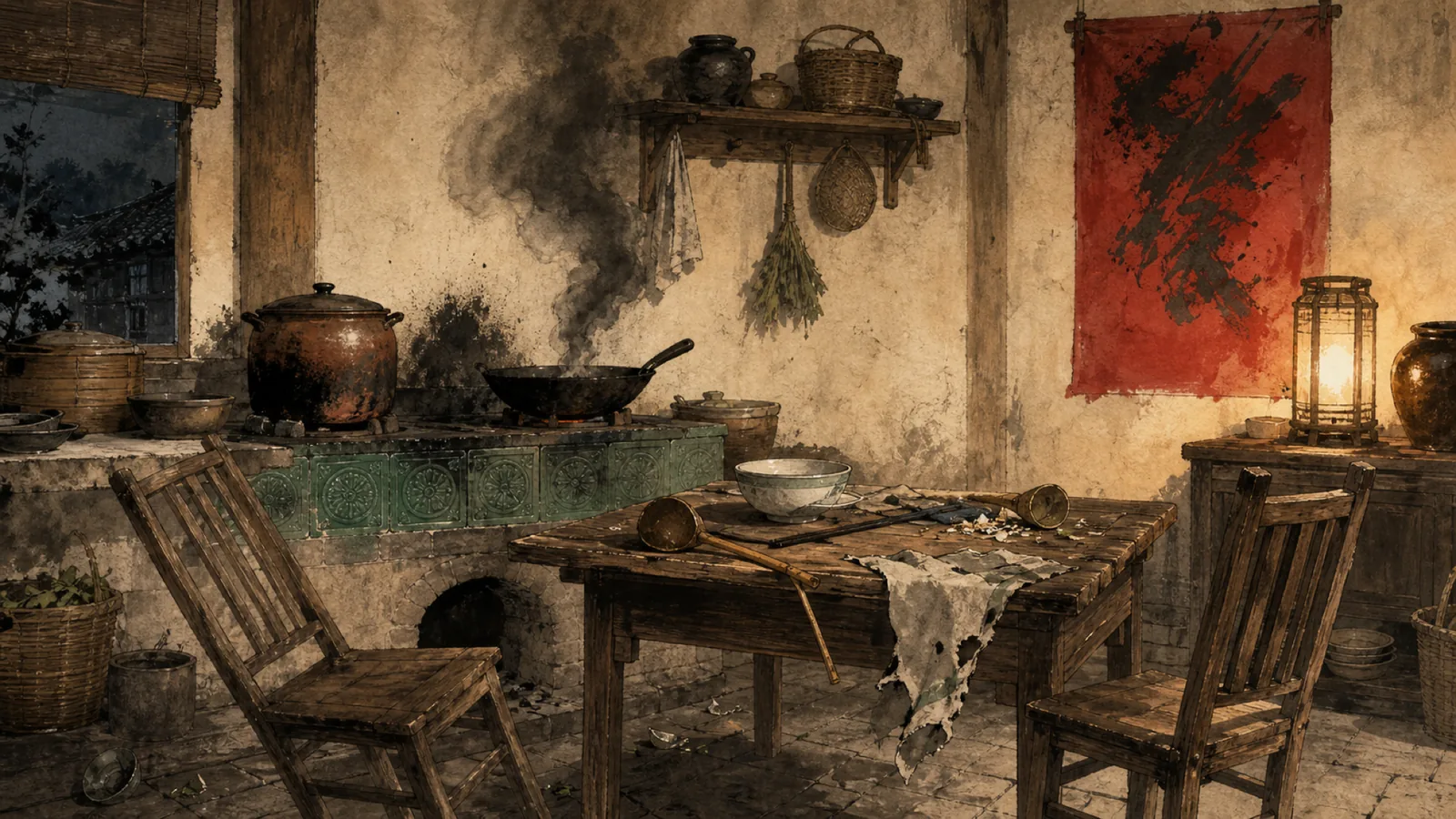
The New Year’s Eve middle stretch is a long set-piece around the writing table, and it carries the heart of the episode. Yan Zheng paints couplets with Changning gripping the brush beside him. The first pair he writes turns the season into weather rather than blessing — Ice melts, the springs pulse. Snow clears, young grass rises. Changyu watches him replace the village’s recycled wishes with something that sounds like a man who has noticed where he is.
The ink splashes. The line that survives the spill is the line that matters. Yan Zheng recites the Book of Songs fragment: When storms darken the sky, the rooster still crows. Having seen the graceful one, how could I not rejoice. The narration that follows is Changyu’s, addressed to the audience as a confidence — the courtyard going quiet, the snow softening, a shaft of light landing squarely on her in the middle of winter. The hour places its emotional load not on a kiss but on a recitation across a writing table, and the slow-burn pays in the camera’s patience.
The neighbors come asking for couplets after that. Yan Zheng writes for Mrs. Kang the line she does not request out loud. She asks for no more fighting, leave my family a bloodline to carry on, let my two grandsons grow up safe and sound — a grandmother’s plain prayer in the year the empire is conscripting eighteen-year-olds for the Lucheng front. The lane wife who once spread the jinx rumor in batch 1 sits across from a marquis writing her a private blessing without knowing his name.
The princess scene that names the third board
Tucked between the village beats, the palace gives the hour its third pole. The Grand Princess receives her mother’s verdict on the Lantern Festival arrangement: she will meet Li Huai’an, the marriage will proceed. She refuses on a line that names her own status as a piece: I am not a piece on your board. Her exit sarcasm — asking her nanny whether she would care to join her in hanging herself — reminds the audience that the women of this story share one architecture even when the costumes diverge. The Lin’an butcher’s daughter and the Grand Princess are both being arranged. Neither has consented. The princess was once betrothed to Marquis Wu’an before he was reported dead, but the unfinished chess game points toward a Gongsun attachment her mother wants severed. The audience knows Marquis Wu’an is alive in a butcher’s courtyard. The princess does not.
Tiny details worth clocking
- Qi tells his master he met a dead man walking. The first explicit acknowledgment, from inside the capital faction, that Marquis Wu’an’s survival is circulating among enemies. Hidden-identity expires the moment a third party speaks the name out loud.
- Prince Changxin’s recruitment offer escalates from grain to land: the four prefectures of the northwest will be my reward to him. The wager has been raised to four provinces.
- The Crown Prince seal — Treasure Seal of Chengde — is the title Prince Changxin’s faction claims as the rightful succession Wei Yan stole sixteen years ago.
- Changning’s calligraphy debut produces Certainly Rich as the horizontal scroll. Yan Zheng accepts it with adding a dog’s tail to a sable coat — a polite scholarly idiom for an unworthy addendum — and Ning hears it as praise.
- The closing image is Changyu drunk at the table, mumbling if you won’t feed the wolf, you won’t catch the cub. Yan Zheng asks her what cub. The hour ends on a question he has just been offered the resources to answer in ways that will take her out of reach.
Verdict
Episode 13 is the hinge hour. The fake-marriage-to-real-love thread gets its public-assumption beat — neighbors queueing for the marquis’s couplets, a wife jealous of a borrowed afternoon, a New Year’s Eve toast — and at the same hour the hidden-identity thread becomes a multi-faction problem. Prince Changxin enters the board as a third pole. Wei Yan tightens his grip on Lucheng. He Jingyuan camps across the alley. A Crown Prince seal and two hundred thousand dan of grain land inside the same twenty-four hours as a couplet about storms and a graceful one. Both clocks now run.
What keeps the hour from being merely plot-busy is how it lets Changyu name the end of her own marriage out loud in the afternoon, then write a couplet under it at night. The drinking scene supplies the emotional thesis the rest of the batch will pull against. I know he will leave one day. The hour does not pretend otherwise. It only asks how much living the leads can do in the time before the political clock catches them.
Rating: 8.6/10
More episodes from Pursuit of Jade — A fallen marquis, a butcher's blade, a war for love. Jump to any episode in the season:
Where to go next
Reviewed by Mira Vance · QuizFandom Editor & Lead Reviewer. Every rating is an honest per-watch assessment from the desk that also writes the quizzes — not a press release rehash.