Pursuit of Jade Episode 39 Review: The Real Traitor Is Named in Act One, and Unnamed Again by Act Three
What happens — the short version (spoilers)
- Changyu reads Consort Qi's letter and produces the candy box that hid it; Wei Yan is condemned and ordered seized.
- Sui Yuanhuai breaks the palace gate; a terrified Qi Sheng tries to hand him the imperial seal before Xie Zheng arrives and exposes Qi Min for colluding with the Northern Jue.
- Wei Xuan takes an arrow meant for Xie Zheng and dies naming Wei Yan as not his real father, who nonetheless saved his mother.
- Lady Wei reveals Wei Yan married her to protect her and raised another man's son for two decades.
- The Empress Dowager testifies that the late emperor murdered Consort Qi on a fabricated pregnancy charge and handed Wei Yan the chancellorship.
- A flashback reveals Wei Yan took the Jinzhou blame to keep the Crown Prince's treasonous drunken words from reaching the late emperor; Sui Yuanhuai dies falling while still gripping Qianqian's wrist.
Wei Yan is exposed as the architect of Jinzhou in the cold open, and the rest of the hour systematically pulls that conviction apart. The episode names the wrong man, kills the wrong heir, and finally walks the audience into a prison cell where a chancellor sits over a Go board and is asked why he has been losing on purpose for eighteen years.
A candy box, a forged tally, and a verdict that won’t hold
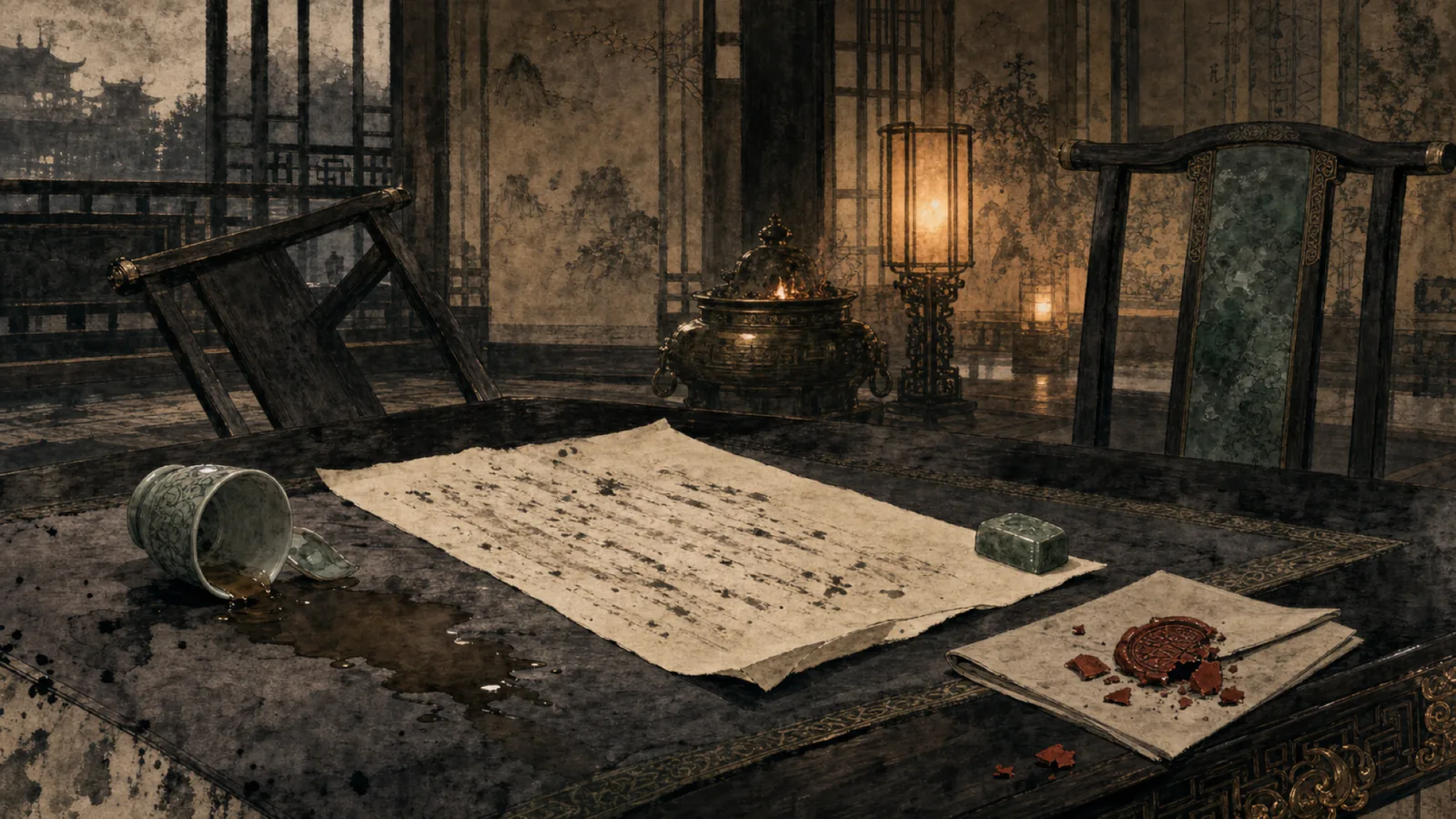
The cold open is the spine of the season delivered in two pages of dialogue. Changyu reads Consort Qi’s letter aloud in front of the court — Father and brother are trapped, yet I am confined in the palace. I beg your aid — and produces the candy box her mother hid it inside for seventeen years. A thief crying thief. The chancellor who has run the empire since Jinzhou fell is named in the same room he has ruled.
Grand Tutor Tao, the Minister of Works, authenticates the tiger tallies — the same forged tallies that ordered Wei Qilin to hold Jinzhou alone seventeen years ago. The Ministry of War’s archives have been burned, but the man who supervised the forging is alive, and he is one Qi Sheng has trusted to keep the records straight. The catastrophe is verified by a witness the chancellor chose.
What is striking is how short the section is. The script burns the revelation in seven minutes — Your crime deserves death. Seize him — because the writers have a different argument to make for the rest of the episode, and the public version of the truth needs to be on the floor first to dismantle later. Wei Yan’s rebuttal — and you think that’s enough to smear me? — does not deny the affair. It does not deny abandoning Jinzhou. By hour’s end, that distinction will turn out to be what the script was holding back.
Sui Yuanhuai breaks the Dayin Gate before the sentence can be carried out, and the hour pivots.
Two heirs, two false names, one Go board
The throne room is the cleanest mirror beat the show has staged. Sui Yuanhuai walks in, banners up — Welcoming the true master back to the palace — and finds Qi Sheng already off the throne, holding the imperial seal out in trembling hands. It’s all yours. The puppet ruler has been so frightened by one hour of rebellion that he is begging to be relieved of office. Being emperor is too hard. The line is grotesque and pitiable in the same breath, and the show lets it sit.
Then the script flips again. Xie Zheng arrives with the Jizhou army at his back, and the unmasking is not the chancellor’s. Qi Min, you secretly colluded with the Northern Jue, intending to use this chance to bring down Dayin. The heir who watched his father die at Jinzhou has sold Dayin land to barbarians to fund his own coronation. I’m merely finishing what Wei Yan left undone. His legitimacy collapses on the same evidence as the chancellor’s: a man supposed to defend the northern border traded it for a personal goal.
Yu Qianqian’s verdict on him is the speech the show has been holding for ten hours. You’re selfish, brutal, and moody. It’s all just an act. You’re only hiding your own fear. It is verbatim the diagnosis the Grand Princess delivered to him in E29, and Qianqian arrives at it independently from the other side of the abduction. That’s not love. It’s possessiveness. It’s control. I just want to leave you forever. Two women have now said the same sentence to him in two separate rooms. The script will not allow him a romantic reading of his own crimes.
The most surprising beat is who takes the arrow for the marquis. Wei Xuan, the chancellor’s son — impeached in E34 — steps into the attack and takes an arrow for Xie Zheng. I took this one to repay you for saving my mother. He dies with his last sentence aimed at the chancellor: You are not my father, you bastard. Two truths land at once. Wei Yan is not the boy’s biological father, and Wei Yan did, in fact, save his mother. The villain the cold open convicted has just been remembered by his son as the man who pulled his pregnant mother back from a pig-cage drowning.
The aunt’s confession and the empress dowager’s accounting
Three days later, Xie Zheng receives Lady Wei in the marquis’s hall — the aunt who married into the chancellor’s house — and she kneels to plead for Wei Yan’s life. Xuan’s father was one of the Chancellor’s men. He died on the battlefield. My family wanted to drag me back and drown me in a pig cage. The Chancellor saved me. He took a pregnant subordinate’s widow as his wife on a public marriage that protected her from her own clan, and raised another man’s son under his surname for two decades. The hour’s villain is reframed twice in one minute: not the boy’s father, not a betrayer of either wife or subordinate.
Changyu asks the aunt the question the audience is asking. Did he never marry because of Imperial Consort Qi? The aunt does not know. The Chancellor’s heart runs deep. The dialogue does not exonerate Wei Yan of Consort Qi. It leaves the affair open and gives the answer to a different witness.
The empress dowager is the witness. The mid-autumn banquet was the night Wei Yan got drunk and forced himself on a palace maid — the late emperor saw it, could not afford a scandal, and gave the maid to Wei Yan to cover the offense. Three months later, Consort Qi was discovered pregnant. The imperial physician’s records did not match. The royal house interrogated her, found the timing did not work, and burned Qingyuan Palace down with her inside it. The fire reeked of tung oil. The physician who examined Qi left a suicide note: Consort Qi had never been pregnant at all.
So the seventeen-year frame has two layers. Wei Yan raped a palace maid. He did not father an imperial child. He did not seduce Consort Qi. The late emperor murdered her on a fabricated pregnancy charge his own crown princess engineered, then handed Wei Yan the chancellorship and the political problem of an empty throne. The empress dowager delivers it across one unbroken monologue from a sickbed, the room hushed, a single string holding under the speech. It is the kind of restraint the late stages of the show have been criticized for not finding consistently, and finding it here matters.
The hour closes in the prison. Xie Zheng arrives at Wei Yan’s cell with a Go set. It was the late Emperor who set the trap. So why did you take the blame all these years? Wei Yan does not answer in dialogue. The hour cuts to the New Year’s banquet at the Eastern Palace, eighteen years ago. Wei Qilin is there. He Jingyuan is there. The young Crown Prince Chengde — Qi Yuan — is drunk on his grievance about his father’s favoritism toward the Jia family. If the Emperor lacks virtue, let him abdicate, then. Wei Qilin heard it. He Jingyuan heard it. Wei Yan heard it. The seed of the Jinzhou catastrophe was a sentence spoken at a winter banquet by the heir who later died because he could not unsay it.
Wei Yan rushed back from Jinzhou not for an affair but to keep that sentence from reaching the late emperor. He took the blame for the abandonment because the alternative was naming Crown Prince Chengde a treason suspect, and the late emperor would have killed every man at that banquet to suppress it. The chancellor absorbed the massacre, the loss of the twelve prefectures, his closest friend’s death, and the seventeen-year frame around Changyu’s surname, to protect the heir whose grandson is now offering him a Go board. Losing at Go isn’t hard. The line young Wei Yan once said at that banquet, to a Crown Prince who could not lose gracefully.
Tiny details worth clocking
- Changyu’s name was given to her by He Jingyuan, on Wei Qilin’s request, at that banquet. Long may we bask in grace’s light, where jade steps see spring grass bloom bright. The Tang couplet has been the show’s title for forty hours; the audience finally hears it spoken by the man who picked it, in front of the man it was picked from.
- Wei Yan’s line to Xie Zheng — Jiuheng, you haven’t let me down — uses the courtesy name Wei Qilin gave Xie Zheng as a child. The chancellor has not stopped naming him as Qilin’s nephew since Jinzhou.
- The Empress Dowager’s testimony names the late emperor — Qiyi — onscreen for the first time. The man at the top of the seventeen-year frame is given a name only after he has been identified as the architect.
- Sui Yuanhuai’s death is not a duel. He throws himself off the upper level still holding Qianqian’s wrist, and the last image is her hands. He’s never learnt to let go. The villain who built a whole abduction on the word mine is killed by his own grip.
Verdict
The hour does something unusually risky for a forty-episode period drama in its second-to-last week. It delivers the public version of the central reveal in the cold open, then spends the rest of the runtime arguing, with evidence, that the public version is wrong. The chancellor is not exonerated of every charge — the rape is named, not papered over — but the Jinzhou frame is dismantled, and the figure who has been read as the season’s villain is reclassified, in one monologue and one flashback, as the man who refused to name the truth aloud because the truth would have killed more people than the lie.
The cost is small. The Wei Xuan arrow beat happens fast enough that the death lands quieter than it should. A more patient finale-adjacent episode would have given the boy his own scene. The rest earns its patience. The prison-cell flashback to the osmanthus wine banquet is the closest thing this season has had to a clear argument. The argument is in the room. The man holding the Go pieces is the one who has been holding it for eighteen years.
Rating: 8.7/10
More episodes from Pursuit of Jade — A fallen marquis, a butcher's blade, a war for love. Jump to any episode in the season:
Where to go next
Reviewed by Mira Vance · QuizFandom Editor & Lead Reviewer. Every rating is an honest per-watch assessment from the desk that also writes the quizzes — not a press release rehash.