Pursuit of Jade Episode 17 Review: The Hour That Itemizes Love as Logistics
What happens — the short version (spoilers)
- Changyu packs Yan Zheng clothes, shoes, banknotes and a divorce letter needing only his thumbprint, releasing him on her terms; he reads it as the apology she can't say aloud.
- They nearly fight; he kisses her, she slaps him, he kisses her again, and he asks for one year because he has an enemy who must die or he will.
- Changyu tells him 'you saved me here, now you abandon me here' and watches him walk into the dark without signing the letter.
- Conscription officers sweep Xigu Alley, taking Mr. Zhao and others; a captain wrongly logs Changyu's husband Yan Zheng as swept up on the road.
- Wei Xuan reports to the capital that the Marquis lives; the Chancellor reluctantly schedules a celebration and his wife notes he finally has an heir back.
- Ms. Yu's caravan rolls south and Changyu refuses to leave, choosing to stay for Mrs. Zhao; she waits at the sealed gate for a husband already riding the other way as a marquis.
Changyu prepares the divorce kit — clothes, shoes, banknotes, a letter waiting for one thumbprint — and lets the man she has spent ten episodes warming to leave Lin'an on her terms. By morning the conscription officers arrive in Xigu Alley and rewrite whose name is on the road.
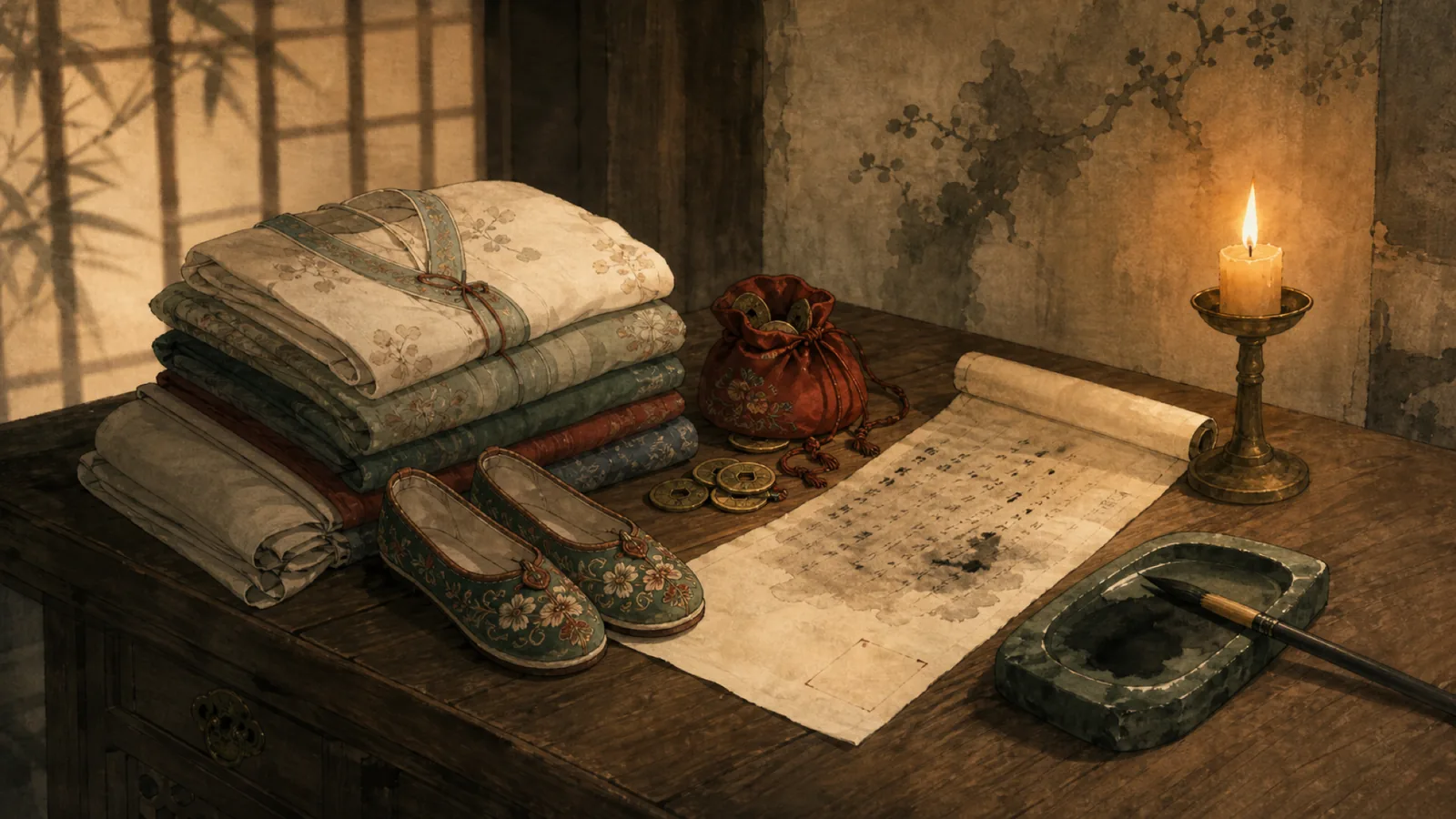
The bundle on the bed is a love confession in inventory form
The cold open is the whole hour in miniature. Yan Zheng is having a small wound dressed; Changyu has spent the night doing what a butcher’s daughter does when she cannot say what she means. She has packed for him. Clothes folded. Shoes paired. Banknotes — easier to carry on the road — and at the bottom of the stack, the divorce letter. Only the thumbprint is missing.
A woman who has been told her whole life that words are unreliable trusts objects, and the objects here are arranged like an apology she cannot make out loud. How thoughtful, he says, and the line lands like a slap because he can read the stack as easily as the audience can. The bundle says: I have already imagined you gone. I have already gone over the ledger. I will not be the one who keeps you.
What complicates the scene is the line she gives him next. That way, whatever you do later, you won’t be tied down. She is not asking him to stay. She is releasing him in the most thoroughly Tang-mercantile vocabulary she has — closure as paperwork, freedom as banknotes, severance as a clean room. The fake marriage that began as a butcher-stall property dispute is being unwound by the same archetype that started it: a woman who knows that a contract is the most honest thing two people can hold between them.
Yan Zheng does not match her register. He asks about her future husband, and the joke turns serrated. Someone refined. Well read. Smiles easily. He is naming Song Yan and they both know it. The next two minutes are the closest the show has come to a fight — he calls her cold and stubborn; he sketches his own future wife as a gentle, virtuous, household-running fantasy that does not exist.
Then he kisses her. Then she slaps him. Then he kisses her again and she lets him. The hidden-identity romance grammar tips for one unprotected second — I have an enemy. Either he dies or I do. Give me one year — and the audience hears the first time Yan Zheng has spoken to Changyu about the part of his life she does not yet have a name for. It is not a confession of who he is. It is a calendar.
“You saved me here. Now you abandon me here.” — the closure that arrives wrong
What lifts the opening sequence past romance-procedural is the line Changyu gives him after the kiss. She does not say it angrily. She says it the way you say something true that you have only just understood yourself. You saved me here. Now you abandon me here. I guess that’s closure.
The line collapses the whole c-drama vocabulary of the show — fallen-noble hiding in a butcher’s house, slow-burn fake-marriage-to-real-love, the courtyard well, the brass basin, the lamp-oil flicker on a wounded man’s face — into one geometry. He came in through the snow at the start of the series. He is leaving through the same gate. The space between is the marriage, and the marriage is now a closed shape with two doors and no contents.
Yan Zheng does not say he loves her. Changyu does not ask him to stay. The scene leaves the thumbprint unsigned and the divorce letter on the table because both people are old enough to know paperwork can wait if the man is dead in a year anyway. She watches him walk into the dark. The next time we see her she is sitting in a quiet house and saying out loud: When he was here, he barely spoke. Why does it feel so quiet now that he’s gone?
The conscription sweep, and the second wife left waiting in Xigu Alley
The hour’s second act is what makes E17 a structural turn rather than a domestic interlude. Conscription officers arrive in Xigu Alley with rope and a ledger. Jizhou is mobilizing. Mr. Zhao is taken. Jin Yuanbao and his men are taken. A grandmother throws herself at Madam Song’s robe and begs for her grandson Kang Dan, whose father already died at the front. Madam Song refuses, hands her a token of goodwill, and tells her to send the boy off proudly — that way he won’t shame the court. Her own son Song Yan, the bookish scholar, is exempt because the capital counts study as service.
The script lets the irony sit without underlining it. The refined scholar Changyu was teased about a few hours earlier is the one man on the lane who does not march. By the time Changyu returns home and the captain asks if her husband is named Yan Zheng, the script has arranged its trick — he must have been swept up on the road — and a Lin’an captain who has every reason to believe his own report walks away convinced he has solved the problem.
The audience knows the report is wrong. Yan Zheng never went near the conscription line. But the village does not, and the village now has a story about Changyu’s husband that will travel ahead of the truth. Yan Zheng. You’d better wait for me, she says at the sealed Lin’an gate, holding a bundle for a man who is already a marquis riding the other direction. The fake marriage has been resurrected by clerical error, and that is funnier and more painful than any speech she could have given him the night before.
The court scene, and the Chancellor who does not want a celebration
The Wei household pivot is the third hinge. Wei Xuan — the son who shot Xie Zheng with an arrow at the start of the season — arrives back at the capital to report the Marquis lives. The Chancellor receives the news the way he receives all news: by calculating what it costs. The court wants to celebrate. Seven days. Five days. Three days. The numbers shrink in real time as the Chancellor performs modesty for a throne wanting to perform generosity. Marquis Wu’an is young. His merits are modest.
The Grand Tutor does not let it pass. He is His Majesty’s marquis, not merely your nephew. The line draws the borders the rest of the hour will play within. Xie Zheng is alive, Xie Zheng is the Chancellor’s nephew, and Xie Zheng is the border commander who refused his uncle’s orders, drafted civilians, and launched an unauthorized assault on Chongzhou. The Chancellor is being asked to celebrate the survival of a man he tried to have killed.
The Chancellor’s lady receives Zheng’s survival in a small voice and names what the room is not supposed to say. At last, you have an heir. The line lands with a chill the Chancellor does not bother to soften. Whatever Wei Xuan came home expecting from his father, it was not the news that the cousin who replaced him is back.
Tiny details worth clocking
- The wrist guard scene at the Yixiang restaurant is the smallest beat in the hour. A village man tells Changyu leather wrist guards are for heavy labor, not for young ladies. The next scene — across the kingdom — is a map of Dayin on a war table. The script is doing register work in two adjacent rooms.
- The birthday inscription Yan Zheng leaves Changyu reads may you live long and worry-free. She murmurs that the characters are simple. Was he afraid I wouldn’t recognize them? The only direct sign in the hour she has been thinking about what a real husband would have written.
- Ms. Yu leaves Lin’an the next day. Her housekeeper turned up dead in the snow, merchants are fleeing south, and she offers to take Changyu and Ning with her. Changyu refuses. Mrs. Zhao only has me now. The village safety net is thinning in real time and Changyu chooses to be the last knot in it.
- The cricket Mr. Zhao carved for Ning before he was conscripted gets traded to Bao’er for a jade pendant. No one will make me crickets anymore. The child’s line carries the whole conscription sweep’s weight.
- The wound on Xie Zheng’s face in the Yanzhou command tent is a slap mark from a butcher’s daughter, and a subordinate identifies it correctly in three guesses. The Marquis Wu’an entrance the troops cheer for is a man trying not to wince while his lieutenant teases him about his wife.
Verdict
E17 is the hinge the rising-action act has been promising. The opening twenty minutes finally let Changyu and Yan Zheng fight with the vocabulary they have been holding back — banknotes, divorce paperwork, a kiss in a courtyard, the line give me one year — and the rest of the hour rearranges the board around the absence he leaves behind. Mr. Zhao boards the convoy with a horse Changyu bought from Blacksmith Chen, Ms. Yu’s caravan rolls south, Bao’er leaves Ning a pendant and carries off the cricket: Xigu Alley empties around Changyu, one familiar face at a time, and the script trusts the viewer to feel the gravity of the empty house without explaining it.
The Wei residence scene does the structural work the batch needs. Wei Xuan’s confrontation with his father — if I were Nezha, I’d return my flesh to you — is the first time the show has let the Wei family quarrel speak plainly, and the household’s final line about the heir confirms what the audience suspected: Wei Xuan has been a placeholder for the lost nephew for sixteen years and now the placeholder knows it. The closing image of Marquis Wu’an reviewing his Yanzhou troops while a divorce letter sits unsigned on a butcher’s table is the kind of two-clock split a c-drama lives for. The slap mark on his face has not faded.
Rating: 8.6/10
More episodes from Pursuit of Jade — A fallen marquis, a butcher's blade, a war for love. Jump to any episode in the season:
Where to go next
Reviewed by Mira Vance · QuizFandom Editor & Lead Reviewer. Every rating is an honest per-watch assessment from the desk that also writes the quizzes — not a press release rehash.