Pursuit of Jade Episode 36 Review: One Hundred and Eight Lashes Buy the Right to Speak a Wife's Name
What happens — the short version (spoilers)
- The Marquis returns in triumph through a handkerchief-throwing crowd, halting only beneath Changyu's ribbon.
- At the Xie family mausoleum Wei Yan demands he sever ties with Changyu; the Marquis instead takes one hundred and eight clan-law lashes to repay his upbringing and walk free of the debt.
- Still bloodied, the Marquis swears a wedding vow to Changyu before his parents' spirit tablets, and she recites it back.
- The Marquis dreams of his mother's suicide by hanging, the source of his grief tied to osmanthus cakes.
- A decoded message reveals Wei Yan once had an affair with Imperial Consort Qi Rongyin, the mother of the missing heir.
- Both factions lock down their own family members ahead of the palace banquet in three days.
Three days after the campaign, the Marquis returns in triumph and rides past a handkerchief-throwing crowd to a private mausoleum, where his uncle is waiting with a whip. Built around a single transaction — a beating paid in front of two spirit tablets, and a vow spoken into the smoke afterwards.
The triumphal return is staged so Changyu can see what she is not
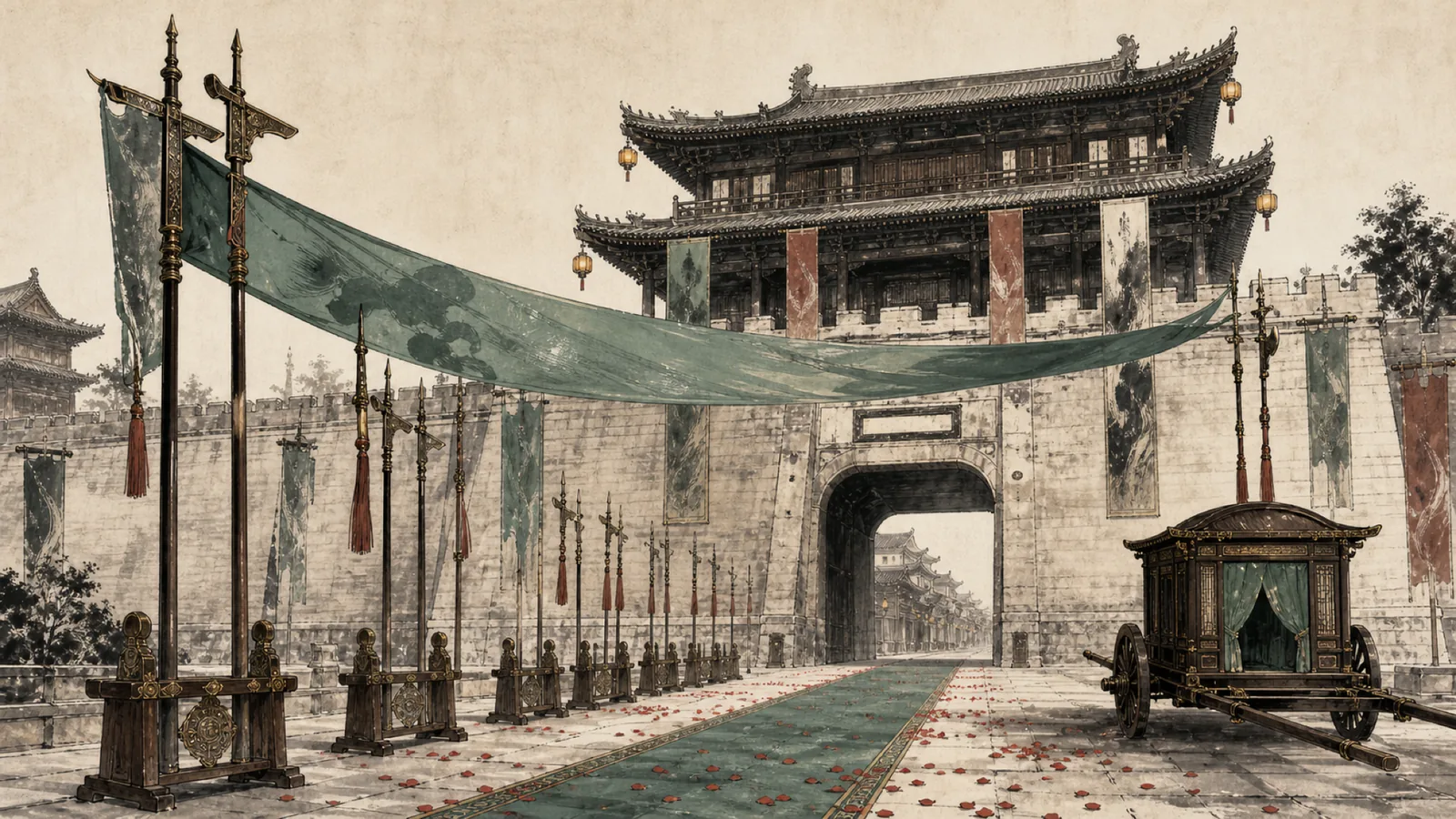
The cold open is a parade and a demotion in five minutes. Three days later. Yong’an Gate. Changyu stands in the crowd in plain clothes while Ning teases her about not being able to stay away. A throwaway cut places the political weather on the page. Song Yan of the Ministry of Rites was stripped of his post, sent back to his native place, and barred from future service. The Rites official who lobbied to formalize Wei Yan’s wedding plans is gone before the marquis has ridden through the gate. The chessboard is being cleared.
Then the parade. Handkerchiefs land in the dust; one girl threatens to knock him out with a rock and is wrestled down. The marquis rides through it without a flicker until he calls a halt beneath a single ribbon dangling from a tavern beam. The ribbon is Changyu’s. The crowd registers the halt and the gossip flips on a coin. Is that not the Flower-Adorned General? Our General Fan is every bit as formidable as any man. The same mouths that called her that pig butcher of yours a beat ago are upgrading her to a marquis’s match. An older onlooker names the hour’s second half. We just want to watch a good romance unfold between a hero and a beauty. The civilian voice is being allowed to recite the genre rule the script is about to walk over.
The cut to Heaven is unjust — Sui Yuanhuai watching from a tavern window, alone — closes the public movement. What the parade buys is permission. The capital has now seen Changyu as something other than a butcher’s daughter.
A mausoleum, an uncle’s whip, and the count to one hundred and eight
The center is one room. Xie Family Mausoleum. Wei Yan stands before the tablets on the anniversary of his sister’s death and admits he forgot the osmanthus cakes he prepared. The marquis arrives to confront him after the guards have been dismissed. Are you not afraid I might demand a blood debt from you? The chancellor’s answer is the season’s voice in his mouth. Your mother is watching us here. Why would I put you in a difficult spot here and disturb her peace? The negotiation that follows is staged in front of two name tablets — Lord Xie Linshan and Lady Wan. The moral leverage Wei Yan wields is the only one he has left.
The argument is the season’s central account, itemized. Seventeen years ago, when you recalled the troops and rushed back to the capital, did you ever consider that your reckless decision would cost my father and mother their lives? Wei Yan refuses the framing. I returned to the capital under imperial command to suppress a rebellion. The nephew offers the test. Then dare you swear a bitter oath before my parents’ tablets? The chancellor will not. He pivots to the contract of upbringing — I raised you for one reason only — and the marquis’s counter is the line the season has been earning. You merely forged a blade fit for your hand. You just never expected that blade would one day turn against you.
The trade is clean. The clan-law sentence — disloyalty and unfilial conduct merit 108 lashes — is proposed as the price of severing Changyu. The marquis takes it on different terms. Every lash today, I will take willingly. Let this repay what I owe you. But from this day forward, never again speak of raising me or debts of gratitude. He pays the debt to walk out of it. The whip starts.
The count is one of the longer single takes the season has spent on a body. Thirty-five. Thirty-six. Thirty-seven. While the numbers climb, the Family Precepts placard is shown overhead. By ninety-nine the marquis is silent. By one-hundred-and-eight he is still upright. Changyu reaches him after one-hundred-and-eight has already landed, so the scene makes the aftermath pay instead of staging her as the interruption.
When it ends, Wei Yan tries to invalidate her marriage on procedural grounds — a proper marriage requires a parents’ consent and a matchmaker’s word, the name used was false. The marquis pulls her in front of the spirit tablets and speaks his vow into the cold air of his family mausoleum. Fan Changyu, a woman of Lin’an. She saved me from death’s door. When my heart had gone cold, she taught it to love again. This woman is the companion of my life. I will never betray this vow. My heart will stay true till death. Changyu, who has never had a wedding rite in her life, recites the second half back to him. He says it. She says it back. Twice on the page, because a vow sworn at a grave is a contract, not a flourish. Wei Yan watches without intervening. He cannot disturb a vow sworn at his sister’s grave any more than he could swear a false oath at it. The whip bought the vow. The vow is the whip’s receipt.
The chess record from the palace and the imperial-consort affair
The third movement is two letters. Back at the Xie residence the marquis dreams of a child’s vigil at his mother’s hanging. Mother. No. Let me die. The osmanthus cakes were never about the cakes; they were about the day she could not be talked back from the rope. Changyu sits the night out beside him. In the morning she gives him what his uncle has refused for seventeen years. He raised you for 17 years. Now the debt is repaid. The vengeance must be taken. Do not punish yourself for others’ sins.
Then the falcon’s chess record. Mr. Gongsun has deciphered a message smuggled out by the maid witness Xie Zheng has been protecting, and one line surfaces. Wei Yan had an affair with an imperial consort. The flashbacks stage two letters addressed to Yan. The first is a courtship letter. The wedding rites are ready, and so are the gifts. Everything is in place now, except for you. The second is the goodbye, sent from inside the palace after an imperial summons. Bound by His Majesty’s command, I have no choice. The signature is Rongyin — and the card that lingers on screen reads Imperial Consort Qi Rongyin. The Crown Prince’s consort. The mother of the missing heir. The political marriage that produced the most exalted son under heaven Sui Yuanhuai claimed to be at the start of batch three. The chancellor lecturing his nephew about loyalty to family and country was, seventeen years ago, the man whose love letter was overtaken by an imperial decree on the eve of his wedding. The Jinzhou betrayal now has a motive signed in another hand entirely.
Grand Tutor Li’s closing beat tightens the noose on the other side. The old man has been pretending to be ill, and he now orders Wei Wenkan confined before the banquet. Take my dear brother into custody. The palace banquet is in three days. Both factions have locked their own family members down.
Tiny details worth clocking
- The 108-lash punishment is clan law — administered by Wei Yan in his role as the marquis’s maternal uncle. The chancellor is also, legally, the closest blood the Xie line has left. The body he is whipping is the one he raised.
- Qi is the imperial surname. An affair with Consort Qi Rongyin, if proven, would constitute treason at a level Wei Yan’s chancellorship cannot survive.
- The sickening scent of osmanthus and the hem of my mother’s dress hanging from the beam — the hour’s first explicit confirmation of how Lady Wan died.
- Sui Yuanhuai’s bedchamber scene gives the season its most transactional moment of villainy. Become my Empress. Yu Qianqian’s read is brutal and correct. All you want is someone at your side, so that when your dream shatters, you will not be alone. The object she has before he demands it back is a tiger tally she is not yet supposed to know exists.
- Wei Yan rehearses his alibi at the tomb — I returned to the capital under imperial command — and refuses to swear it out loud before his sister’s tablet. The refusal is the answer.
Verdict
This is the episode the season has been holding for the back half. The 108-lash sequence is the kind of long-form physical setpiece that a slower-paced costume drama can earn and a streaming-era pace usually cannot, and the run earns it by refusing to let the beating mean only one thing. It is a clan-law sentence, a financial settlement on seventeen years of upbringing, a price tag on the right to swear a wedding vow at a private grave, and — once the whip stops — the receipt the marquis hands his wife so she can stop being a borrowed name. The vow that follows works because the body is already broken when the words come out. He is paying for the line before he says it.
Where the run stumbles, it stumbles in connective tissue. The triumphal-parade sequence runs three minutes too long, and the gossip-mob switcheroo from pig butcher to Flower-Adorned General is staged a little too neatly. The Sui Yuanhuai empress-headdress scene is a holding pattern. And the chess-record reveal is delivered as a piece of paper Gongsun decoded offscreen — a the strategist already did the work shortcut on a beat the season has spent thirty hours building toward. The reveal lands because the calligraphy and the title card sell it, not because we watched the discovery happen. Real concessions to pace. But the mausoleum vow is the kind of scene a forty-episode drama exists to produce. The weight is earned.
Rating: 8.6/10
More episodes from Pursuit of Jade — A fallen marquis, a butcher's blade, a war for love. Jump to any episode in the season:
Where to go next
Reviewed by Mira Vance · QuizFandom Editor & Lead Reviewer. Every rating is an honest per-watch assessment from the desk that also writes the quizzes — not a press release rehash.