Pursuit of Jade Episode 16 Review: A Butcher's Daughter Walks Soup Into a Prince's Room
What happens — the short version (spoilers)
- Changyu plans to free Ms. Yu by kidnapping the magistrate; Yan Zheng instead explains the grain levy is a setup to provoke a suppression and frame the government for the unrest.
- At the magistrate's house, his daughter reveals a man calling himself Wei Xuan forced the requisition; Changyu refuses Song Yan as payment and demands Ms. Yu's release instead.
- Disguised as a maid, Changyu ties up the fake Wei Xuan (actually Prince Changxin's son Sui Yuanqing), threatens to bleed him like a New Year pig, and walks him out as a hostage; he forcibly kisses her cheek and vows to remember her.
- Yan Zheng and He Jingyuan's forces intercept the two hundred thousand dan of grain on the road and return it to the people.
- Fleeing through the snow, Sui Yuanqing duels a hooded rider, recognizes him as the supposedly dead Marquis Wu'an, then is swept into the river.
- Yan Zheng comes home and lies about a riverbank chase, protecting Changyu from the memory of the assault she has decided to bury alone; Lord Li privately calls the marriage cruel to her.
The grain levy was always the bait. Episode 16 lets Changyu carry a tray into a tiger's parlor while Yan Zheng intercepts two hundred thousand dan on the road and a prince two doors down learns the Marquis he buried sixteen years ago is back to count the cost.
The cold open names what the marriage is now
The hour skips any domestic scene. Yixiang Restaurant gets sealed, Ms. Yu is dragged to the yamen for a murder she didn’t commit, and Changyu’s first move is to tell Yan Zheng she will kidnap the magistrate to free her friend. In their private courtyard she lays out the plan the way she lays out cleavers on a butcher’s stall: take Ning and hide, if I’m captured take care of her. The butcher’s-daughter survivor archetype snaps into operational mode.
What Yan Zheng does next is where the hour turns. He does not argue the morality of kidnapping a magistrate. He argues the agenda. People with their own designs are using the grain levy to incite the villagers; Yixiang Restaurant is just the first stone; the setup is engineered to draw Jizhou troops into a suppression so the rumor — the government’s grain levy drove the people to rebel — will harden into recorded fact. He recites it like a man reading a familiar map. How do you know all this? she asks. I’ll tell you later. It is the closest he has come to confessing.
The marriage stops being a hiding place inside this exchange. He sends her to find Chief Constable Wang and seal the city gate. The butcher’s daughter will run political logistics for a hidden marquis. The fake-marriage-to-real-love trope is doing two jobs at once: she does not yet know who he is, and he is asking her to behave as if she did. The doorway beat closes with the only line where his voice softens. If you really can’t control the rioters, you must protect yourself. Then the door, then the cut — no embrace, no music swell.
The Pondering Pavilion sequence is the hour’s spine
The interior of the magistrate’s house is the show’s best-staged set piece to date. Magistrate Cui is hiding behind his daughter’s skirts; his daughter — the same girl who once fought Changyu over Song Yan — is rattled enough to open the door to the woman she used to bully. Her confession is a marvel of writing economy: a self-proclaimed Northwest Military Commissioner named Wei Xuan showed up with troops, took her father hostage, forced the silver-and-grain requisition, and Clerk Guo turned coat to save himself. It was him again, Changyu mutters. The clerk who watermarked the Ma Village massacre and the Yixiang frame-up is the same hand. The script is keeping its account books.
What lifts the scene above plot-mechanics is the trade. The magistrate’s daughter offers Song Yan — the bookish neighbor both girls once wanted — as payment for help. Changyu refuses with a flatness that is its own punchline: you keep Song Yan for yourself. The price she names instead is the release of Ms. Yu from the prison. Two women who spent half the batch fighting over a scholar settle the account in two lines.
Then the maid’s clothes go on. Changyu walks into Wei Xuan’s room carrying a soup tray. The general inside — who is actually Sui Yuanqing, eldest son of Prince Changxin, posing as Wei to engineer the rebellion — sees through the cover almost instantly. Wei Xuan is notorious for being brutal and lustful. No reason for him to suddenly become chaste. He lets the maid in anyway because he wants to see what she will do.
What she does is tie him up first, use the hostage position against his men, and walk him out under threat of death. I didn’t bring my butchering knives. Otherwise I’d show you how New Year’s pigs are bled. The season’s best one-liner because it is functional rather than ornamental — she is naming her tools so the man knows exactly what she would do with them. Sui Yuanqing, tied and disarmed, registers her face for a longer beat than the moment requires. I’ll remember you. You’d better not remember me. The kiss — hostage-style, his mouth pressed against her cheek as she binds him — sits inside this exchange and refuses to be played as romance. The script files it as an assault that Changyu does not narrate to her husband later. The audience watches her file it away. The hour is laying a debt that will be called in for several episodes.
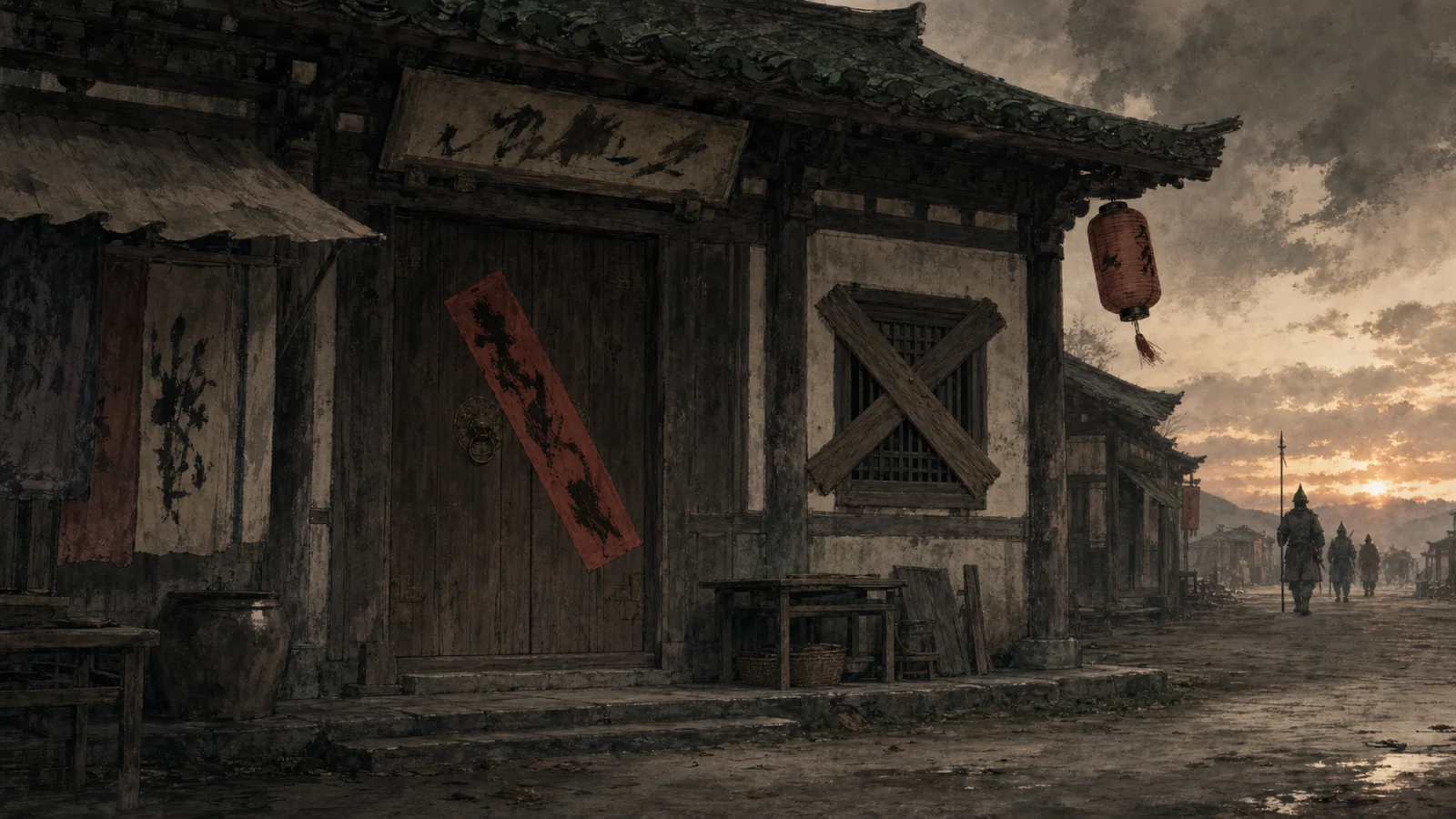
The city gate, the grain, and the prince who recognizes a ghost
The third act runs three parallel clocks. Yan Zheng works with Constable Wang to hold the city wall while the rioters pound the gate. The magistrate, pushed toward the tower after his daughter names Sui as the scapegoat, gives a wavering speech about returning the grain. The grain itself, loaded onto carts for Chongzhou, has been intercepted on the road by two coordinated forces: Xie Zheng’s Bloodclad Cavalry from one side, He Jingyuan’s Jizhou army from the other. Two hundred thousand dan, recaptured. Lord He arrives in time to bless the magistrate’s improvised lie and call Constable Wang a hero. The cover story holds for the village. The grain pours back to the people.
Then the move the batch has been promising since Episode 10. Sui Yuanqing, fleeing through the snowy woods, is overtaken by a single rider. The two men cross swords. The hood comes off. Marquis Wu’an, Sui says, the word catching in his throat. You’re actually not dead? Sixteen years of a state lie collapses in one shot. He does not kill Sui — the river takes the prince first — and the question of whether he survived the fall hangs in the room like smoke.
The taunt Sui throws before the duel is the one that earns the kiss-debt back. Who is that little maid on the tower to you? Her skin is so fair. The taste when kissing it was truly sweet. Xie Zheng’s expression does not change. The audience knows it should have. That line replays in Changyu’s kitchen later when Yan Zheng comes home late and lies about a chase along the bank. He is not protecting his cover here. He is protecting her from a memory she has decided to bury alone. The slow-burn vocabulary is now bilingual: each is hiding from the other, and each is doing it as a kindness.
The hour’s last gift is the snow-side conversation with the man who arrived calling himself Lord Li — He Jingyuan’s student, a Li-family grandson with his own ideals and a court grandfather entangled against the Wei faction. He asks Xie Zheng what his plans are for Mrs. Fan. You might see this marriage as expediency, but for Mrs. Fan, it’s a true heart wasted. It seems rather cruel. Xie Zheng answers with the only line the politics will let him: this is my family issue. The Li-family grandson has read the marriage more honestly than the marriage’s two participants have managed to say out loud.
Tiny details worth clocking
- Madam Song arrives at the magistrate’s door with shoe patterns and trinkets from her exam-bound son. The magistrate’s daughter refuses tea, sends her away, and the older woman curses her in the alley: just a magistrate’s daughter, does she really think my son will kneel? The script clears Song Yan’s marriage prospect with a comic vignette while the war-room scene preps one room over.
- They say turtles live for millennia. That bastard won’t turn into a turtle and live immortal, right? Changyu’s joke about Sui’s river fall is the tell. The character who would not need to ask is the one who needs the answer most. The script props her certainty on humor and lets the audience hear the wobble underneath.
- The duel’s sound design: no music. Just blades on blades, the breath, and the snow muffling everything else. Strings are being saved for another scene.
- I’m just following our Magistrate’s orders. Changyu’s cover phrase to the disarmed Sui Yuanqing is the working slogan of the hour — every player is doing damage on someone else’s authority and reserving the right to deny it tomorrow.
- Lord He’s last word to Magistrate Cui — all those who kept rioters outside the gate, each should be rewarded — is a quieter brocade box. He Jingyuan is buying loyalty in installments, and the local officials are signing receipts they do not yet know are receipts.
Verdict
Episode 16 is the structural turn the rising action has been building toward. Three threads — the village safety net, the political conspiracy, the hidden-identity marriage — collapse onto the same hour and force each character to act with information they were not supposed to have. Changyu walks soup into a prince’s room without knowing he is a prince. Xie Zheng intercepts two hundred thousand dan of enemy grain without telling his wife who he is. Sui Yuanqing names the Marquis the realm has been mourning, and the river decides whether the recognition survives. The discipline is in what gets withheld: the kiss never gets spoken between the spouses, the recognition never gets relayed back to Changyu, and the lie about a chase along the riverbank lands as the new working currency of the marriage.
The hour earns more than the surrounding setup episodes because it forces three reveals at once and lets none of them resolve. The Bloodclad Cavalry surfaces. Marquis Wu’an gets named to his face by an enemy. The fake marriage stops being a hiding place and becomes a base of operations. By the courtyard scene where Changyu asks if Yan Zheng is hurt and then says that villain fell into the river, two people are lying to each other for love and not yet daring to call it that. The batch’s slow burn now has a fuse, lit on both ends.
Rating: 8.7/10
More episodes from Pursuit of Jade — A fallen marquis, a butcher's blade, a war for love. Jump to any episode in the season:
Where to go next
Reviewed by Mira Vance · QuizFandom Editor & Lead Reviewer. Every rating is an honest per-watch assessment from the desk that also writes the quizzes — not a press release rehash.