Pursuit of Jade Episode 15 Review: Money Can Turn Even Ghosts Into Laborers
What happens — the short version (spoilers)
- At an inn, Changyu and Yan Zheng negotiate sharing one basin and one bed; his teacher pushes him to marry her, but Yan Zheng insists he wants to keep her wild and plans to leave anyway.
- At a noodle stall Yan Zheng pays a 21-wen bill with a silver ingot, and Changyu quietly clocks that he has far more money than a wandering scholar should.
- Grandfather, being starved by an unfilial aunt, reveals that Changyu's father was never his blood son; her parents paid to register under the Fan name and staged their own deaths to protect the girls.
- Changyu tells Yan Zheng she wants revenge 'even in my sleep' and declares her only path is money, since she can't take the exams as a man.
- In the capital, Wenkan is sent to the front to seize command from Wei Xuan; Yan Zheng walks a massacre site he says Wei Xuan didn't cause, reading it as Prince Changxin stirring rebellion.
- At Yixiang, a customer's death gets Qian framed; Changyu extracts a confession naming Clerk Guo, but bailiffs arrive and haul Qian away before she can act on it.
Episode 15 is where Changyu names her vengeance out loud and sets a price on it, where an old man finally tells her her own surname was a borrowed coat, and where Yan Zheng listens to a teacher tell him he is selfish for wanting to leave her wild.
The basin, the bed, and the small ledger of class
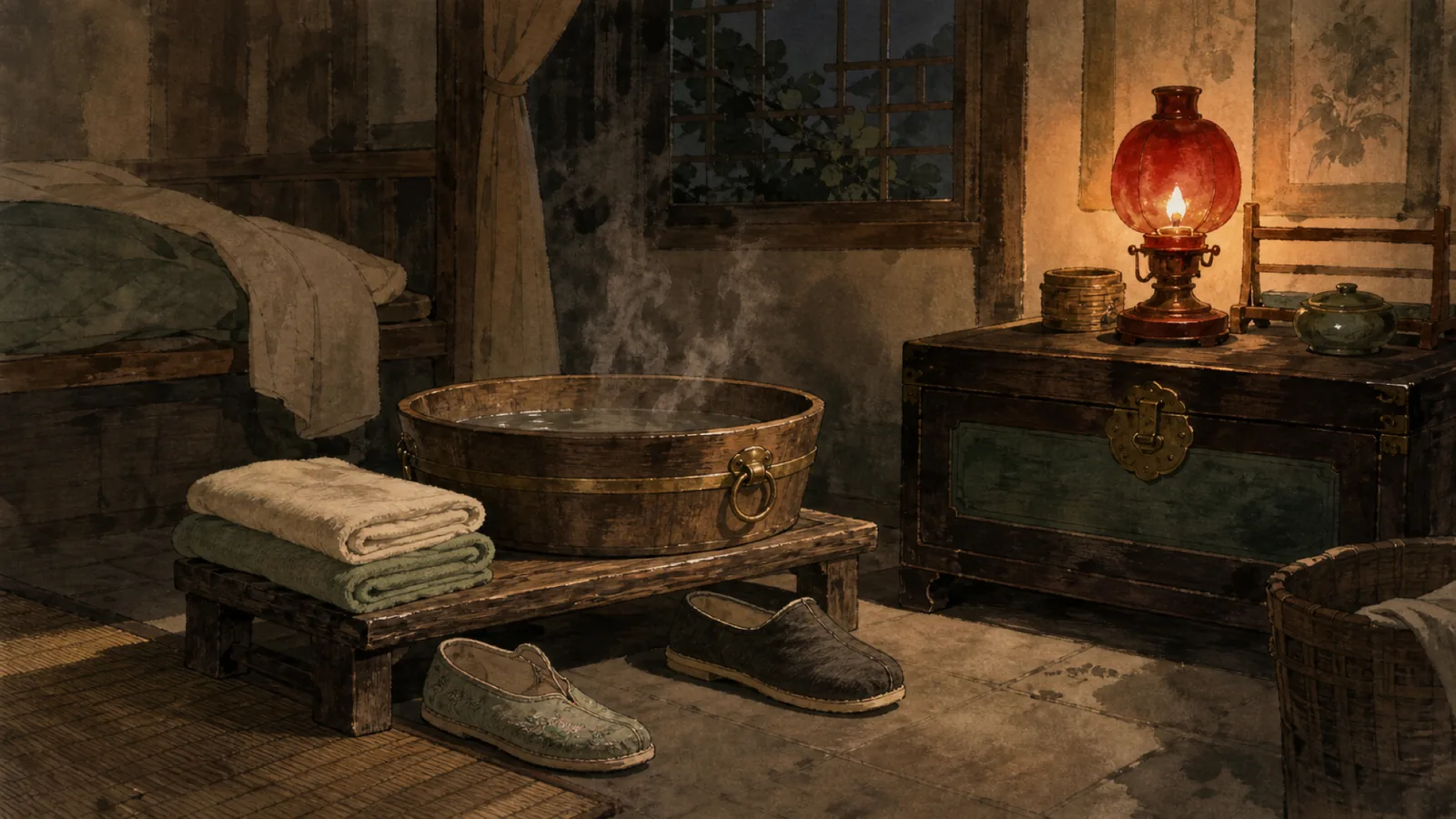
The cold open does not look like a structural hour. Lamp-oil light in an inn room, a borrowed kettle, two travelers negotiating who washes what in which water. Yan Zheng waits to pour his hot water into the basin. Changyu calls him over before the steam dissipates. Pour it in here instead. Mine’s already gone cold.
What stops him is not the cold water. It is the math. Into the basin? He has asked the question politely enough that Changyu hears every assumption in it, and answers in the same register. I don’t know what you’re used to, but in my house, we share one basin. The line is a small ledger in three sentences. It does not accuse him of being highborn. It tells him she has noticed.
Yan Zheng rinses outside with cold water in winter weather rather than soak his feet in water her sister has used. He is refusing to perform an intimacy he has not earned, in a register that would make him a hypocrite the second a different basin appears in a different house. Then the joke lands: only one bed. Fuling produces the solution. There’s one fellow whose snoring is unbearable. No one can sleep in the same room with him. The fallen-noble gets the snoring roommate. Changyu is left reciting the catalogue of her failures. Was it because of that sack? Or the foot bath? Is soaking feet that frightening?
The lamp-lit conversation that follows is the one the viewer has been waiting for. Yan Zheng’s teacher pushes the inevitable question. You truly mean to leave the Fan sisters behind? Yan Zheng answers in the voice of a man who has rehearsed the refusal. Bring them to the front lines? Sleep in the open, live with blades at our throats? The teacher counters with the sentence the slow-burn has needed. Precisely because battle is merciless, you need a woman who can bear the Xie family name.
What the teacher gets back is not an argument. It is a confession. I only wish to see her grow as she is now, wild as grass. The burden of a great clan’s matron would only bind her. He has read Changyu correctly. He has decided to leave anyway, because leaving is the only way he knows to spare her from the version of him he cannot stop being.
A silver ingot in a noodle shop
Scholar Song stumbles in bandaged the next morning — a child hacked at me — Changning’s revenge tour logged in plain sight without comment. Then Changyu and Yan Zheng eat noodles at a stall, and the village starts narrating.
The mockery is the one the fake-marriage trope always invites. A grown man dining out and letting a woman foot the bill. No shame at all. Must be living off her. Yan Zheng answers the way a hidden marquis answers — by overpaying. He produces a silver ingot to settle a twenty-one-wen bill. The stall keeper protests they cannot make change. Changyu gets the moment of confirmation in the smallest reading. No one would bring an ingot just to eat noodles. Where did you get that kind of money? She does not press. He does not answer. The noodle shop has just hosted two simultaneous conversations about the same man, and Changyu has heard the first one she can do anything about.
The grandfather’s room, and the surname that was never theirs
The hour’s center of gravity is the scene in the grandfather’s bed.
Changyu has come home to news she expected and news she did not. The yamen has imposed a grain-and-silver levy by headcount — four taels per person, on the heels of New Year. Grain and silver together is unheard of, Yan Zheng murmurs. Unless other counties are doing the same, this magistrate may be lining his own purse.
Changyu slips silver into Mrs. Zhao’s room, then goes to check on Grandfather. She finds him being starved by a daughter-in-law who sits eating meat beside him and calling him a thief of breath. Changyu produces the deed in her father’s name, reminds the aunt that the Dayin Code allows a widow to be dismissed for unfilial conduct, and tells her to leave. Grandfather answers her mercy with the script’s small, exact wound. Kind-hearted to a fault. You’re just like your father.
What Grandfather says next is the blow the batch has been priming since the third uninscribed stele in Episode 10.
Erniu wasn’t my blood.
Seventeen years ago Changyu’s father came to Xigu Alley with her mother and paid Grandfather a large sum to register under the name Fan Erniu — Grandfather’s long-lost son who had been taken as a child and never found. The day before the deaths, her parents left Grandfather a letter and the deed and said only that their dying together was the only way to ensure you and Changning survived. Her uncle, fallen into gambling, later stole and burned the letter and tried to take the house. Grandfather has been carrying the secret as a private penance ever since.
Changyu’s surname is a borrowed coat. Her parents were not killed by bandits over a treasure map — they staged a death they walked toward voluntarily because someone they could not outrun had found them. The hidden-identity trope has now been turned on the female lead. She has been living under a hidden identity for sixteen years and did not know.
Money can turn even ghosts into laborers
Yan Zheng finds her on the courtyard step and asks the question the show has been holding back. Were my parents truly killed by bandits over a treasure map? Do you want to avenge them? Changyu’s answer is the line that earns the title. I do. Even in my sleep.
What follows is the most articulate vengeance-arc speech the female lead has delivered to date. Yan Zheng walks her through the architecture of court intrigue — factions, classmates, in-laws, Officialdom in Dayin is a web spun tight — and asks what she would do if the official version turned out to be a lie. Changyu answers from inside the survivor architecture she has been building since Episode 1. No matter who is involved in my parents’ deaths, I will keep digging. Web or no web, there is law. There is reason.
Then she names her plan. She would have taken the civil exams or the military route if she had been born a man, she says, and cleared her parents’ names from inside the court. She cannot. The only path left is money. Money can turn even ghosts into laborers. The butcher’s-daughter survivor has just declared a campaign she cannot fund from a noodle stall, and the man listening is the one person in Lin’an who could write her a check large enough to bend a court. He will not. Not while leaving is still the speech he is rehearsing.
He offers a birthday wish instead. She answers with the small confession the slow burn has been pulling toward. You’re leaving? Do you have to leave? Then the recovery. That was silly of me. It’s not as if you won’t return. Right? The hour does not let him answer.
Two courts, one massacre, and the trap that springs on Qian
The capital sequence stitches together the political layer the village does not see. Li tells Wenkan the betrothal to the Grand Princess is decided, the wedding delayed two years, then hands him an urgent dispatch. Wei Xuan has detained General He. Wenkan is sent to the front that night with Li’s command seal — force Wei Xuan to return command to He Jingyuan, bring Wei Xuan back in chains.
Yan Zheng, on a different road, walks a massacre site. The corpses have been killed by Wei troops, but he tells his men flatly it was not Wei Xuan. Someone else is stirring the embers. Then a survivor stumbles out of the snow with the village version — Ma Village was levied, sent its village head to beg, was ambushed by the magistrate’s soldiers on the way. By the time he finishes, a peasant uprising is fixing itself in real time. The teacher reads the cut precisely. It seems Prince Changxin has begun to move.
The hour closes inside Yixiang. A customer ate there yesterday and died overnight. His family arrived at dawn with a coffin and a chant of a life for a life. Qian has called in every favor she has and not a single door has opened. Even Magistrate Cui refuses to see her. Changyu and a friend execute the show’s most satisfying close-quarters extraction — a pig-tongue ruse, the threat of mutilation, a dog summoned — until the loudest of the staged mourners breaks. It was Clerk Guo. The bailiffs arrive at the back door before Changyu can do anything with the confession, and Qian is taken — over every protest — because she knows the only judge who matters has already been bought, and a friend dragged into the same court is a friend lost for nothing.
Tiny details worth clocking
- Scholar Song cannot count above six. The number he stops at is the number of hits Changning landed before she dropped him.
- The teacher frames the slow-burn in a single noun. A woman who can bear the Xie family name. The bride a Marquis Wu’an needs is a political asset whose strength is legible to a clan.
- The deed survived because Grandfather kept it back; the letter did not, because the uncle stole and burned it while trying to seize the estate. The aunt’s gambit to take the house is built on the wreckage of that stolen secret.
- Lord Li’s patriarch names his campaign promise out loud — to uproot completely of Wei Yan and the corrupt faction around him. The slow-burn romance will have to detour around it.
- Changyu sends Mrs. Zhao silver before confronting the aunt. She is funding her revenge in one room and her neighbors’ levy in the next. The math will catch up.
Verdict
Episode 15 carries a lot of weight. The teacher’s conversation reframes Yan Zheng’s reluctance as something other than honor — he is choosing Changyu’s wildness over a marquis’s wife, and the slow-burn has finally been given its first articulated reason. The grandfather’s monologue collapses Changyu’s surname into a fiction and recasts the entire batch-1 grief arc as a cover story she has been living inside without knowing the door. The teahouse conversation gives her the line the rest of the season will be measured against. The only path left is money.
What keeps the hour from collapsing under its own freight is the basin scene at the open and the noodle stall at the middle — two people learning how to share one room, the largest political question in the realm still circling around the one Changyu asked without expecting an answer. Where did you get that kind of money? When the wounded stranger leaves at the end of the episode, he is leaving a woman who has just named her plan and is one silver ingot short of executing it. The fake-marriage clock has not reset. The vengeance clock has just started.
Rating: 8.6/10
More episodes from Pursuit of Jade — A fallen marquis, a butcher's blade, a war for love. Jump to any episode in the season:
Where to go next
Reviewed by Mira Vance · QuizFandom Editor & Lead Reviewer. Every rating is an honest per-watch assessment from the desk that also writes the quizzes — not a press release rehash.