Pursuit of Jade Episode 4 Review: Ask My Broom If It'll Allow It
What happens — the short version (spoilers)
- Bandits raid for the house deed and Changyu beats them off with a broom and her neighbors, while Yan Zheng deliberately hides his real strength.
- Cleaning his wound, she reads his scars and clocks he's trained in martial arts; he gives a half-true 'armed escort' story she lets pass.
- Yan Zheng tutors the illiterate Changyu for court, and she substitutes 'egg' for every character she forgets.
- Song Yan offers to take her as a concubine; she refuses and kisses Yan Zheng in front of him out of spite.
- At the live-in wedding, Changyu lets Yan Zheng keep his borrowed name and he revises the vows to 'we decide together.'
A bandit raid in the opening minutes, a courtroom rehearsal in the middle stretch, a wedding in the back half. Episode 4 is where Changyu and her hidden-identity husband become one household, and where the village stops being neighbors and starts being a fortress.
The brawl is the thesis, and the broom is the proof
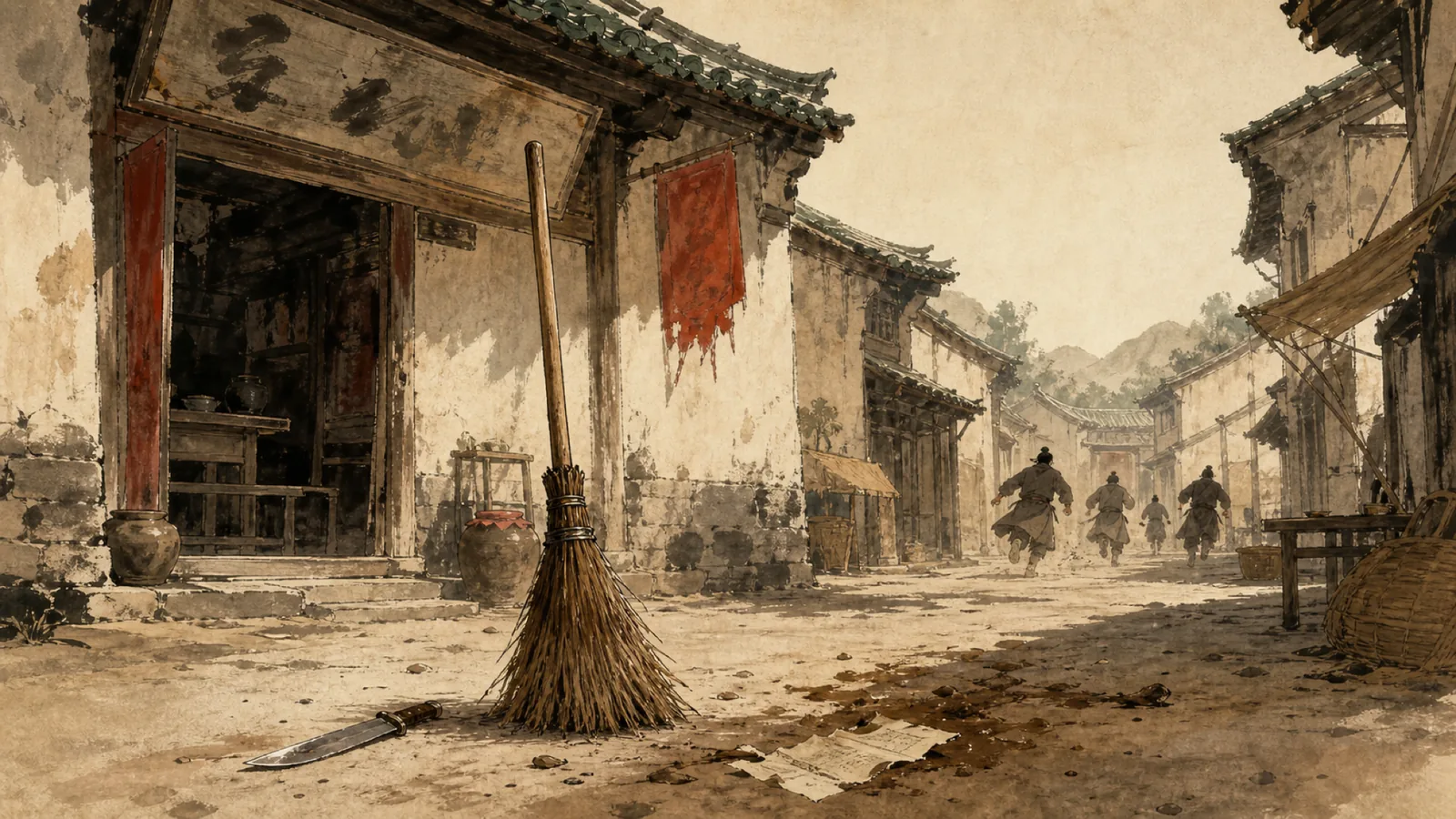
Pursuit of Jade has spent three episodes positioning Fan Changyu as the kind of female lead a c-drama historical-romance rarely commits to: a butcher’s daughter with calluses on her palms and a temper that does not flinch. Episode 4 stops positioning and starts proving. The opening sequence is a full brawl scored to the dull thunk of a wooden broom hitting flesh, and the line that will follow this show into its highlight reels lands inside the first two minutes: if you want to leave, ask my broom if it’ll allow it.
The choreography is doing specific work. The bandits arrive with proper weapons. Changyu has a broom. The Xigu Alley neighbors arrive with kitchen tools and a willingness to sit on people. The bandit boss starts the scene calling these villagers a bunch of damned scoundrels; he ends it crumpled under a pile of grandmothers, begging for mercy. The genre’s instinct in this setup is to let the male lead glide in from offscreen and resolve everything with three sword strokes. Yan Zheng — the wounded stranger Changyu has agreed to marry, whose real name the village does not yet know — could end this in seconds. He does not. He deflects a thrown blade once and lets Changyu finish her own fight.
That choice rewrites the hour in advance. The man hiding his identity is also hiding his strength, because revealing either would put Changyu in the position the genre normally assigns her: dependent. The bandit boss, in his last scrambling lie, calls Yan Zheng her esteemed husband and tries to retreat with dignity. He has accidentally said something true. By the time the scene clears, the deed of conditional sale is back in the chest and a thesis has been established: the woman in this house defends the house, and the man in the house is here on her terms.
The aftermath closes with the neighbors realizing they sat on Yan Zheng hard enough to aggravate his wound, and the tonal dial resets to comedy without losing a beat. The village’s loyalty is the joke and also the spine the next thirty-six episodes will lean on.
The pulse-check is the real reveal, and Changyu lets it pass
The aftermath scene in the bedroom is the hour’s quiet center. Yan Zheng’s wound has split open in the brawl. Changyu cleans it, and as she does, she reads his back the way her father — also a former armed escort — taught her to read scars. From your build, I can tell you’re trained in martial arts. She has clocked him.
The hidden-identity trope usually milks this moment for dramatic irony — the audience holds the secret, the heroine stumbles around it, the writer drags out the gap. Pursuit of Jade refuses the drag. Changyu sees the truth almost immediately and chooses not to push. Yan Zheng offers her a half-lie — I was an armed escort — technically not false, missing the relevant detail by several social castes. Changyu accepts it. No wonder. My father was also an armed escort before.
The structure is planting a contract, not a deception plot. Whatever this man is hiding, he is, in her words a few scenes later, someone who knows gratitude. She does not need his real name to know what he is for. The interior architecture of fake-marriage-to-real-love is exactly this — two people building a private agreement the outside world cannot read. Changyu has read it earlier than expected. The rest of the season will catch up.
The wound itself is a receipt. He took it for the deed. The deed is the only thing in this house worth taking. He is, by the village’s transactional logic, already part of the house. The scene ends with him quietly thanking her — thank you — and the moment stretches long enough to let the word settle into something neither of them is ready to name.
Courtroom rehearsal, and Song Yan’s revenge plot in three clay dolls
The middle stretch is courtroom-prep comedy paying off something the show has seeded since the pilot. Changyu cannot read. Her uncle Fan Daniu has filed a petition to take her house, and Dayin Code requires the head of the house to appear in court personally. Yan Zheng turns out to be able to write — I’ve traveled far and wide. You learn a thing or two — and produces, almost casually, the legal phrasing Changyu will need. He tutors her on the Seven-Step Poem. Pods burned to cook peas. Peas weep in the pot. Grown from the same root. Why torment each other?
Changyu, in one of the sweetest comedy beats of the run, cannot remember the difficult characters and substitutes egg for every one she has forgotten. When the household is egg, you must choose an egg. The scene is funny because she is committed; she is committed because she has decided this house is hers to keep. The poem itself — Cao Zhi’s, about brothers turning on each other — is doing double work: Changyu rehearses it for court, but the man teaching it to her is being hunted by exactly the kind of brotherly betrayal the poem describes. The line we share the same father, why kill me first will land differently the third time someone says it.
Song Yan, the provincial graduate next door, is the antagonist of opportunity. He sneaks in that night and offers to take Changyu as his concubine to save the house. He frames it as charity. Changyu reads it as the insult it is. You think by stooping to take a pig-slaughtering woman like me as your concubine, I should be grateful? Song Yan is the genre’s reminder of what almost every other historical-romance lead would have been — the man who reads books and refuses to soil his reputation for a butcher girl until it benefits his image. Changyu kisses Yan Zheng in front of him out of pure spite, and the show lets it be exactly that — spite, then a slow-blooming realization that the spite-kiss has done something the spite-kisser did not budget for. His parting threat — wait until I pass the exam, you’ll get what’s coming to you — lays in a slow-burn villain. The clay-doll token of love he carried for nearly twenty years is the kind of object c-drama writers use to load a Chekhov’s gun.
The wedding does the trope work, then quietly reroutes it
The back half is the wedding proper, doing two things at once. On the surface, the standard fake-marriage ceremony — Three Libations, joined nuptial cups, husband and wife bow to each other — staged for comedy with Mrs. Zhao narrating and Mr. Wang arriving late with tears in his eyes. Underneath, the marriage contract is being rewritten in real time.
The matchmaker recites the live-in-husband terms: the man changes his surname, the children take the wife’s surname, the wife sets the rule, the husband obeys. Changyu reroutes every one. My husband doesn’t need to change his surname. He’ll remain Yan Zheng. It’s a good name. The audience knows the name is borrowed. Changyu knows it too. She is signing the contract under the borrowed name on purpose. Then Yan Zheng, in his quietest line of the hour, takes the wife sets the rule clause and revises it himself: If there are matters, we’ll discuss together and decide together.
That is the marriage they have actually entered. Not the patriarchal model, not the inverted live-in model, but a third thing the village’s rule book has no language for. Mr. Wang gives Changyu the only blessing in the hour that lands without irony: consider me as half a family, and him as the other half. Changyu’s father is dead. The village has decided, by acclamation, to be her father instead.
The hour closes on a small joke that is also a real beat. Changyu, alone in the bedroom on her wedding night, apologizes for getting in his way at the basin: I’m used to living alone. I keep forgetting there’s a man here now. Forty-six minutes spent building a household. The last line reminds us the woman inside it is still learning how to share it.
Tiny details worth clocking
- The deed Yan Zheng saves is a deed of conditional sale, not the title outright — a Dayin Code distinction the show will return to when Fan Daniu pushes again.
- Changyu uses egg (蛋) as her placeholder for forgotten characters because her mother told her to. Throwaway gag, but also a quiet flag that her literacy gap is generational and gendered.
- The twenty taels Yan Zheng earns selling an imitation of masters’ works to the Four Seasons Bookshop reveals his hidden range includes a literary education. Mr. Zhao is sworn to secrecy. The audience is not.
- The matchmaker Kang’s slur about ugly and lame live-in husbands is a c-drama running joke usually kept as background noise. Pursuit of Jade weaponizes it — the reveal of Yan Zheng’s face is staged like a courtroom verdict against Kang specifically.
- The Manual of the Bedchamber Arts Mrs. Zhao slips into Changyu’s hands at the dish basin is the kind of detail the show will come back for.
Verdict
Episode 4 is where Pursuit of Jade earns the right to call itself a slow burn. The brawl, the courtroom rehearsal, the wedding — all three serve a single quiet move: the contract between Changyu and Yan Zheng has been written, and neither has read the same version. He thinks he is paying back a debt. She thinks she has acquired a tenant who happens to be good with a sword. The audience holds the names neither has said aloud — a Marquis under the borrowed identity, a missing rebellion in the background, a provincial graduate already plotting revenge. The pleasure of the episode is watching all of that gather while the household refuses to let it touch them yet.
Fake-marriage-to-real-love lives or dies on whether the household feels worth defending. Pursuit of Jade’s answer is unambiguous. The household is the village. The village is the show. Everything else will have to come through Mrs. Zhao first, and Mrs. Zhao will sit on it.
Rating: 8.4/10
More episodes from Pursuit of Jade — A fallen marquis, a butcher's blade, a war for love. Jump to any episode in the season:
Where to go next
Reviewed by Mira Vance · QuizFandom Editor & Lead Reviewer. Every rating is an honest per-watch assessment from the desk that also writes the quizzes — not a press release rehash.