Pursuit of Jade Episode 7 Review: The Yamen Tries to Bury a Butcher's Daughter, and a Hidden Marquis Pulls His First String
What happens — the short version (spoilers)
- The magistrate convicts Changyu before investigating, using the charge as cover so killers can search the Fan house.
- In the woods Changyu kills for the first time defending her family, then carries the wounded Yan Zheng through the snow.
- Yan Zheng's fever dream reveals his real lineage as Xie Linshan's son, his mother dying repeating his name.
- Back in court, the magistrate threatens torture until Changyu throws herself between Yan Zheng and the rod.
- A Teacher from Luyuan Academy arrives and quietly pressures the magistrate; Yan Zheng is acquitted and Changyu released, but the frame is only paused.
A frame-up wrapped around an ambush, a magistrate convinced he can profit by closing a case fast, and the first time this drama lets Yan Zheng draw on resources that do not belong to a wounded stranger. Episode 7 is where the village arc ends and the chess game begins to show its pieces.
The court convicts before it investigates, and the writer wants you to notice the order
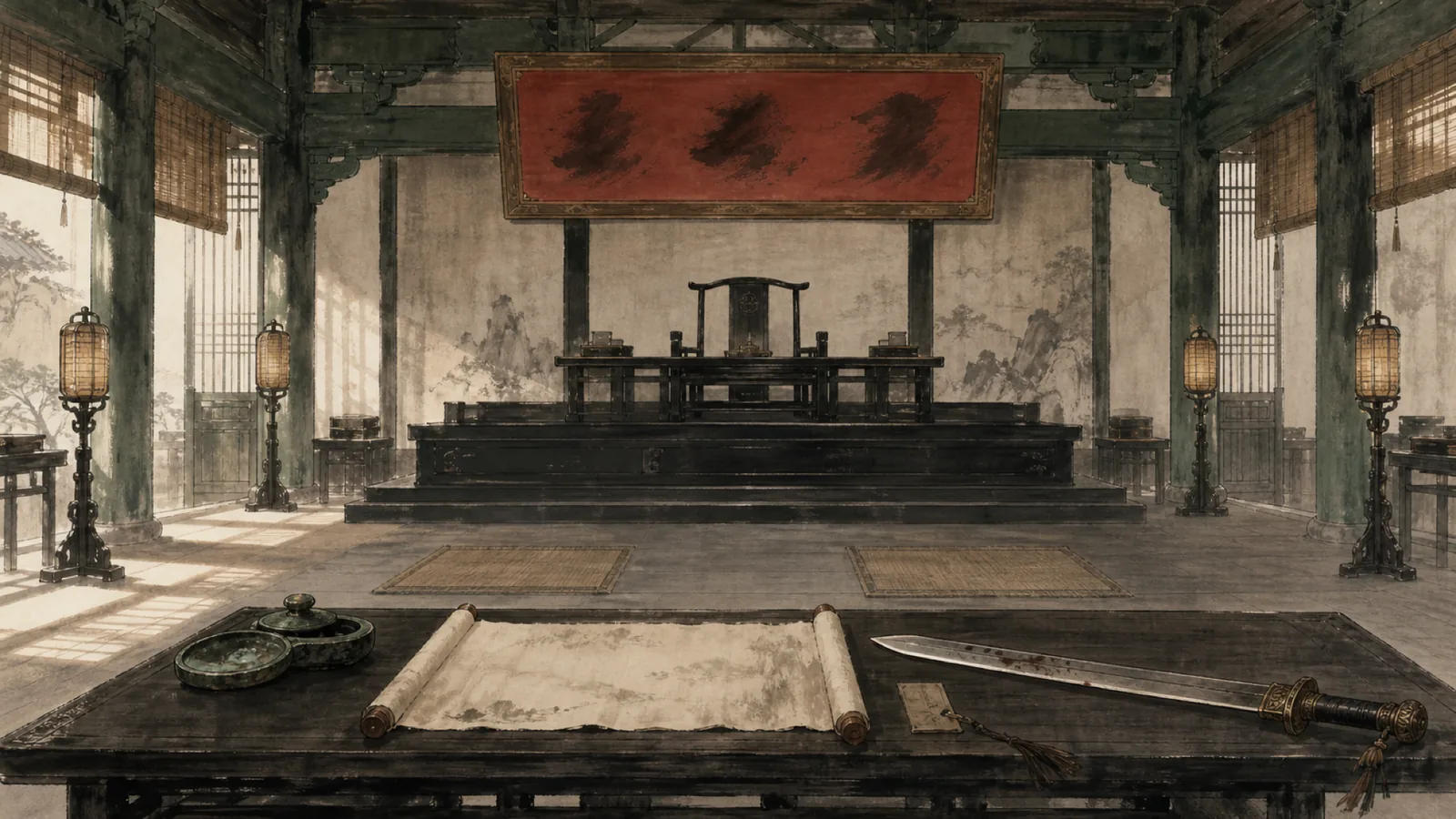
The hour opens mid-scene, which is itself a choice. There is no establishing shot of the yamen courtyard, no slow walk past the integrity, prudence, diligence placard that the camera will return to twice more this episode. Changyu is already on her knees. Madam Mi is already wailing. The magistrate is already nodding along to a theory that has not been tested. By the time the body is described — long blade, multiple wounds, the killer skilled with a knife — the courtroom has its verdict the way a closed market has its prices: settled before anyone speaks.
What follows is a small masterclass in how a frame-up performs justice without practicing it. The constable’s testimony does not establish opportunity, only capability. The widow’s grief is converted, in real time, into evidence — anyone watching can see her certainty, and the magistrate treats certainty as proof. Even the neighbors arriving in a cluster to vouch that Changyu was home all night is folded into the prosecution: maybe she did not strike the blow herself, maybe she hired the blow. The case writes itself once the conclusion is assumed.
Then the magistrate orders the search of the Fan house. This is where the hour turns. Whoever set Changyu up wants her in a cell while her real home is hit. The writer puts the courtroom and the empty house in conversation: the public charge is theater so the private violence can run undisturbed. Once you see that shape, every line in the first ten minutes reads as misdirection on someone else’s behalf, and the question shifts from is Changyu guilty to who needed her out of the way long enough for three bodies to land on her parents’ floor.
The yamen will return to the same hall later in the hour to convict on the second case, and we will see the same placard from the same angle, and the verdict will once again arrive before the evidence does. The writers are patient enough to let the rhyme do the work.
Yan Zheng, the snow, and a name spoken twice in delirium
The middle stretch is the episode’s emotional spine, and it lives almost entirely in two physical performances: Changyu carrying Yan Zheng through the snow, and Yan Zheng’s fever-dream collapsing two decades of grief into a single osmanthus cake.
The fight in the woods is built for stakes, not choreography. Three Xuan Tie killers, a sister hidden behind a tree counting to ten, a brazier still warm in the abandoned house — the writer lays in the props that a later rescue will pull on. Changyu kills for the first time. We do not see her process it on screen; the reaction is offloaded into the carry. She drags an unconscious man through packed snow asking him whether she married him for a household or for muscle, and the joke is real and the panic underneath it is realer. Other women marry for someone to hold up the household. Did I marry you just to build my strength? It is the line that tells you she has stopped thinking of this man as a project and started thinking of him as a person she cannot afford to lose.
The fever dream is where the show finally pays out on six episodes of withholding. We see, in pieces, the boy Xie Zheng — the father called a hero of unshakable honor, the mother sick at the loom, the osmanthus cakes she will not stop making even when her hands shake, the moment she tells him I cannot stay and watch you grow. The mother dies in his arms repeating his real name. Xie Linshan. The first time Yan Zheng’s true patrilineage is voiced aloud in the drama, and it arrives as a deathbed plea, not a reveal.
When he surfaces from the dream, Changyu is feeding him medicine, and he flinches as if she were holding a knife. The two halves of the man — the wounded mercenary on the kang and the orphaned heir under it — meet in that flinch. She apologizes for nothing she has done. She substitutes candied tangerine peel for the osmanthus cake she heard him crying about in his sleep. The fake marriage has done what fake marriages in this genre always do: stopped being a contract and started being a household. The structure plants the change without underlining it. He drinks the medicine.
The Luyuan card, and what it costs to play it
The third act returns to the same yamen hall, and this time the magistrate has the documentary high ground. No registration papers. A travel pass issued only last week. A live-in son-in-law with no village to vouch for him. The verdict is, again, foregone — twenty heavy strokes to extract a confession, the body of Fan Daniu enough to justify whatever the magistrate writes down later.
Then Changyu throws herself between Yan Zheng and the rod. She is bleeding from the cut on her forehead, still wearing the cangue, and the line she delivers is the cleanest political reading any character has voiced this season. Wearing your official hat to bully an orphan? What justice is this? The neighbors back her. The courtroom turns. The magistrate, who five minutes earlier was certain he could close two murder cases in a single afternoon, suddenly has a crowd-control problem.
The Teacher arrives after the rod has fallen and the courtroom has nearly tipped into open defiance. He walks in like a man who has been in worse rooms, and the script is careful to let his composure do the talking. Yan Zheng is a student of Luyuan Academy. Might we speak privately? The private conversation is not shown — only the magistrate’s face on the way out, and the official, courteous bow he gives a man he was about to flog. Luyuan Academy stands at the pinnacle of scholarship in this realm. Those noble heirs aren’t people I can afford to offend.
This is the first time the audience sees Yan Zheng’s hidden network do anything. Up to now the man has been the wounded stranger, the snow-carrier, the silent husband paying his debt in butchered pork and quiet labor. Episode 7 makes us watch him cash a chip he has not previously touched, and the cost is legible on his face: he did not want to use Luyuan here. The Teacher’s whispered neither of us can reveal who we truly are is the episode’s quietest line and its most expensive — a marquis hiding in a butcher’s loft has just spent one of his finite covers to save his contract-wife from a county hack.
The verdict that follows is not a victory. Yan Zheng is acquitted — the magistrate finds in writing that he killed a bandit in defense of family. Changyu is merely released, with no evidence either way. Fan Daniu’s case stays open. Madam Mi screams in court that her husband died unjustly, and the script is honest enough to let her scream go unanswered. The frame is not broken. It is paused.
Tiny details worth clocking
- The placard reading integrity, prudence, diligence is shot three times this hour, each from a slightly lower angle. By the third cut the camera is almost ground-level, looking up at words the magistrate has not earned.
- Changyu hands her sister a whistle and tells her not to blow it yet — if you blow it now, you’ll only draw more of them. The same restraint that keeps Yan Zheng silent about Luyuan is being trained, in real time, into the next generation of this household.
- Mr. Wang the constable is doing his own quiet revolt. He warns Changyu something happened at your house too before the magistrate can use the bodies as new charges. He stays a procedural ally without ever becoming a plot device.
- Xuan Tie death warriors are named for the first time, attributed to the Weis’ hounds. The episode plants the antagonist faction without showing the antagonist’s face — classic c-drama patience.
- Yan Zheng identifies, while studying the bodies, that they were not after me. The frame-up was for Changyu specifically. Someone is interested in the butcher’s daughter independent of the marquis hiding in her loft, and the show files that question for later.
Verdict
Episode 7 is the show’s first true plot inflection. Up to now the drama has been running two parallel arcs — Changyu surviving widowhood and a hostile village, Yan Zheng surviving an assassination he barely escaped — braided with a fake-marriage rope. This hour cuts both arcs open. Changyu kills for the first time and discovers the household she has built can be taken from her by a frame. Yan Zheng spends a cover-story chip and discovers someone is hunting Changyu in her own right. The Teacher’s arrival ends the village’s ability to contain this story; whatever comes next moves at the pace of Luyuan and the Weis, not the magistrate and the widow. The romance does not advance through declaration; it advances through Changyu choosing to carry the body of a man she could have left in the snow, and through Yan Zheng letting her.
Rating: 8.4/10
More episodes from Pursuit of Jade — A fallen marquis, a butcher's blade, a war for love. Jump to any episode in the season:
Where to go next
Reviewed by Mira Vance · QuizFandom Editor & Lead Reviewer. Every rating is an honest per-watch assessment from the desk that also writes the quizzes — not a press release rehash.